

Everybody is winging it (and why it's the best news you'll ever get)
(The "Idiots Above You" Theory)

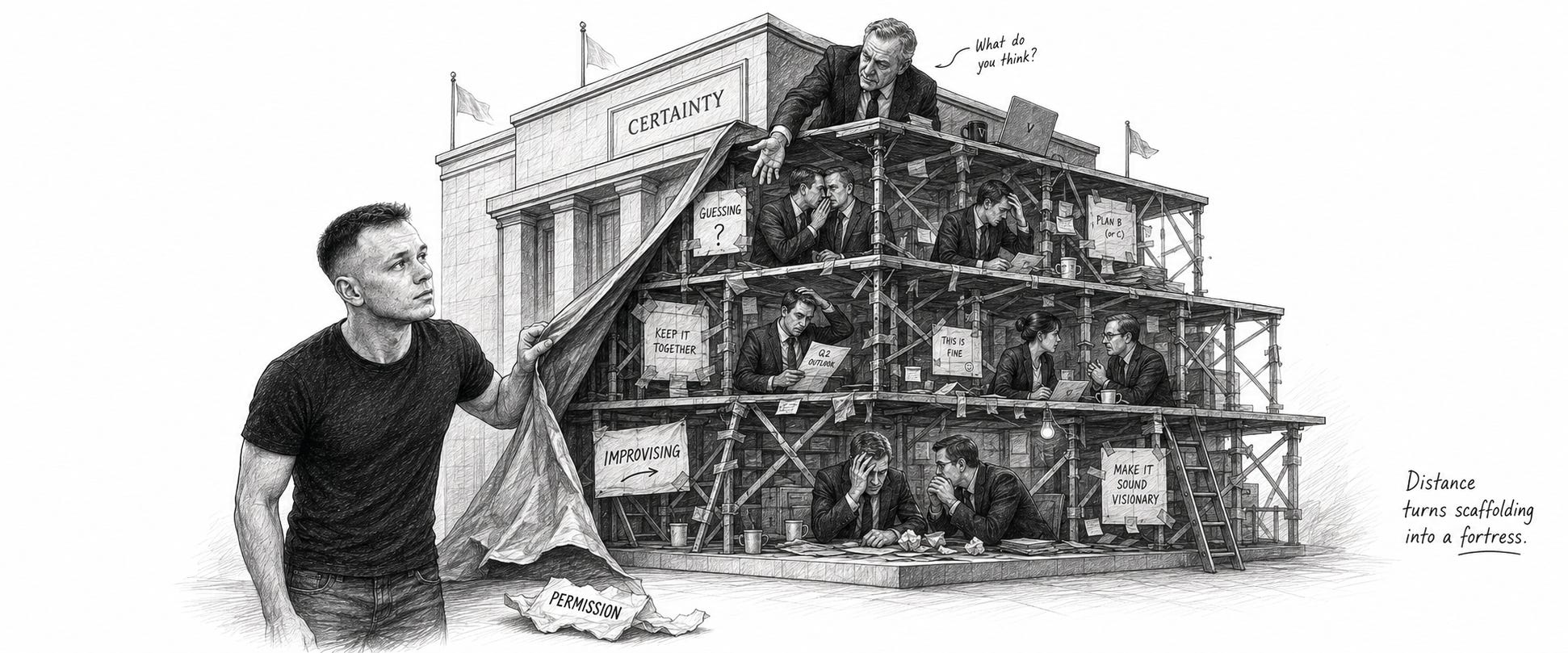
I was just eighteen years old and a few weeks into my first sales job in Spain, when I got my first real peek behind the curtain.
I had moved from Denmark for a telemarketing job I had no business being good at. New country, new language, a cheap headset, and a script I could barely say without stuttering. By the end of my first week I was at the top of the sales leaderboard, and I remember waiting for someone to walk over and explain to me that I somehow got lucky.
Instead, my manager pulled me aside and asked what I was doing differently.
Sit with that for a second. The man whose job was to teach me how to sell wanted to know my method. I didn’t have a method. I was a teenager improvising in a foreign country, and the person above me, the one with the title and the experience and the salary, was improvising too. He simply had more practice looking like he wasn’t.
I didn’t have language for what I felt that day, but I have it now.
The world looks like it’s run by people with secret certainty, deep expertise, and perfect judgment, right up until you get close enough to see that most of it is held together by improvised confidence.
Maybe you’re on the other side of that curtain right now. Waiting until you feel ready, waiting for a certificate, a cosign, an invitation into the rooms where the real players supposedly sit. I spent years waiting like that, and the bill came to every month I didn’t start.
Let me show you what I found in every room after that one.
Certainty is a costume, and distance is what makes it convincing
From far away, every level above you looks like a fortress.
The founder on stage sounds inevitable. The director in the meeting sounds certain. The creator with the big audience posts like someone who has never once stared at a blinking cursor wondering if they’re a fraud. And because you only ever get to see the finished output (the launch, the keynote, the polished feed), your brain fills in the rest of the story, assuming there must be a plan behind the confidence, deep knowledge behind the plan, and some qualification behind all of it that you haven’t earned yet.
Well... I’m here to bust your bubble buddy.
The launch you admired went through three panicked rewrites the night before it went live, the boardroom strategy was invented in a hallway forty minutes before the meeting, and the confident answer you heard was a guess delivered slowly enough to sound like wisdom. By the time anything reaches your eyes it has been cleaned, rehearsed, and retroactively dressed up as intention, even when it started as a coin flip.
Polish is post-production. (I say this as someone who spent years producing polish for other people, which we’ll get to.)
The cruel part of the illusion is the geometry of it. You compare your backstage to everyone else’s stage, your 2am doubt against their 2pm announcement, and you conclude that the gap between you is made up of competence, while in reality most of that gap is made of distance. Stand close enough to anyone impressive and the fortress turns out to be scaffolding with good lighting.
And the costume is rarely deliberate. The people above you project certainty for the same reason you would in their seat, because the room expects it, and because saying “I’m figuring this out as I go” out loud feels like handing in a resignation letter. So everyone performs certainty for everyone else, and everyone privately assumes they’re the only one performing.
It took me about ten years and four very different rooms to see the whole pattern.
Every room I made it into had the same secret
After that telemarketing floor, I spent close to five years in corporate doing insurance sales, and I treated those years like a search for the floor where the adults were.
I assumed it existed somewhere above me. A level of the building where decisions came from deep insight instead of confident guessing, where the people in charge knew things the rest of us didn’t. What I found instead were quarterly strategies born in the same meeting they were announced in, forecasts built on last year’s spreadsheet and a feeling, and directors who presented both with total conviction because conviction was the actual job. The higher I looked, the more familiar everything became.
Fine, I thought. Corporate is also just more theatre.
The real ones must be the entrepreneurs.
Then, in 2021 I discovered Notion through my brother, built a template store by copying a model that was already working, and grew it to the point where I could quit my job in August 2022. I walked into the online business world fully prepared to feel like the only impostor in rooms full of six and seven figure creators.
Then the ghostwriting agency happened, and it destroyed the illusion for good. At its peak my agency was doing close to €50K a month, which meant I wasn’t just observing big accounts from the timeline anymore. I was inside them. I saw the messy drafts and the second-guessing up close, and I watched people who are genuinely famous on the internet ask me, a kid from Denmark, what they should post next. Their audiences saw oracles on a pedestal. I saw smart people with good systems, better nerve, and absolutely no master plan.
Every single room had the same secret.
And the secret was that there was no other room.
Somewhere along the way, I gave the pattern a name:
The Idiots Above You Theory
“True terror is to wake up one morning and discover that your high school class is running the country. “
– Kurt Vonnegut
The theory goes like this. At every altitude of the world, the people in charge are improvising with incomplete information while projecting more confidence than they actually feel. And it goes all the way up. Your boss is improvising, his boss is improvising, the board is improvising, the investors funding the board are improvising, and the people being interviewed on the news about all of it are improvising too. Vonnegut wasn’t joking. It really is your high school class running the country, just with better suits and twenty more years of practice sounding sure.
I want to be precise about the word idiot, because I use it with affection. I qualify for it myself, and so does every single person I’ve admired up close. In this theory, an idiot is anyone operating without the manual, and the entire point is that there is no manual. Nobody has it. Nobody ever had it. The people you assume are reading from it are reciting from memory things they made up last year.
Slow down on this one, because there’s an obvious objection worth handling. Real skill exists, yes. Surgeons train for a decade and I very much want mine to have done so. Pilots drill emergencies until the responses live in their hands. The theory points at something different: even genuine experts are only experts inside one narrow lane, they entered that lane unqualified like everyone else, and outside of it they are exactly as lost as you are.
And the bigger game, the one you’re actually worried about (careers, money, building something, life), has no certified experts at all.
It only has people with more reps.
Here’s what the theory does to you once you actually believe it. The gap between you and the people above you gets reclassified. What you used to read as qualification turns out to be a head start, and a head start is just time. Time responds to one thing, and that thing is movement.
Which brings us to the lie that keeps most people standing still.
The Illusion of Permission
You were trained to wait, and the training started early.
You spent roughly eighteen years raising your hand before speaking, asking to use the bathroom, and waiting for someone else’s red pen to tell you whether you were good. Then employment picked up right where school left off, with titles to be granted, reviews to be passed, and promotions handed down like adult permission slips. By the time you finally want to build something of your own, the waiting is in your bones. So you do what you’ve always done. You look around for the adult in the room.
Let’s run this as a test.
Say you want to start the newsletter, post the video, launch the product, raise your prices. Name the person who signs off on that. Picture the committee that reviews your application and declares you ready. Picture their faces, their office, the form they’d stamp.
You can’t, because the committee doesn’t exist. What exists is a publish button and your own hesitation wearing a clipboard.
That feeling of needing approval is what I call the The Illusion of Permission, and it survives on one assumption: that the gatekeepers know something you don’t. But you already know what’s behind the curtain now. The employers, the platforms, the critics, the certified experts, every gatekeeper you could name is improvising too. Which means you’ve been outsourcing your start date to people who are guessing.
The illusion is sneaky because waiting looks responsible from the outside. It photographs as humility, and that’s exactly what makes it so expensive. Nobody ever sees what the waiting cost you, because the years you lose to it never show up on any scoreboard.
Here is the sentence I wish someone had said to me on that sales floor at eighteen: you can literally just do things (shout out @Jayyanginspires). There’s no felt difference between the people who are allowed and the people who aren’t, because the category of “allowed” was never real. You can stop auditioning for a committee that was never going to convene.
And once the permission question dies, only one question is left.
Movement was the qualification all along
“Everything around you that you call life was made up by people that were no smarter than you.”
– Steve Jobs
Run the timeline backwards on anyone you consider qualified and you find the same embarrassing origin: a person doing the thing before they were qualified to do it. The reps came first and the credential came second.
Qualification is a receipt, and it only prints after the purchase.
My entire life is downstream of accepting that order of operations. Nobody approved the Notion store; I copied a working model and shipped it (I wrote a whole letter about why you don’t need a unique idea, and this idea is its older brother).
Nobody certified me to quit my job in August 2022; I handed in a notice and found out. Nobody licensed me to help build Stanley, an AI product, as a guy with no computer science degree. Every meaningful jump in my life followed the same sequence, where the movement came first and the competence arrived later, on a delay, looking inevitable only in the rearview mirror.
The math heavily favors moving, and most people never sit down and actually do it. Acting without permission risks a flopped post, a refund request, a launch that lands quietly. Each of those is a bruise, survivable and mostly invisible within a month. Waiting risks years, and you’ve been pricing the bruise like a funeral while pricing the years like they’re free.
There’s a second payoff to movement that nobody tells beginners about.
Motion is visible, and visibility recruits. The moment you start shipping, the right people can finally find you, the feedback that actually teaches you starts arriving, and small doors open that no amount of preparation would have unlocked. The door you’ve been waiting in front of was never locked. It just doesn’t open for people standing still.
So the only honest question left is what to do with all of this on a Tuesday morning.
How to operate once you’ve seen behind the curtain
Seeing it once isn’t enough. The school wiring is strong, and the Illusion of Permission grows back if you don’t actively kill it. This is the protocol I run, and the one I’d hand to anyone who asks.
Name the permission you think you’re waiting for. Finish this sentence in writing: “I’m allowed to start when...” Then try to name the actual human being who grants that condition. The sentence usually dies right there on the page, and watching it die is the point.
Ship one thing this week you feel unqualified to ship. Small, public, slightly embarrassing. The goal has nothing to do with the outcome of the thing itself. You’re collecting proof that the sky stays up.
Swap the question. Replace “am I allowed to do this?” with “what is the actual worst outcome if I do?” and write the answer down in full sentences. Audited honestly, the worst case is almost always a bruise you’d recover from by Friday.
Reclassify the people above you. They were never your judges, and they make terrible ones anyway, since they’re improvising too. Use them as maps instead. Someone two steps ahead of you is evidence the path holds weight, so study their moves and skip the part where you wait for their blessing.
Build your Evidence Stack. Keep a running list of every time you moved without permission and survived, and every time you moved without permission and won. Reread it on the days the illusion grows back. Confidence built this way becomes a database instead of a mood, and a database doesn’t care how you feel in the morning.
The world is held together with duct tape and nerve by people figuring it out in real time, and the ones above you are mostly distinguished by one decision: they started before they felt ready and kept going long enough for the costume to fit.
That means the whole game changes the day you realize the entry exam was never scheduled, because the people you assumed were grading you are sitting in the same room, taking the same test, quietly hoping nobody asks to see their notes.
Keep learning, evolving, and building.
You got this.
– Pascal
Things I work on outside this, in case any of them are useful:
@iampascio on Twitter, my profile where I post my experiments and numbers
@xgrowthpascal on Twitter, where I’m going from 0 to 10k followers in 3 months
@creatorpascal, my personal brand where I also share these essays as articles
Love it!! And i can relate to every sentence