

Everyone saying 'information is cheap now' is about to look very stupid
There’s one kind of knowledge that’s always been rare. It was rare before AI. It’s rare now.

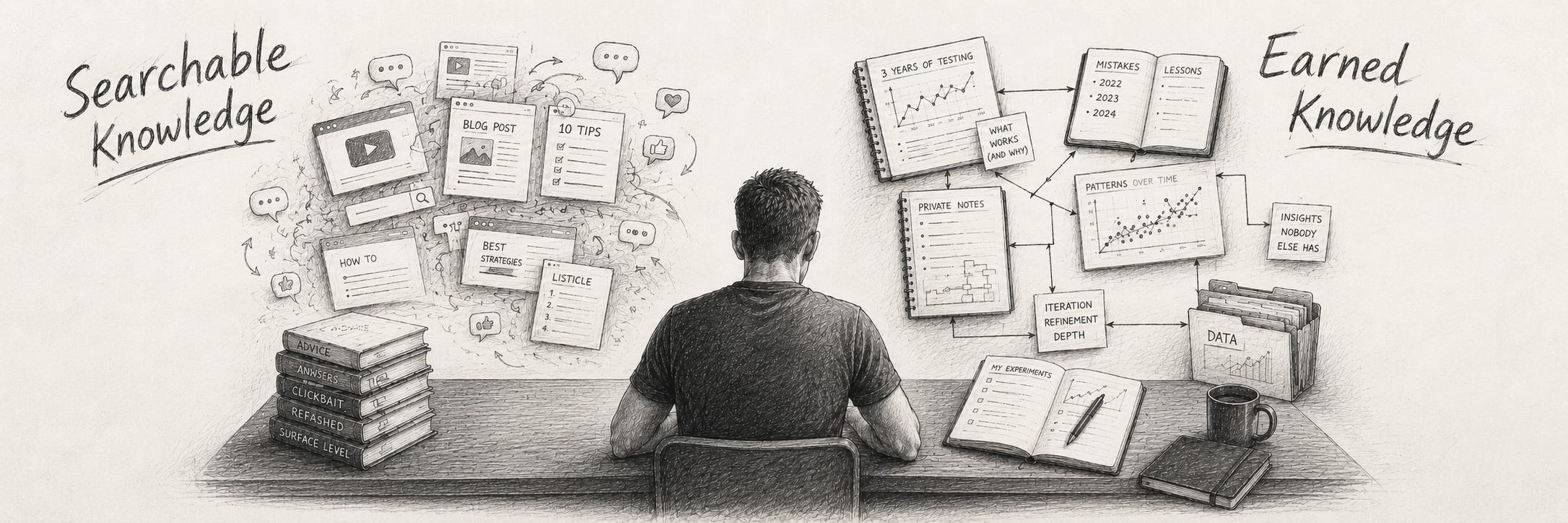
And it’s about to get even rarer, because as the world’s attention floods toward AI-generated content, the people still quietly doing the work in private and accumulating earned knowledge that nobody else has, are about to become the scarcest resource on the internet.
Before I tell you what it is, we need to get one thing out the way first.
There’s this take making the rounds right now you’ve probably heard.
Goes something like: “Information is cheap now. AI changed everything. The only thing worth paying for is implementation.”
Many smart people are saying it. And other smart people are nodding along to it. It has the texture of something obvious, the kind of statement that ends a debate before it even begins.
But the people repeating it haven’t actually thought it through. They’ve collapsed two completely different categories of knowledge into one bucket and then declared the bucket dead. And in doing so, they’re about to be very wrong about which info products survive the next decade and which ones don’t.
I want to pull those two categories apart in this article.
Because once you can see them clearly, three things happen.
You stop falling for courses that were always going to be replaced by AI.
You stop dismissing courses that AI literally can’t touch.
And if you’re a creator, you stop building the kind of digital product that’s about to get steamrolled and start building the kind that gets more valuable every year.
Let’s dive in.
The distinction: searchable knowledge vs earned knowledge
There are two kinds of knowledge in the world.
The first kind is searchable knowledge. It’s everything that already exists in published form somewhere (books, blog posts, YouTube videos, Reddit threads, podcast transcripts). It’s the stuff you used to Google, skim a course for and the stuff that lived in public for anyone willing to look hard enough.
The second kind is earned knowledge. It’s everything that lives in the heads, private files, and muscle memory of people who actually did the thing. The testing data they never published. The mistakes they corrected three years ago. The pattern recognition they built by running the experiment 5,000 times. The stuff that was never written down anywhere, because the person who has it doesn’t even fully know they have it.
These are two completely different categories of knowledge, with two completely different supply curves, and two completely different futures.
Let’s break them down one by one.
Searchable information was always cheap, AI just made it obvious
“Information is not knowledge. The only source of knowledge is experience.”
– Albert Einstein
Most of the information AI supposedly “killed” was already free.
It was sitting in YouTube videos, blog posts, Reddit threads, forum archives, podcast transcripts. It had been free for fifteen years. The only reason people paid for it was because it was inconvenient to find, or because someone bundled it nicely with a course logo and a Stripe checkout and a promise that this version was somehow different.
Think about what a “How to Grow on Twitter” course typically contained, circa 2020. Post consistently. Use hooks. Engage with others. Provide value. Be authentic. Maybe a few templates. Maybe a list of “best times to post” pulled from a study someone else ran.
Was that information ever actually scarce? No. It was free in fifty different YouTube videos and Medium articles. The course just packaged it nicely.
What ChatGPT did was make the packaging obsolete. It didn’t “kill the knowledge” because there was no real knowledge to kill. It killed the interface people were paying for. The convenience layer.
Searchable information has a few telltale traits:
It existed in public form before the course was made
It can be assembled by reading other people’s blog posts and watching YouTube videos
It has no proprietary insight, no testing data, no specific result attached
If you stripped the creator’s name and face off the course, it would be indistinguishable from any other course on the topic
A model trained on the public internet has already absorbed it
If your course is built on those five things, AI isn’t killing your business. It’s just speeding up an extinction event that was always coming.
A quick way to find out if your information is earned or searchable is to simply prompt an LLM about it. Type “how to grow on Twitter” into ChatGPT today and you’ll get the same advice that lived in 4,000 Medium articles for the last five years. ChatGPT didn’t invent this, it just compressed it.
Which is exactly what should happen to that level of advice.
But notice the implication buried in this. ChatGPT is only as good as the corpus it trained on, and that corpus, for any given topic, is the public internet. So if a topic was thoroughly documented in public, the AI gives you a decent answer.
Which raises the obvious next question — what about everything that wasn’t documented in public? What about the knowledge that was never written down anywhere?
Earned knowledge was never in the corpus, and it never will be
Here’s where the “information is cheap” crowd misses the structure of the problem entirely:
AI models pull their knowledge from a finite source. The public internet. Books. Forums. Transcripts. Anything that was already published in a form a human can read.
Now look at what’s missing from that list.
The Notion dashboards I keep my private testing data in. The 47 spreadsheets where I tracked which tweet structures worked at which follower counts. The DMs between me and other operators where we compared notes on what was working that month. The screenshots of three years of analytics. The mistakes I made in 2022, corrected in 2023, refined in 2024, and am still iterating on now.
None of that has been published anywhere. Not in a blog post, not in a thread, not in a course module (not in full, anyway). It lives in my head. It lives in those private files and in the muscle memory I built from writing 100-200+ tweets a month for years.
That’s an enormous body of knowledge that no AI model will ever have access to because it was never made public to begin with.
This is what I call earned knowledge.
Earned knowledge has properties that searchable information doesn’t:
It comes from doing the thing, not reading about the thing
It’s tested against reality, not derived from theory
It includes the failures, the dead ends, the things that should have worked but didn’t
It’s specific to a context e.g. what works at 800 followers is not what works at 50,000
It’s never written down in full, because the person who has it doesn’t even know they have it half the time
That last one is the property people miss the most.
When I sit down to teach somebody Twitter growth, half of what I teach them is stuff I never thought to write down before the lesson started. It’s stuff I do automatically because I’ve been doing it so long. It’s the chef who can’t give you the recipe because they’ve made the dish ten thousand times and they just know when the sauce is right.
You don’t get that stuff from ChatGPT. You don’t get it from a book either, which is the funny part of this whole conversation. The “information is cheap” crowd talks like AI was the first thing to make knowledge accessible, but books did that 500 years ago. And for 500 years, people have still paid mentors, coaches, and teachers for the stuff books couldn’t capture.
That stuff is the same stuff AI can’t capture.
Earned knowledge doesn’t move through publishing, but through transmission.
“Just prompt it better” is the rebuttal that disproves itself
The “just ask ChatGPT” crowd has a clever counter to all of this. It goes: “Well, you have to know how to prompt it. If you prompt it well enough, it gives you good answers.”
Let’s actually run that experiment together right now.
Suppose I prompt ChatGPT with everything I know about Twitter growth. I tell it about the 1,000-follower threshold where the algorithm starts treating accounts differently. I tell it about how thread structure changes effectiveness based on account size. I tell it about which bio formats convert profile visits into follows at three times the rate of others. I tell it about timing patterns, niche pivots, the difference between an engagement loop and a vanity metric.
Now I ask it to write me a Twitter growth strategy.
Notice what just happened. I gave ChatGPT all my earned knowledge so it could give it back to me in a slightly nicer format. Which is fine, useful even. But ChatGPT is now functioning as a slightly fancier text editor. It’s not generating new fresh insight. It’s simply repackaging mine.
If I’m the one with the knowledge, the AI is downstream of me.
Not the other way around.
And if I don’t have that knowledge, say I’m a beginner trying to figure out Twitter growth from scratch, well then I can’t write that prompt, because I don’t know any of those things yet. The AI defaults to its training data, which is the public internet, which gives me “leverage trending hashtags” in 2026.
(I actually got that answer last week. I’m not making it up.)
This is the trap nobody talks about. ChatGPT is incredible if you already know the answer. It’s almost useless if you don’t.
The same dynamic has always existed with searchable information. A medical textbook is invaluable to a trained doctor and almost useless to a layperson. The textbook doesn’t replace the ten years of training that taught the doctor how to interpret what the textbook is saying.
AI is the next iteration of that pattern.
The “information is cheap” crowd is mistaking the textbook for the doctor.
The info products AI is killing actually deserve to die
I don’t want to come across as defending the entire info product industry, because a lot of it is genuinely bad.
The “course on how to make a course” pyramid? Garbage.
The “I made $10K once and now I’m going to teach you how to make $10K” tier? Garbage.
The 80-page PDFs sold for $97 that read like they were written in two weekends and contain nothing you couldn’t find on the first page of Google? Garbage.
The “secret” frameworks that are just rebranded versions of frameworks that have been around for forty years? Garbage.
These deserve to die. They were always going to die. AI just pulled the timeline forward by a decade. And honestly, this is good news for everyone. It’s good for buyers, who stop wasting money on products that don’t help them. It’s good for the industry, because every garbage course makes the legitimate ones harder to sell. And it’s good for operators who have something real to teach, because the noise floor is finally getting cleared out.
The cleaner the floor, the more visible the signal.
But here’s the part the doomers don’t talk about. While AI is gutting one half of the info product industry, it’s making the other half more valuable than it’s ever been:
Specific operator knowledge from someone who actually did the thing
Frameworks built from real testing, with the testing data attached as proof
Personal playbooks that include the mistakes and the corrections, not just the polished final answer
Implementation help where someone reviews your specific work in your specific context
Community access where you can compare notes with other operators in real time
Notice the pattern. The dying half is one-to-many information transfer. The thriving half is transmission of earned knowledge plus implementation feedback in a tight loop.
AI is incredibly good at the first half, but it cannot do the second half at all.
So the question isn’t “is the info product industry dying?” It’s “which half am I building from, or which half am I buying from?”
If you’re on the dying side, you’re cooked.
If you’re on the thriving side, you’re about to enter the best decade of your career.
Pivot or die.
The new info product is knowledge + implementation, not one or the other
The “information is cheap, only implementation matters” crowd does get one thing right: implementation does matter. A lot.
Where they go wrong is in concluding that knowledge therefore doesn’t. The truth is that you need both, and the modern info product has to deliver both, or it’s not going to make it.
Pure information without implementation has always been weak. You read the book, nod along, close the book, and three weeks later you don’t remember any of it and your life hasn’t changed. This isn’t AI’s fault. It was true before AI. Books, courses, lectures, they all suffer from the same gap between knowing and doing.
But pure implementation without earned knowledge is just as weak.
If I sit you down to “implement” with you, but the knowledge I’m implementing into your business is stuff I read in a book yesterday, you’re not going to get good results. Implementation is a multiplier, not a substitute. It multiplies whatever quality of knowledge is being implemented.
Bad knowledge × good implementation = mediocre results.
Generic knowledge × good implementation = generic results.
Earned knowledge × good implementation = actual transformation.
This is why the new info product can’t be either-or. The model has four layers, and it needs all of them:
The knowledge layer. A course, playbook, or written body of work that captures the operator’s earned knowledge in a form no AI could replicate.
The community layer. A space where buyers compare notes, ask questions, and learn from each other’s specific implementations. New earned knowledge gets generated here in real time, between members.
The implementation layer. Direct access to the operator (or trained coaches) who can review the buyer’s specific work, give feedback on their specific situation, and walk them through what to adjust and why.
The proof layer. The operator’s own results, openly shared, as evidence that the knowledge being taught actually produced something in the world.
This is the model that not only survives AI but actually becomes more valuable, because as the noise floor of generic information rises to infinity, the signal of operator-tested, implementation-supported knowledge stands out more and more.
I built Notion Money Academy on exactly this model. Every module was rooted in my actual journey from a $5 first sale to $275k in revenue selling Notion templates. Nothing in the course was searchable and none of it lived in the public internet before I put it there.
Twitter Growth Academy follows the same blueprint. 250+ modules across 10 courses, all of it earned knowledge from years of testing on my own accounts and accounts I work with. Plus a community for the peer layer. Plus weekly live calls where we go through your specific account, your specific niche, your specific bottleneck.
Knowledge plus implementation. Both, not either.
A five-question filter for buyers and builders
Here’s a practical framework you can use, both as a buyer evaluating courses and as a creator deciding what to build.
Run any info product through these five questions. The more “yes” answers, the more AI-proof it is.
Does the creator have specific, documented results from doing this thing themselves?
Not “I studied this topic for years”, but did they personally do the thing, and is there proof? If the answer is no, the entire course is built on borrowed authority, and AI can deliver borrowed authority for free.Does the course contain testing data, mistakes, and corrections (not just final answers?)
The most valuable part of any operator’s knowledge is the path, not the destination. What did they try that didn’t work? What did they think was right that turned out to be wrong? What did they discover by accident? If the course only shows “here’s what works,” you’re getting the surface, and the surface is what AI already has.Is the knowledge specific to a niche, a stage, or a context?
“Be consistent” is universal advice. “If you’re between 800 and 1,500 followers in the personal development niche, your reply strategy needs to look like X for the next 30 days” is specific advice. AI is great at universal. AI is terrible at specific. Which one is the course actually selling?Is there an implementation layer where you get feedback on your specific work?
A pure self-paced course is going to be worth less every year. The new floor for serious info products is some form of implementation support (community, calls, reviews, coaching). Without it, the course is a textbook competing with infinite free textbooks.Would the creator’s knowledge survive being given to ChatGPT?
This is the ultimate test. Imagine you fed every public thing the creator has ever said into ChatGPT. Would ChatGPT now be able to teach the course? If yes, the course was always built on searchable information. If no, if there’s a body of unpublished testing, private data, and pattern recognition that lives only in the creator’s head, the course is built on earned knowledge. And AI will never replicate it.
If you’re a buyer, run this filter before you spend a dollar on any digital product. If you’re a creator, use it to figure out what to build, what to cut, and where to put your energy for the next five years.
The info product industry isn’t dying with the rise of AI. It’s only the lazy half that’s being obliterated. The serious half is about to be the most valuable real estate on the internet.
As AI compresses every form of generic knowledge into a $20/month subscription, the only thing left with any pricing power is the knowledge AI doesn’t have. The knowledge that was never written down, that came from years of doing the thing, breaking the thing, fixing the thing, and slowly developing a feel for how it actually works.
That kind of knowledge has always been rare. It was rare before AI. It’s rare now. And it’s about to get rarer, because as the world’s attention floods toward AI-generated content, the people quietly doing the work in private, accumulating earned knowledge that nobody else has, are becoming the scarcest resource on the internet.
If you’re one of those people, this is your decade.
If you’re learning from one of those people, this is your decade too.
And if you’re still pumping out generic “how to do X” PDFs that read like a ChatGPT export, well... consider this your warning shot.
Pivot or die.
— Pascal (aka. Pascio)
(I’m writing 30 essays in 30 days. This is day 4/30. Learn more here).
P.S.
Follow me @xgrowthpascal where I’m documenting my journey from 0 to 10,000 followers in 90 days live and in public.
Follow me @iampascio where I share my build in public content, experiments and everything else I’m currently building or playing with
Fire article, loved it.
I never believed in this "AI will take all jobs" BS. What I now it's true is that without skills and experience, then AI can take your job away - but only temporarly.
That's how powerful human beings can be.