

Everyone should build a High-Profit One-Person Empire™
0 paid ads, 0 employees and 95% profit margins.

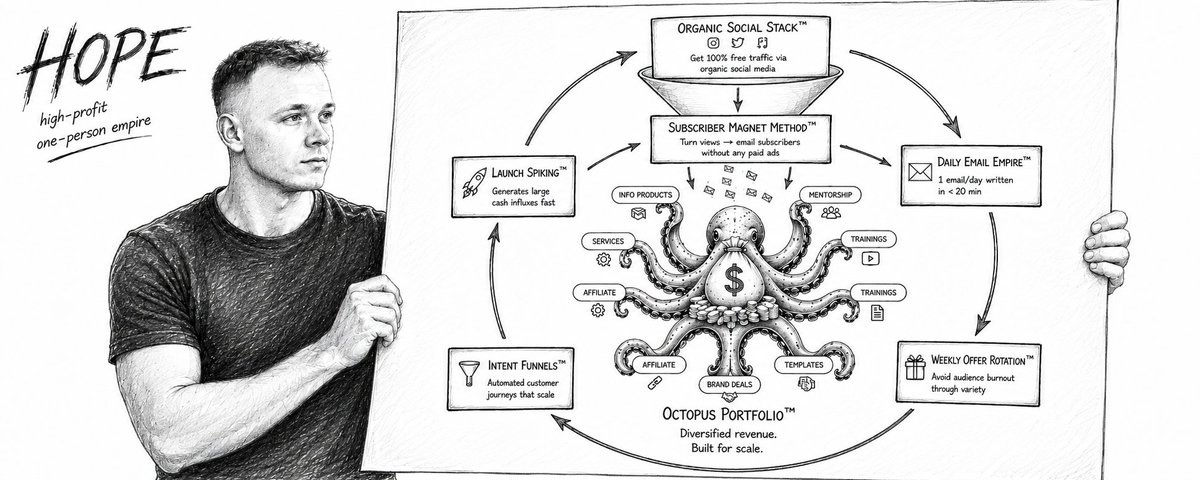
I started out in the online space in Early 2022. Just a regular joe with zero prior experience and zero followers online. My very first digital product (ever) was a $5 Notion template.
By June, less than six months later, I was making two thousand dollars a month from those templates. By August I had quit my 9-5 job. A few years later, that same little template business grew into an empire that has made me well over a million dollars, that runs almost entirely without me, and that has never had a single employee or paid ad running.
I am giving you the ending first because the middle is where almost everyone gets it wrong, and I got it wrong at first too. For a long stretch in between I was burnt out, miserable, and completely convinced the answer was to build something bigger and better.
The answer was the opposite.
After the templates started working, I did exactly what every course, guide and mentor tells you to do. I scaled. I took the money and the momentum and tried to build a real company around it. At the time, I had acquired a new side skill from doing the template business (writing viral tweetS).
So I started doing that for someone else... with success.
And then another person. And another. And another.
Suddenly I found myself running a big ghostwriting agency with a roster of clients and me attempting to train other people to do what I did best before it all came crashing down on me. At its peak it cleared close to fifty thousand dollars in a single month, and from the outside it looked like I had made it.
Inside, I was coming apart.
I woke up every morning with my chest already tight, reaching for my phone to see what had broken overnight. Every one of those moving parts was a person to pay and a problem to solve. The business kept getting bigger and my life kept getting smaller, and I was working harder than I ever had while quietly dreading the thing I had built.
I had left a job I hated to create this, but somewhere along the way I had simply rebuilt the job, paid more for it, and handed myself the worst boss I ever worked for. And within the same quarter, it did come crashing down.
But that collapse was the best thing that ever happened to me, because it forced me to sit with a question I had been avoiding for a long time:
What if bigger was never the answer?
What if the best business I could build was the opposite of a company, a small, sharp, mostly automated machine that one person could run and keep nearly all the money from?
The answer to that question became the thing I started building next. The thing I run today, fittingly dubbed my High-Profit One-Person Empire™
It holds itself to a single standard I call the 95/95 Method™. Ninety-five percent profit, and ninety-five percent of the work automated or systemized. The goal is keeping the most, automating the most, and buying back my own time, which just so happens to be the #1 thing in a business that you can never earn back again.
What H.O.P.E™ actually is
A High-Profit One-Person Empire™ is a business built around one person and a body of work, designed for the most profit and the most freedom with the least complexity. It runs on a handful of simple parts: content that earns attention, an audience you own, digital products that sell while you sleep, and systems that handle the repetitive work for you.
You sit at the center, directing all of it like a conductor, while pocketing almost everything that comes in as a result of it.
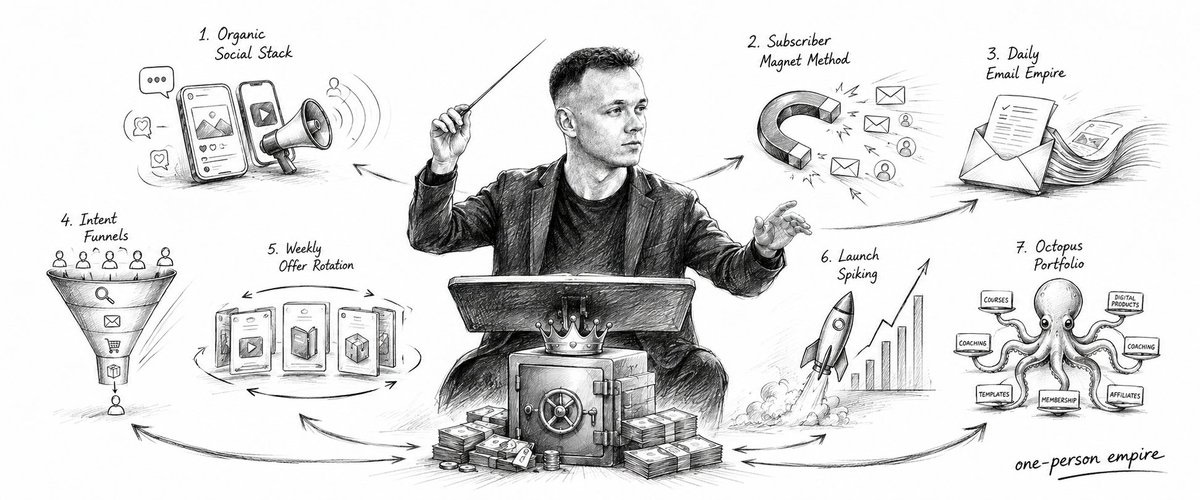
The whole thing is held to one standard, the 95/95 Method™: ninety-five percent profit, and ninety-five percent of the work automated or systemized.
Every decision gets measured against those two numbers. If something brings in revenue but also brings a salary, a support queue, an ad bill, or a reason you can never log off, it fails the test, no matter how impressive it looks.
Now, to fully understand how this model works, let’s go a layer deeper and explore the different kinds of vehicles you can use to generate money.
The five money trees
In The Millionaire Fastlane, a book that I highly recommend you read if you haven’t already, MJ DeMarco makes a point that reorganized how I think about business building. At this point, I think it’s safe to assume you already understand that wealth is generated from owning a system that produces income without your direct time being the only input.
Yet, most have no clue what those systems could actually be.
MJ calls these systems “money trees”, and he lays out five of them.
The first is rental systems, where you own or control an asset and rent it out over and over, like real estate, licensing, or royalties.
The second is software systems, where code does the work instead of people, like apps, automation, and AI tools.
The third is content systems, where you create information or media once and sell it many times, like books, courses, newsletters, and templates.
The fourth is distribution systems, where you control how products reach people, like ecommerce, affiliate deals, marketplaces, audiences, and email lists.
The fifth is human resource systems, where other people perform the work inside your business, like agencies, teams, and contractors.
Here is what is interesting about these.
A High-Profit One-Person Empire™ quietly plants three of those five trees at once, in one person. Content systems are your products and your writing. Software systems are your automations and funnels, and sometimes even own tools. Distribution systems are your audience and your owned email list.
You are running three proven wealth engines stacked on top of each other, alone, with nobody’s permission required.
It also deliberately refuses the fifth one.
Human resource systems are the painful tree, the one that grew the agency that nearly broke me, and this model leaves it alone on purpose. The whole point of a H.O.P.E is that you manage leverage instead of people.
And in doing so, you get set up perfectly for the first one, rental, which is the one you graduate into later. Once your empire is printing real profit, that profit is what you funnel into real world assets that pay you to own them, real estate and the lot.
You build the high-margin machine first, then you let it buy the rent checks.
And most importantly, you do them in the right order.
There is also a deeper thing going on here, and it’s what most business advice misses.
Most entrepreneurs are artists at heart. They do not actually want to run one rigid company forever, managing the same 100 people and the same single product until they retire. They want the freedom to build whatever their heart wants to make next.
The human resource model chains an artist to a desk.
A one-person empire hands them a studio, because the Octopus Portfolio™ (more on that in a second), means the next thing they want to create always has a place to live.
The seven profit levers
Your High Profit One-Person Empire™ runs on seven profit levers. I built each one of these into my own business in a very particular order, and every one of them solved a problem the last stage had created.
1. The Octopus Portfolio™
This is the offer engine. Instead of betting everything on a single product, you build a spread of offers at different prices, so the business grows tentacles and has no single point of failure. Many small bets if you will. I started with one Notion template, then made a few more, then a course, then another course, then software, one or two clients, a handful of students and probably a couple of affiliate deals and brand collabs on top.
When one offer cools off, another carries the month. A single product is a bet you can lose while a portfolio is what lets you sleep at night.
2. The Organic Social Stack™
This is the traffic engine. A shelf full of offers is worthless if nobody knows they exist, so you generate attention for free by publishing every day on the platforms that give it away. For me that was X first, then everything else after. It doesn’t matter if you’re best at doing videos (YouTube/IG), or writing (LI/X). All that matters is that you have one or more channel that turns your thinking into reach without you ever paying for a click so strangers find you.
3. The Subscriber Magnet Method™
This is where renting your audience stops and and owning it starts. Followers live on someone else’s platform, and you control none of it. I learned that the day one of my accounts got suspended and a chunk of my reach vanished overnight, with no warning and no appeal.
So you pull people onto an email list with something useful you give away, and that list becomes the most valuable and profitable asset in the business, because it is the one audience no algorithm can take from you.
4. The Daily Email Empire™
This is the cash register. The email list gets daily emails with analogies and aphorisms that weave naturally into products, written like you are talking to a friend, teaching and telling stories. It is not only where you get paid, but where trust compounds quietly until buying from you feels like the obvious next step, and it is the difference between an audience that likes you and an audience that pays you.
5. The Weekly Offer Rotation™
This is how to sell consistently without burning your audience out on one thing. Most big businesses I know have just one single offer. Not only are they at constant risk of audience burnout (people getting tired hearing about the same thing over and over), but the founders themselves are also at great risk. The risk of boredom. Which, surprise surprise, leads to burnout too.
Instead, you rotate different offers from your portfolio in front of your list on a steady cadence. This is what killed the feast-and-famine cycle that had defined my whole career, and it turned my income from terrifying peaks and valleys into a steady rhythm.
6. Launch Spiking™
This is how big revenue moments are created on demand. Every so often, on top of that steady motion, you run a launch with a deadline to spike cash and attention. Maybe you’re building a new product, or shutting down an old one.
The trick is that a launch is a lever you pull on purpose and then come down from again. A surge layered on a calm baseline to generate a large cash influx in a short amount of time. Living permanently in launch mode is its own kind of burnout, and this is how you get the spikes without it.
7. Intent Funnels™
This is what makes the machine run without you. You build evergreen funnels around what people actually want, so that someone who shows up wanting one specific thing is guided to the right offer automatically, whether you are at your desk, asleep, or on a beach.
This is the lever that, even for me 5 years into running my business, is still work in progress. The more work invested into this profit lever, the higher long term ROI you’ll get on that time investment down the line.
The life it actually buys
Here is what it gave me that the $50k/m version could never.
My morning dread is basically gone. There is no payroll hanging over me, no client who can end my year with a single email, and no ceiling that somebody else drew for me. The whole business fits inside one head and one inbox, both of them mine. It also out-earns the agency by a wide margin and I keep almost all of it, because there is no team to pay and no ad budget bleeding out every month.
I also work fewer hours, and on things I actually care about, and the systems simply handle the rest while I am off living my life. The burnout that nearly ended me turned out to be a symptom of the wrong structure, and the structure was something I could fix. That is the silent promise underneath this whole model I’m running today.
Revenue is the number everybody brags about, yes, but it’s also the most misleading figure in business, because someone pulling a million a year with a team and an ad budget can take home less, and live worse, than someone pulling a fraction of that alone from a laptop. The number that actually runs your life is the one you keep, and a one-person empire is built to make those two numbers close to equal.
I started by selling Notion templates with no real idea what I was doing.
The empire then came later, quietly, brick by brick, one layer at a time.
So if you’re wondering if it’s doable for you?
Well, as I like to say...
There’s always H.O.P.E™
If you ask me, a business worth building is an empire of one.
The door is wide open, and it is open right now. In fact, it’s opening more day by day as AI improves and agents take over. That, and the tools that let one person do the work of ten are still new, the audiences are still reachable (for free), and most people are still chasing VC, pouring their energy into hiring and ad-buying and building the bloated version I nearly died inside of.
You can skip all of it.
You already have the only ingredient that matters, which is you: your mind, your taste, and the one thing you can do well enough that people will pay for it. Everything else in this model exists to take that single asset and multiply it. Content spreads it → a list owns it → email monetizes it→ a portfolio packages it→ and systems scale it.
The creator is the asset, and the rest is leverage wrapped around it.
So stop trying to build something big enough to impress people, and start building something small enough to set you free.
Plant your three money trees you can run alone, skip the one that chains you to a payroll, and let the profit buy the fourth one later.
This way, you get to keep the money you make with a lean operation that allows you to actually live a life too.
I’m currently in the process of thinking about how I can teach others to build their own empire, but I’m still working out the details.
If you want to be one of the first to know,click here to join the waitlist.
You got this.
- Pascal
Things I work on outside this, in case any of them are useful:
@iampascio on Twitter, my profile where I post my experiments and numbers including growing Stanley for X
@xgrowthpascal on Twitter, where I’m going from 0 to 10k followers in 3 months
@creatorpascal on Twitter, my personal brand where I share essays just like this one (currently doing 30 essays in 30 days. This is day 26).
You nailed the thing most people never see. Revenue is vanity, margin is sanity. Nobody prices in the stress. Complexity builds a machine that ends up owning you back.
What are we all gonna do with all that money?!