

Everything you're building will leave you empty
(unless you fix this one thing)

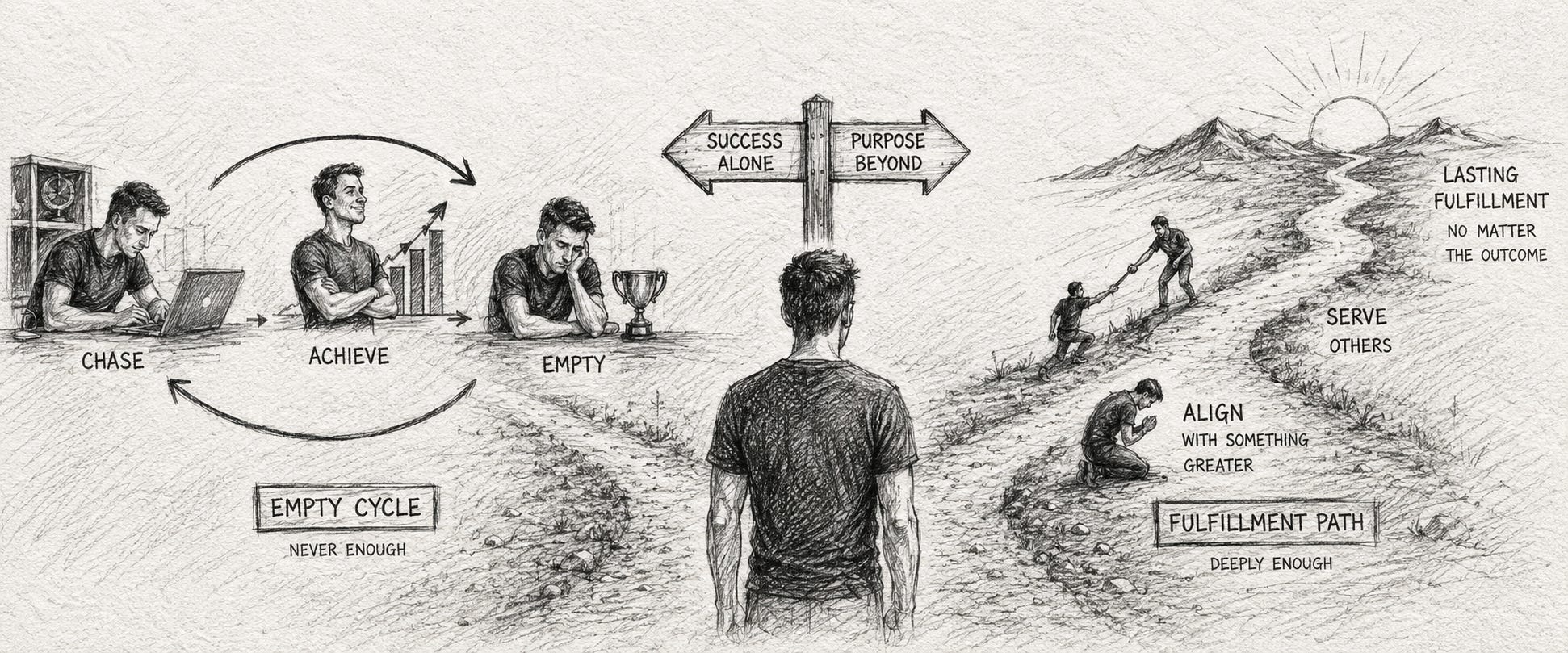
The most dangerous moment in a founder’s life is the one right after they finally get what they wanted.
It’s not while they’re struggling or grinding out the 3am nights or failing all of their launches. Those are painful, sure. But they also come with a built-in psychological painkiller: the belief that once you break through, things will feel different and that the emptiness has a cure called “making it.”
But then you make it. The revenue hits, the product works and important people start saying your name in rooms you’re not in. And for a few weeks, maybe a few months, it does feel different. It’s got this very unique type of high that any founder who’s “made it” knows. A glow almost. The deep exhale that finally tastes like justification.
And then... boom. Nothing.
Something worse that sadness. A flatness almost. A suspicion that the whole structure you just spent years building was supposed to contain something it doesn’t actually contain. You look at the thing you built, and it’s real, and it works, and people pay for it, and you feel... kind of restless. You’re hungry again. But this time the hunger doesn’t have a name.
I’ve felt this.
More than once in fact. And the more I talked to other founders, creators, and builders who had crossed some version of their own finish line, the more I realized this wasn’t a personal deficiency, but rather a structural one.
The architecture of ambition, the way most of us are taught to pursue goals, has a hole in it. A load-bearing wall that was never installed.
That missing wall is what I’ve started calling the Divine Fulfillment Principle. And I think it’s the difference between people who build empires that sustain them and people who build empires that slowly eat them alive.
Let me explain what I mean.
Achievement is just a temporary spike
“He who has a why to live can bear almost any how.”
— Friedrich Nietzsche
There’s a pattern that plays out so reliably it should be a clinical diagnosis.
A person identifies the goal they want to accomplish. Then they pour everything into it. Time, money, energy, relationships, health, sleep. The goal becomes the organizing principle of their entire nervous system. Every decision is filtered through it and every sacrifice is justified by it.
Then they hit the goal. And within weeks, sometimes days, the organizing principle dissolves. The structure that held their life together, the urgency, direction and daily purpose evaporates, and what’s left is a person standing in the middle of their own success wondering why it feels like someone turned the lights off.
It happens to the best of us.
So here’s what’s actually happening under the hood:
You set a goal that is concrete and emotionally charged (”hit $10K MRR,” “launch the product,” “get to 10,000 users.”), whatever it is.
Your nervous system organizes around this pursuit. Dopamine gets released from the pure anticipation of the achievement.
You achieve the goal. The anticipation loop closes. Dopamine drops.
Your brain, now without an active pursuit to organize around, enters a state that feels eerily like depression... even though nothing “bad” happened.
You interpret the flatness as a signal that you need a bigger goal. So you set one. And the cycle repeats, each time with a slightly hollower core.
The uncomfortable truth is that achievement, by its nature, is a spike. It gives you a momentary elevation, and then it becomes the new baseline. It’s simply how your psychology is designed. To pursue.
Which means if all you have is a series of goals, no matter how ambitious, you’re building on a foundation that resets to zero every time you succeed.
To take this a layer deeper, this is why so many visibly successful people are quietly miserable. They’re succeeding, repeatedly, and yet they’re discovering that success without a deeper anchor is just a more expensive version of the same emptiness they were trying to escape.
That deeper anchor is what most goal-setting frameworks completely ignore.
The two layers of “why” that actually sustain a person over the long term
“The soul becomes dyed with the color of its thoughts.”
— Marcus Aurelius
Most advice about motivation operates on a single layer. Find your “why”, get clear on your purpose, write it on a sticky note, tape it to your mirror. And when the going gets hard, stare at it until you feel something.
This is not an entirely wrong way to approach it.
It is however dangerously incomplete.
I’ve started thinking about the “why” behind sustained effort as having two distinct layers, and if you only have one of them, the whole thing eventually collapses.
The first layer is what I call the Brute Force Goal.
This is the concrete, emotionally charged, almost primitive target that powers the 3am sessions and the irrational persistence. Build the thing. Make the money. Ship the product. Prove the thesis. Retire your parents. Become undeniable. Whatever form it takes, the Brute Force Goal has weight because it is emotional enough to organize behavior around. It gives your nervous system a command and turns vague aspiration into direction.
I wrote an entire article on this mental model that you can read here.
And frankly, you need this. Without it, you’re a philosopher with no output.
The Brute Force Goal is the engine.
But the engine, by itself, will eventually burn you out, or worse, deliver exactly what you asked for and leave you staring at the ceiling wondering what the point was.
The second layer is what I call the Divine Fulfillment Principle.
The idea, stripped to its core, is this: true fulfillment comes from being rightly oriented toward something bigger than yourself. For some people, that’s God. For others, it’s service, truth, beauty, family, duty, or simply a sincere relationship with something transcendent. The name itself matters less than the orientation.
Money can indeed can make life smoother and achievement can give you confidence. But none of those things, by themselves, seem able to produce deep peace. They produce spikes. And then, very often, they produce another hunger.
That’s why the strongest “why” has both layers.
It needs enough ambition to make you move, and enough transcendence to keep the movement from hollowing you out.
This is where most productivity advice, most business advice, most “find your purpose” advice falls apart. It operates entirely on one oversimplified layer: Get clear on the goal. Execute relentlessly. Optimize. Iterate. Scale.
And it works... right up until you get what you wanted and realize the thing you were chasing was a proxy for something the goal was never capable of delivering.
The cathedral builders of the ancient world understood something you don’t
“A man who becomes conscious of the responsibility he bears toward a human being who affectionately waits for him, or to an unfinished work, will never be able to throw away his life.”
— Viktor Frankl
A reader of mine recently shared something that stuck with me. He spent eight and a half years developing a signal-processing ECG system at a small startup in the ‘80s and ‘90s (a machine designed to detect heart attacks before they happened).
He had four reasons for persisting through what most people would consider an insane level of sustained effort: 80-hour weeks under fluorescent lights, years of incremental progress, an outcome that was never guaranteed.
The first was personal. His father-in-law died of a surprise heart attack at 46. His own father had a triple bypass at 55 and was never quite the same. If he could build something that prevented those kinds of tragedies, the sacrifice had a weight behind it that no business plan could provide.
The second was curiosity. The problem was genuinely interesting. Hard, layered, requiring him to combine computer engineering with cardiac electrophysiology and work alongside leading doctors and researchers.
The third was money. Stock options. The real possibility of financial upside beyond a traditional wage slave salary.
The fourth was ego. The drive of doing something, as a small team, that had never been successfully productized and put into medical practice.
All four of those together sustained him. They saved at least 25 lives during development and testing, improved the quality of life of many more, and sold machines with insurance reimbursement to their doctor-customers.
The project stayed with him as a life highlight more than 30 years later.
Here’s what I noticed about that story: all four motivations were real. But they weren’t equal. The money and the ego would have eventually run dry. Every founder who’s chased those things long enough knows the ceiling. The curiosity kept the work intellectually alive. But the thing that made 80-hour weeks under fluorescent lights feel like a calling instead of a sentence was the fact that people were not dying because of what he built.
That’s the transcendent layer.
The part that turns sacrifice into something sustainable.
Think about the people who spent decades building cathedrals in medieval Europe. They knew they would never see the building finished. Their grandchildren might not see it finished. And yet they carved stone with precision and care that would embarrass most modern architects.
They were oriented toward something they believed was infinitely larger than themselves, and that orientation changed the texture of the work entirely. The labor didn’t need to be exciting because the purpose was inexhaustible.
That is the Divine Fulfillment Principle in action. A structural observation about what sustains a human being across decades of effort.
Curiosity is oxygen, but it’s not the fire
“The important thing is not to stop questioning. Curiosity has its own reason for existing.”
— Albert Einstein
I want to be careful here not to dismiss curiosity, because it matters enormously too, and the reader I mentioned made this point well.
Without curiosity, deep work becomes mechanical suffering.
You can force yourself through it for a while, but eventually the system rebels. Curiosity gives the work oxygen. It keeps the mind alive inside the repetition. And this is real. The people who last longest in any field are almost always the ones who remain genuinely curious about the domain. They’re still asking questions, finding edges to explore and still surprised by what they discover on Tuesday that they didn’t know on Monday.
But on the other hand, curiosity alone is not strong enough to carry a person through the truly dead parts of a serious pursuit.
Curiosity gets you into the room, sure. It helps you discover the problem, play with the edges, and stay intellectually engaged. But when the work becomes ugly, repetitive, slow, socially invisible, and unrewarded for longer than expected (which it will, in any meaningful pursuit), curiosity often needs to be joined by something heavier.
The ECG story is a good example. It had curiosity: an interesting hard problem, many sub-problems, new knowledge domains to absorb. But curiosity alone wouldn’t have sustained 80-hour weeks for nearly a decade. What sustained it was the confluence of curiosity, personal stakes, financial upside, ego, and underneath all of that, the fact that people’s lives were on the line.
Remove the transcendent layer and the rest starts to wobble.
You can see this play out in real time across the tech industry: brilliant, curious people burning out not because they stopped being curious, but because the curiosity was connected to nothing beyond itself. They were solving interesting problems that solved nothing meaningful, and eventually their nervous system figured out the trick.
Curiosity is the oxygen. The Brute Force Goal is the spark.
But the transcendent orientation (the thing that makes the fire worth tending through long, cold, unglamorous stretches), that’s the fuel that doesn’t run out.
The void that follows winning is a signal
“What does it profit a man to gain the whole world and forfeit his soul?”
— Mark 8:36
When people say “money isn’t everything,” they’re not dismissing its value. They’re pointing at something real that most ambitious people don’t take seriously until they’ve experienced it firsthand.
You can have the income, the dream setup, the respect of your peers. You can hit every metric you wrote on the whiteboard three years ago. And after the initial high fades (and it always does), you can find yourself restless, unfulfilled, and quietly panicking because you don’t know what’s supposed to come next.
That void is a sign that the architecture was incomplete from the beginning.
The Divine Fulfillment Principle is, at its core, a diagnostic tool. It says: if you feel empty after getting what you wanted, the problem is that you were relying on that thing to provide something it was never designed to provide.
Material success can give you comfort. Freedom. Options. Leverage. These are real and valuable. But they cannot give you the sense that your life is rightly ordered, that you are oriented toward something that would matter even if nobody was watching, even if the money disappeared, even if the product failed.
That sense comes from a different place entirely.
It comes from anchoring your work, your ambition, your daily effort in something that transcends the outcome. For some people, this is explicitly spiritual: a relationship with God, a practice of prayer or meditation, a sense of divine purpose. For others, it’s less religious but equally deep: a commitment to service, to truth, to creating something that outlasts you, to being useful in a way that has nothing to do with your bank balance.
The form matters less than the function. The function is: you need something that doesn’t reset to zero when you succeed.
A transcendent goal is the hardest thing to find right now (and that’s exactly why it’s important)
Here’s the part that’s hardest to say honestly.
Finding a transcendent orientation (a genuine, load-bearing relationship with something bigger than yourself) is probably harder today than it has been at any point in recent history.
There’s a reason for that. The culture is saturated with cynicism, nihilism, rage-baiting, and a relentless current of irony that makes sincerity feel dangerous. If you’re stressed, it’s hard to look out and look up. If you’re drowning in notifications, it’s hard to hear the quieter signals. And if every public expression of faith or purpose gets immediately dissected and mocked, it takes a certain stubbornness to pursue one anyway.
But this is precisely why it matters.
The scarcity of transcendent orientation is itself an opportunity. And not in the shallow business sense, but in the deepest possible sense. In a world where almost nobody is anchored to something beyond their own metrics, the person who is anchored has an almost unfair advantage. It makes you more durable, grounded and capable of sustaining effort through the long, unglamorous stretches where most people quietly give up.
And here’s the real unlock for ya’.
You don’t have to wait until you’ve “made it” to develop this. In fact, if you develop it early before the success, before the money, before the external validation, you actively avoid the structural collapse that so many successful people walk into blindly (myself included).
The void doesn’t have to happen. It only happens when the architecture is incomplete. To avoid that, build both layers from the start, and the achievement becomes what it was always meant to be:
A byproduct of a well-ordered life instead of a substitute for one.
The protocol: how to build both layers
This is not complicated. But it requires a kind of honesty that most ambitious people are not used to practicing, because the culture of ambition tends to reward self-deception and punish introspection.
Follow curiosity, because it reveals the terrain. You cannot force yourself into the right pursuit. Curiosity is the scout. It shows you what your mind naturally gravitates toward, what problems light you up, what domains you’d explore even without a financial incentive. Follow it. But understand that it’s showing you where to look, not what to anchor to.
Choose your Brute Force Goal, because it creates direction. Once curiosity has revealed the terrain, pick a target. Make it concrete. Make it emotional. Make it ambitious enough that it organizes your behavior and silences the noise. Whatever it is, it needs to be specific enough to power the 3am sessions and visceral enough to override the part of your brain that would rather scroll. Here’s a full guide on that.
Anchor the work in something higher, because otherwise winning becomes spiritually exhausting. This is the layer most people skip, and it’s the layer that determines whether your success sustains you or consumes you. Ask yourself: what would make this work matter even if it failed? What would make the effort worthwhile even if nobody saw it? What are you serving that is larger than your own ambition? The answer doesn’t need to be religious. It needs to be real. And you need to return to it regularly as a genuine practice of orientation.
Check your motives before big decisions. Before making a significant move (a launch, a pivot, a hire, a sacrifice, whatever it may be), ask yourself honestly: “Am I doing this because it serves the deeper purpose, or am I feeding my ego?” Both can coexist. But if you can’t find the deeper purpose in the decision, that’s worth pausing on.
Build the reflective practice that keeps the orientation alive. This doesn’t need to be dramatic. A few minutes each day is enough. Whether prayer, meditation, journaling or simply sitting in silence, this is enough to maintain the connection. The point is to regularly interrupt the noise long enough to remember what the work is actually for.
Discipline matters, obviously. But discipline without a worthy object becomes self-punishment. And ambition without a higher anchor becomes appetite with a business plan.
The people whose work stays with them decades later, long after the revenue numbers have faded from memory, are almost always the people who had both layers running simultaneously. They were ambitious enough to build something real, and oriented enough to build something that mattered beyond themselves.
That’s the Divine Fulfillment Principle.
Not a rejection of ambition or a call to be less driven. A structural upgrade to the architecture of ambition itself, one that installs the load-bearing wall most people don’t realize is missing until the building starts to crack.
Build both layers. The empire and the foundation beneath it.
Everything changes when you do.
– Pascal
Things I work on outside this, in case any of them are useful:
@iampascio on Twitter, my profile where I post my experiments and numbers
@xgrowthpascal on Twitter, where I’m going from 0 to 10k followers in 3 months
@creatorpascal, my personal brand where I also share these essays as articles