

The art of being productively unproductive
The dark side of "discipline"

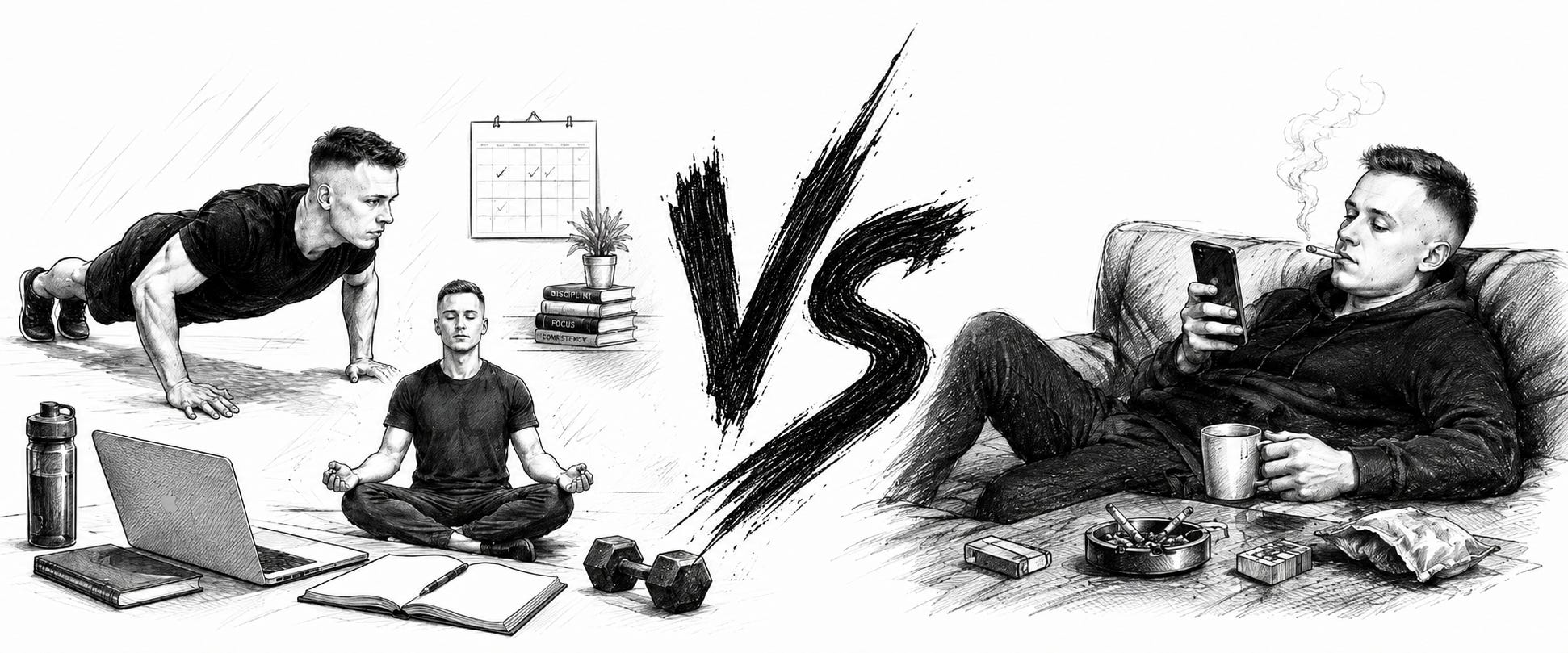
I did everything right.
That’s the part that messes with me the most of all this.
I woke up at 5AM. Hit the cold shower. Journaled three pages every morning. Meditated for twenty minutes. Time-blocked my calendar in thirty-minute increments. Tracked all my habits in Notion. Read a minimum of one book a week. Meal-prepped on Sundays. I even had a morning routine, an evening routine, and a shutdown ritual that took forty-five minutes (each). I didn’t drink alcohol, I didn’t scroll any social media and I went to bed at 9:30PM every night like a monk on a mission.
For two years, I ran my entire life like a productivity experiment. Every hack, every framework, every piece of advice from every guru, every podcast, every bestselling book you can think of... I implemented it. And I did it with the intensity of someone who genuinely believed that if he just optimized hard enough, everything would fall into place.
Well... spoiler alert.
My life didn’t fall into place. It started falling apart.
And I need to tell you what happened, because I think a lot of you are standing exactly where I stood back then, doing everything the internet told you to do, wondering why your life still doesn’t feel like the one they promised you.
The honest truth is that the advice itself is fundamentally broken. And that the people giving the advice are making money from you following it.
The routine that ate my life
Let’s first break down what my days actually looked like at the peak of my productivity obsession, because from the outside they looked perfect.
5:00AM. Wake up (you snooze, you lose). Feet on the floor. Ready to go.
5:05AM. First thing, cold shower. Three minutes of excruciating pain.
5:15AM. Journaling time. Gratitude, intentions and affirmations.
5:45AM. Meditation because you need headspace. Twenty minutes.
6:10AM. Reading sesh. Non-fiction only (obviously). Thirty minutes.
6:40AM. Exercise time. Quick gym sesh or a run. One hour.
7:45AM. High protein healthy breakfast. Prepped the night before.
8:15AM. Deep work block one. Ninety minutes. Phone in another room.
9:45AM. Quick break. Ten minutes only, and still no screen time.
10:00AM. Deep work block two. Ninety minutes.
11:30AM. Email and admin. Thirty minutes.
12:00PM. Lunch.
And it kept going like this throughout the day. Every half hour accounted for and every minute assigned a purpose. Every single activity chosen because some expert somewhere said it was the optimal way to use that time.
You know what this looks like from the outside? Discipline.
But what you don’t know is what it felt like from the inside.
A prison I built for myself and called freedom.
Because here’s what nobody tells you about optimizing every minute of your day: you become a machine that serves the schedule instead of a person who uses the schedule to serve their life. The routine becomes the point and maintaining it becomes the work. Somewhere between the cold shower and the second deep work block, you forget to ask the only question that actually matters: what am I building all of this for?
I didn’t have an answer to that.
I just had a routine.
How I became the most disciplined unproductive person alive
This is the part that’s hardest to explain, because it sounds contradictory.
How can someone who wakes up at 5AM, journals, meditates, exercises, and time-blocks their entire day be... unproductive?
Easy enough if you think about. I was productive at being productive. I was not productive at producing anything that mattered.
My entire day was structured around optimization rituals. The morning routine took two and a half hours. The evening routine took another hour. The habit tracking, the journaling, the reviewing, the planning, all of it consumed enormous amounts of time and energy. I was spending four to five hours a day on the infrastructure of productivity before I did a single minute of actual work with the idea that my work would be more meaningful.
But the work I did? It was whatever fit neatly into a ninety-minute deep work block and not the work that mattered most. No, just the work that was most compatible with the system. I’d choose tasks based on whether they could be completed inside a time block, not whether they were important.
And I’d consistently find myself avoiding the messy, ambiguous and difficult work (the kind that actually moves your life forward) because it didn’t fit “the structure”.
I was optimizing the container, but ignoring the contents within it.
Meanwhile, I had a friend who woke up at whatever time he woke up, had no morning routine to speak of, drank coffee while checking his phone, and then sat down and worked on the one thing that mattered for his business until it was done. Some days that was three hours. Some days it was twelve. He didn’t track habits, journal or meditate... at all.
Yet, somehow he built a business that made him $30K a month on repeat. And all I built was a morning routine that made me feel like I was building a business.
We were not the same. And it took me way too long to see it.
The advice that broke me
Let me walk you through the specific pieces of productivity advice that, individually, sound brilliant and collectively almost destroyed me.
“You must wake up at 5AM!”, they told me.
Why though? Because successful people wake up early? Well, that’s the claim at least. And so I did. For two years. You know what waking up at 5AM also did? It made me exhausted by 2PM. It made me useless in the evening. And it meant I couldn’t have dinner with friends without yawning through the conversation. It compressed my entire social life into weekends and made me feel guilty for staying up past 10PM on a Tuesday. I was well-rested by no meaningful metric. I was just... early.
Nobody asked whether I was a morning person. Nobody asked whether my best work happened at 5AM or at 11PM. I didn’t even ask myself that. The advice was just universal, and thus I followed it universally, even though my brain does its clearest thinking at night.
I was quite literally forcing my biology into someone else’s schedule and trying to feel good about it because it was “discipline”.
“Have a morning routine”, they told me.
So I built one. Then I refined it, rebuilt it, added more stuff to it and optimized it over and over again. My morning routine became a hobby. A project. Something I tweaked and perfected endlessly the way some people build model trains. It was satisfying, sure. And it truly felt like progress. But it was really just a two-and-a-half-hour delay between waking up and doing anything that mattered.
“Track your habits”, they told me.
So I tracked it all. Water intake, daily steps, pages read, minutes meditated. I had spreadsheets. Then Notion templates. Then daily streaks. But you know what habit tracking actually did? It turned every single day into a performance review. Every evening I’d look at my tracker and feel either satisfied that I’d checked every box or guilty that I hadn’t. My self-worth became tied to whether I completed a set of arbitrary daily tasks. It wasn’t me actually living my life, but me completing a checklist and then grading my self worth on it.
“Read a book a week.”, they told me.
So I did. Fifty-two books one year. You know how many I remember? Maybe four. I was reading them just to hit that number. Rushing through chapters so I could move on to the next one. I was optimizing for volume instead of depth. I could tell you I read fifty-two books but I couldn’t tell you what most of them said.
“Batch your tasks.”, they told me.
I batched email. I batched calls. I batched admin. I batched content creation. Everything was batched. I even batched batches. And it turned every day into a rigid assembly line where the slightest disruption (e.g. a call that ran long, a task that took more than its allotted time), cascaded through the rest of the schedule like a falling set of dominoes. I spent more energy protecting the structure than doing the work inside it.
Each of these, in isolation, is defensible advice, yes.
Yet, together they created a lifestyle where I was performing discipline fourteen hours a day and producing almost nothing of real value.
The day it all came crashing down
I remember the exact moment.
I was sitting at my desk. It was a Wednesday afternoon a few years back. I’d done everything by the book. Morning routine, check. Meditation, check. Gym, check. Yet there I was, staring at my screen during deep work block two, and I thought: I have no idea what I’m doing all this for.
Not in an overly dramatic, existential crisis way. In that quiet, factual realization way. Like reading your bank statement and realizing the account is actually empty.
I had the most optimized life of anyone I knew, yet I had nothing to show for it. No business that worked and no financial progress that justified the years of monk-like discipline. Just a beautifully structured (empty) life.
That same week, I burned it all down.
I dumped my habit tracker into Trash, then emptied my trash bin. I slept in until 11.30am. I went to bed whenever the f*ck I wanted. I stopped reading a book a week. I stopped meditating. I stopped journaling. I stopped all of it.
And I replaced it with one question that I asked myself every morning
“What is the single most important thing I can do today?
Read this question one more time, because it doesn’t say “the most optimized thing” or “the thing that fits the system”. It says the thing, that if I did that and nothing else, would mean the day wasn’t a complete waste.
Some days that meant working for twelve hours straight on one project. Other days days that meant having a conversation with someone who could change my trajectory. Some days that meant taking a walk and just... think about stuff. None of it was optimized, but all of it was effective.
Within six months, I’d made more progress than in the previous two years combined.
What I actually learned
Here’s what I wish someone had told me before I wasted two years being productively unproductive.
Productivity isn’t about doing more things, but about doing the right things.
And the right things are usually messy, uncomfortable, ambiguous, and impossible to fit into a thirty-minute time block. The right things require you to sit with uncertainty, to work without a clear endpoint, to put in hours that don’t look good on a habit tracker.
Every piece of productivity advice I followed was designed to make me feel in control. That was the appeal of it. My life felt chaotic, but systems promised order. But that order turned out to be purely cosmetic. Because underneath the routines and trackers and time blocks, nothing was really changing. I was just rearranging the furniture in a house that was on fire.
The people who are actually productive... the ones building things, making money, changing their lives, they don’t operate on elaborate systems of self-optimization. They just have 100% clarity about what matters. And then they spend their time on that, ruthlessly, at the expense of everything else.
They don’t wake up at 5AM because a podcast told them to. They wake up whenever they wake up and then they go build something meaningful. They don’t track habits because they don’t need external validation that they’re doing the work. The work itself is the evidence of that. Neither do they read fifty-two books a year just to do it. They’d rather spend those hours applying one idea deeply than collecting a hundred ideas superficially.
The entire productivity industry is built on one big, profitable seductive lie: that the reason your life isn’t where you want it to be is that you’re not optimized enough. That if you just found the “right routine”, the “right system”, the “right morning”, the “right evening”, the “right set of habits”, that everything would finally click.
*drumroll for dramatic effect*
It won’t.
Because optimization without direction is just spinning in place. Very efficiently and very impressively, yes, but going abso-f*cking-lutely nowhere.
What this actually means for you
If you’re reading this and feeling attacked, good.
That means you recognize something important in what I’m saying.
I’m not telling you this to be cruel. I’m telling you because I know exactly how it feels to do everything right and still end up stuck in a loop that never seems to end. And I know that the reason you’re stuck in it isn’t lack of discipline or laziness, but rather that you replaced the hard work of figuring out what actually matters with the comfortable work of building systems around things that don’t.
Stop optimizing everything, and start choosing.
Choose the one thing that would change your life if you spent the next six months on it. Then spend six months on that. Your full, undivided, unoptimized, messy, imperfect attention.
That’s what productive people actually do. They don’t have better mornings than the rest of us. Just better priorities. And they protect those priorities with their lives instead of burying them under an avalanche of habits, routines, and self-improvement rituals that feel like progress but produce nothing.
All this productivity advice was a perfect substitute for the thing I was actually avoiding: the hard, uncomfortable, unstructured work of building something real.
So don’t make my mistake. Because the life you want isn’t hiding behind a better morning routine, but behind the thing you keep putting off because no system in the world can make it easy.
If this resonated with you, send it to someone who’s drowning in productivity routines and going nowhere. It’s not to shame them, but to make them realize that they don’t need another framework to follow.
They need permission to stop performing so they can get begin building.
- Pascal
Things I work on outside this, in case any of them are useful:
@iampascio on Twitter, my profile where I post my experiments and numbers
@xgrowthpascal on Twitter, where I’m going from 0 to 10k followers in 3 months
@creatorpascal on Twitter, my personal brand where I share essays just like this one (currently doing 30 essays in 30 days. This is day 18).
how long you think it takes to build a content business?
Discipline is rarely about motivation. It is usually about building systems that make good decisions easier and bad ones harder. Small habits repeated consistently change everything.