

How to Be Responsibly Reckless
The Two Clocks Theory

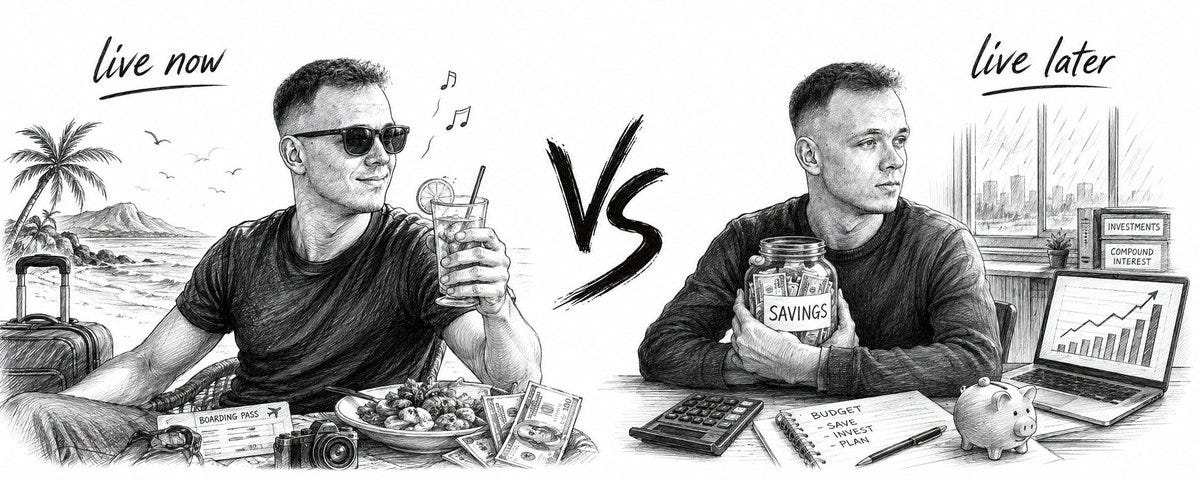
Ever heard of The Two Clocks Theory? Or the 50/50 Principle?
Yeah, me neither, because I only just put a name to these ideas recently even though the feeling behind them has been following me around for years.
I also think they might be one of the clearest ways I’ve found to explain how to live a life that is balanced, happy, and successful without quietly sacrificing one part of yourself for another. To fully understand what I’m about to share with you, I first need to introduce you to my mum.
Wonderful woman. I could sing her praises all day.
She’d worked her whole life, raising three kids mostly on her own, doing the responsible thing every single year: head down, save what you can, defer what you want, because one day the working stops and the real living finally begins. That day even had a name. It was called “pension”.
The date she’d been promised her whole life, the one where she’d finally be free to do all the things she’d spent four decades putting off.
Her pension was supposed to start the year she turned 67.
She passed a few months before her 59th birthday.
It’s happening again
My brother who’s a year older than me stood next to me at the funeral.
And he’s now running the exact same program.
Earn now, live later, wait for “the date”. He watched what the waiting cost her, and saw a lifetime of “I’ll get to it when I’m free” turn into an empty chair, and yet, he’s still running the same identical script. I don’t think he’s even noticed he’s doing it, which is the part that really gets to me, because that’s how deep this stuff goes. You can quite literally watch it take someone you love and still run it yourself on autopilot without a second thought.
Now, my brother has more money saved than I do, without a doubt.
He’s never carried any debt and probably never made a purchase he had to think twice about afterward. He drives an old car that runs fine and that he plans to keep running until it physically refuses to start. There’s this number in his savings account that he treats like a load-bearing wall: you do not touch it, you only add to it.
But I’ve started to worry that he’s spending the one thing he can’t ever earn back. He’s spending time. Specifically, he’s spending the present, in steady monthly installments, on a future he keeps describing and never quite walks into. And the scariest part is that by every standard we were raised to respect, he is the one supposedly winning at life.
Worst of all is that that none of what he’s doing is stupid.
Each and every one of those choices, on their own, are sensible ones.
Don’t blow money on a trip when you could invest it. Don’t quit the stable thing for the uncertain thing. He’s running the exact script we were both handed as kids to a tee: be sensible now, and life will reward you later.
Defer, defer, defer, and one day the deferring stops and the living begins.
That’s what makes it so hard to watch. He isn’t being reckless or lazy... at all. Quite the opposite. He’s being good, exactly the way we were both raised to understand good, and it’s quietly walking him toward the same empty chair.
I know, I know. This probably sounds like the opening of a “stop saving, start living, money is meant to be spent” type of essay.
It isn’t.
And this is exactly where most people writing about it miss the point.
I had the opposite disease
Here’s where I have to come clean, because it would be easy to write this as the wise younger brother who saw the light. I didn’t see any light.
I just caught the exact opposite illness.
Where my brother defers everything, I deferred nothing. I swung so hard the other way it’s almost funny now that I think about it. I never saved a penny in my life. Took out stupid loans and “left it for future me to deal with”. Most of the time, if I’m being fully honest, I barely thought about the future at all.
So I never built that deferral reflex until much later.
When money finally started coming in, I spent it in a way that would make my brother’s eye twitch. I’d watched “later” fail to show up for the one person who did everything right to earn it, so I decided “later” was a fairy tale, and hence, I lived most of my early years like the bill would never come. Carefree, careless, spending everything, postponing nothing, and quietly proud of myself for it. I thought refusing to wait the way she’d waited made me the smartest person in the room.
At some point I started doing the actual math on “later,” and the math turned out to be brutal.
For context, I moved to Spain when I was eighteen for a telemarketing job. Cold-calling strangers on a sales floor, paid mostly on commission, no safety net, no inheritance waiting for me at home and no plan B sitting in a trust somewhere. I had nothing, which I’ve written about before, so I’ll spare you the violins.
The point I’m trying to get across is that for me, the future was an abstraction and the present was the only currency I had to pay with.
Then, as life does it best, the bill eventually came.
A few years back, I built a ghostwriting agency that, at its peak, was doing close to fifty thousand euros a month. I saved almost none of it, because saving was for people who believed in “later,” and I didn’t. So when the thing came apart a few months later (and it came apart fast), I had the income of a small company, but the savings of a teenager. I’d somehow made a small fortune and managed to keep none of it.
That was the moment I finally understood.
My brother bets everything on the long clock, the one where you live to a hundred and patience always pays off.
I bet everything on the short clock, the one where tomorrow isn’t promised so you’d better spend today before its too late.
We made opposite versions of the exact same mistake, assuming we somehow knew which way the clock was going to break.
Oh, how wrong both of us were.
Two clocks is the secret
You are at any given time running two clocks at the same time, and they tell completely different times which may sound confusing at first.
One clock is long. It assumes you’ll live to a hundred. On that clock, compound interest is your best friend, the stupid purchase you skip today buys you freedom in thirty years, and the patient, boring, responsible decisions win every time. On the long clock, my brother is a genius and I’m an idiot.
The other clock is short. It assumes you might not see next year, because the genuinely uncomfortable truth is that you might not. My mother didn’t. On that clock, the trip you keep postponing is one you may never take, the people you keep meaning to visit are aging on a schedule you don’t control, and “later” is a bet against a deadline you can’t see. On the short clock, I’m the sane one and my brother is gambling with the only resource that never refills.
Almost everyone picks one clock and lives their whole life by it.
The savers run on the long clock and reach the end having carefully protected a freedom they never let themselves use. The spenders run on the short clock and reach the end having enjoyed a present that quietly bankrupted them.
My family managed to produce one of each.
The thing I had to lose a fortune and a parent to understand is that you’re supposed to run both at once. Build and invest like you’ll live to 100. Spend your time and your energy like you won’t make it to next year. Be the most patient person in the room with your money, and the most impatient person alive with your actual life.
That’s the 50/50. Half of you planning for a future that probably comes, half of you spending a present that definitely won’t wait.
It’s a way of living that would make a good accountant nervous, and I’ve come to think the nervousness is the proof it’s working.
I’ll happily book a flight to see someone I love this month instead of waiting for a cheaper one next quarter, because next quarter that person is three months older and so am I.
I’ll spend on the dinner, the trip and the experiences I’ll still remember in ten years, and I’ll also happily cut the stuff I won’t.
I refuse to postpone the things that make a life feel like a life. The present is the only part of my calendar I treat as genuinely non-negotiable.
Even if it costs me a portion of my future.
Where the good decisions live
Once you’re holding both clocks, the decisions get easier, because you finally have the right question.
It stops being “can I afford this” and becomes “which clock is this on.”
Future-clock decision? Be ruthless and patient. Invest it, skip it, let it compound, don’t flinch. The newer car my brother won’t let himself buy is, honestly, a great future-clock call. He’s right about that one, I’ll give him that.
Present-clock decision? Stop optimizing and just do it. The flight home to see family while they’re still here to see. The dinner with the friend you keep rescheduling into a quarter that never arrives. The thing you keep promising yourself once everything settles down, even though some part of you already knows “settled” is just a nicer word for the date that never comes.
Most of the quiet misery I see in people my age, especially those who start making money, is that they’re running these clocks exactly backwards.
They YOLO the future, financing a lifestyle on the short clock so they can feel like they’ve made it right now, or they defer the present, filing the experiences that would actually make them happy under things to unlock later down the line.
Both clocks in hand, both read upside down.
Flip that shit.
Treat your money like you’ve got a hundred years to grow it.
Treat your time like the clock could stop this year.
Spend freely on what you’ll remember and cut hard on what you won’t, while quietly building something in the background that assumes you’ll be around for decades to enjoy it.
What he’s actually waiting for
My brother is still saving for “the day”.
He’ll probably reach it, too. He’s more disciplined than I’ll ever be, and the number he’s protecting will almost certainly be sitting there when he arrives. The savings will be there. The security will be there. The spreadsheet will be ever so green with the compounding in full effect.
I just can’t stop thinking about whether the person standing at that date will still want the things he’s been postponing to reach it. Whether the trip still appeals when the body is older. Whether the risk he keeps deferring still feels worth taking when there’s more to lose and less time to recover from losing it. Whether “later” has anything good left in it by the time he finally lets himself walk through the door.
That’s the cruel design of this whole thing.
The money and security does show up inevitably.
But the present is the part that won’t wait around for you to be ready for it.
Every day you spend guarding a tomorrow you’re not living, you pay for it with a today you’ll never get back. That cost doesn’t refund, and it doesn’t compound, and there’s no patient strategy that earns it back later.
So I run both clocks.
I build like I’ve got a hundred years and I live like I’ve got one, because the one thing my family taught me, from both directions at once, is that you never get to know in advance which clock you’re actually on.
My mother worked for freedom she never got to spend. My brother is repeating the same pattern. But I know I’m going to spend mine while I can still feel it, while still building like I’ll need it for fifty more years anyway.
And if it scares my accountant a little, I take that as a sign I’m doing it right.
- Pascal
Things I work on outside this, in case any of them are useful:
@iampascio on Twitter, my profile where I post my experiments and numbers
@xgrowthpascal on Twitter, where I’m going from 0 to 10k followers in 3 months
@creatorpascal on Twitter, my personal brand where I share essays just like this one (currently doing 30 essays in 30 days. This is day 24).
A thoughtful reminder that growth often demands courage before clarity. Sometimes the biggest risk is staying exactly where you are.