

Life Is A Video Game
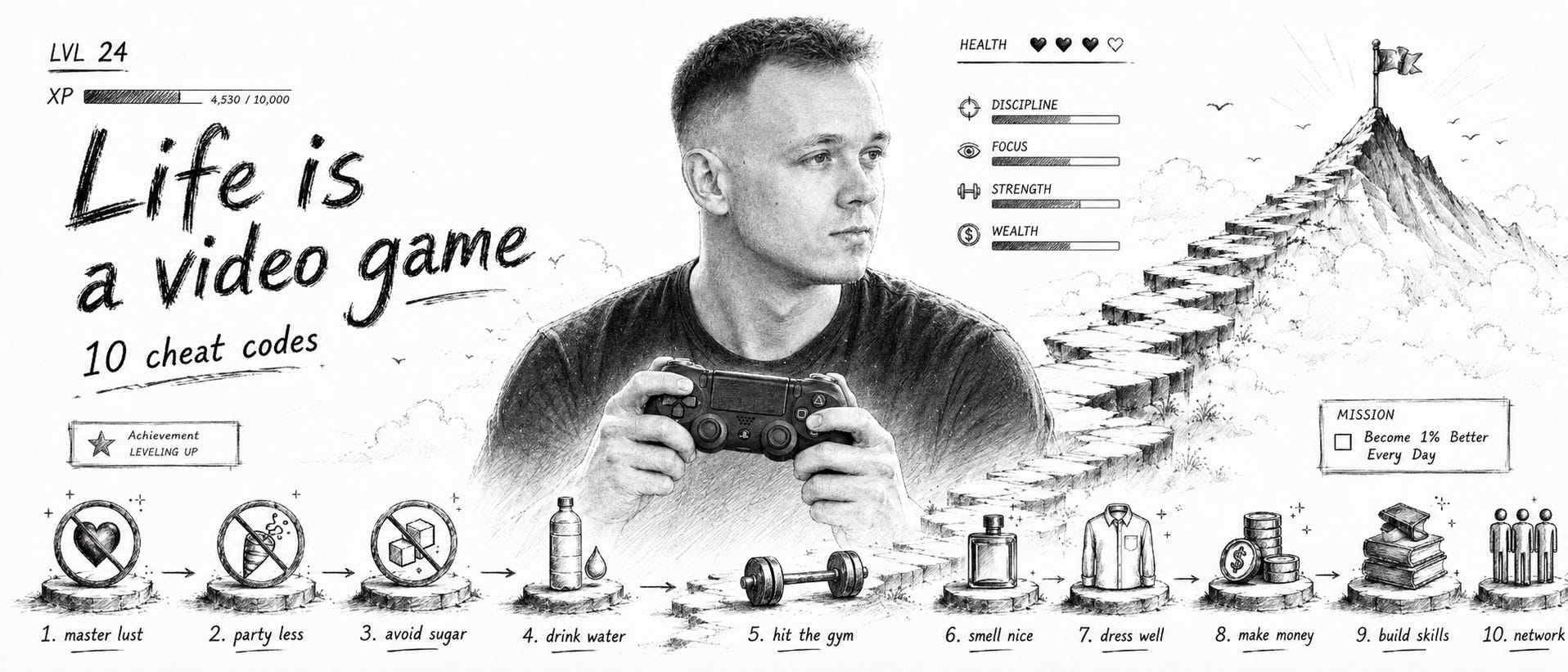
Here are the 10 cheat codes you need to use:

A few years back, I got my first ghostwriting client. And then within months, I had scaled it into a full scale $50,000/m agency. I genuinely felt I had it all figured out.
From the outside it looked like the dream. Retainers landing on the first of every month, a small team, and a level of income I hadn’t seen in any of the corporate jobs I’d left behind. I’d moved out of Denmark, bounced through a couple of cities, and was sitting in front of a laptop building something that, at least on paper, looked like a real business.
Underneath, the whole thing was held together with chewing gum and adrenaline.
I was sleeping around three hours a night, eating whatever happened to be closest to the desk or recommended on UberEats and drinking more coffee than I should have been at twenty-four, running the entire operation on the energy of a guy who had something to prove and no real foundation to prove it from. The business looked like a machine from the outside, and on the inside it was just me, in a hoodie, gripping the steering wheel with both hands while pretending I had it under control.
It came apart just as fast as it scaled.
Clients drifted off one at a time, the work started getting worse because I was getting worse, and by the time I shut the whole thing down I had nothing left in the bank and the strange experience of having built something I couldn’t actually hold.
The lesson took me another couple of years to fully sit with. What had quietly fallen apart was the person running both of them, and that person was running on garbage inputs that no amount of better strategy could have rescued. I’d built a fifty thousand a month business on top of a guy who would have struggled to hold a five thousand a month business if the wind picked up the wrong way.
The ten things I’m about to walk you through are the foundation I didn’t have at the time. Every one of them is something you’ve already heard before. The list itself won’t impress anyone scrolling past it on a Tuesday afternoon, and that’s the entire point of it being on this page.
Going out is genuinely part of a good life and I’d never argue against it on principle. The honest issue is that a heavy night out costs significantly more than you gain, and once you start doing the math properly, you tend to make different decisions on your own without anyone needing to lecture you about it.
One chapter for each, in the order they actually depend on each other.
I – Master your lust
I want to start here because almost nothing else on this list really works while this one is broken, and most men reading this already know that on some level even if they’ve never let themselves say it out loud.
Lust, in the way I’m using the word, is bigger than just the porn habit on your phone at midnight. It’s the entire underlying engine that pulls your attention sideways every time it gets activated. The porn, yes, but also the endless scrolling through women’s accounts, the second look you take at every person walking past you in a coffee shop, the relationships you stay in for an extra year because the sex is good even though you’ve known for months that it should have ended.
The same engine is running across all of those expressions, and that engine, left ungoverned, will quietly eat the rest of your life from the inside out.
Here’s the mechanism.
Your brain has a finite amount of dopamine to spend across a given day, and lust pays out a synthetic, frictionless version of the largest reward your brain can issue (without you having to do anything in the real world to earn it). You scroll, you watch, you fantasize, you finish, you move on, and your brain quietly subtracts that drive from everywhere else you were supposed to be using it that day.
You feel the cost the next morning too. The motivation that should have pushed you into the gym, into a hard conversation, into a piece of work that actually asks something real of you, just isn’t there. You assume you’re tired or unmotivated or having an off week. What’s actually happened is that you spent the fuel last night and you’re now trying to drive forward on a tank you emptied while staring at a screen.
There’s a second cost that takes longer to notice but does more long-term damage. Lust trains your attention to be reactive. To lock onto a stimulus, escalate, finish, and move on. That pattern bleeds into everything else you do. You sit down to write something real or build something hard or read a book that doesn’t immediately deliver, and you find your hand reaching for the phone without ever consciously deciding to reach for it. The wiring has been bent toward a different rhythm, and the parts of your life that ask for sustained attention start feeling intolerable by comparison.
Then there’s a third cost, which most guys won’t actually talk about until they’re well into their thirties. Lust quietly distorts your judgment across every domain where women are even tangentially involved.... which is most of them.
You stay in relationships that aren’t right because the sex is good, you take meetings with people you shouldn’t be taking meetings with because there’s an attractive woman somewhere in the orbit of the deal, and you start building your business around audiences and platforms you don’t actually want to serve because the scroll happens to be more attractive there. Your decisions stop coming from a clear place and start coming from a place that’s being quietly steered by something underneath you that you don’t fully see.
The solution is simple.
Cut the inputs for ninety days.
Pornography is the obvious one, and the rest of the system matters just as much. The dating app scrolling, the Instagram explore page binges, the late-night DM flirting that goes nowhere and the slow erosion of your attention by a steady stream of women you’re never actually going to meet.
The first month is uncomfortable because the whole system is recalibrating itself, and a lot of guys quit somewhere in week three because the discomfort is real and they assume nothing is happening underneath it.
By the second month, the fog starts lifting.
By the third, you’ll notice you have energy and ambition and a kind of forward pull that you’d quietly forgotten was supposed to be your baseline.
This is the leak running underneath everything else on this list, and almost no amount of effort layered on top of it can compensate for what it’s draining away.
Master this one before you touch anything else.
II – Party less
I want to put this carefully because I don’t want it to read like I’m telling you to live like a monk.
Going out is genuinely part of a good life and I’d never argue against it on principle. The honest issue is that a heavy night out costs significantly more than you gain, and once you start doing the math properly, you tend to make different decisions on your own without anyone needing to lecture you about it.
A heavy night doesn’t actually cost one night.
It costs around four days, in my experience. And the older you get, the higher the amount of days. There’s the night itself, which is the obvious part. Then the morning you sleep through, the day after where you’re functional but at maybe sixty percent of your normal capacity, and a third day where your sleep cycle is still off and your eating is still off and your training has been skipped two sessions in a row by now. Stack two of those weekends back to back and you’ve quietly written off most of your month before you’ve even started.
The version of you that’s going to compound (the one showing up to weekday mornings with energy, who can hold a thought for two hours, who can do the unglamorous work that nobody is going to clap for), that version doesn’t survive a heavy weekend habit.
You can be a fun person and also be someone who builds a real life over a decade. The thing you have to give up is the assumption that going out every weekend is free, because the bill is being charged to your future quietly the entire time.
The shift I made around twenty-six was treating my weekdays as the main event and my weekends as supporting infrastructure. Once that flipped, going out twice a month felt like plenty. The novelty actually came back. Hangovers stopped feeling like a normal part of being alive. And the work compounded in a way that it couldn’t when I was burning four out of every seven days.
You don’t have to quit it entirely.
But you do have to stop pretending the habit is free, because it absolutely isn’t, and once you see the receipt, the decision to dial it back tends to make itself.
III – Avoid sugar
This might be the most underrated thing on the list, and it took me longer than I want to admit to figure out how badly it was affecting almost every other area of my life.
Sugar runs your day on a rollercoaster you can’t see while you’re on it.
You eat something sweet, your blood sugar spikes, you feel great for about forty minutes, and then everything crashes. You experience that crash as fatigue, brain fog, irritability, or a hunger that doesn’t really make sense given how recently you just ate. So you eat again, and this time usually something else with sugar, because that’s what your body has been trained to crave... and then the cycle restarts. By three in the afternoon you’re exhausted and blaming your job or your workload or your life, when the actual culprit is what you put in your mouth at eleven in the morning.
What changes when you actually cut sugar is hard to describe until you’ve felt it yourself. The afternoon slump goes away entirely. The nine o’clock restless craving for something sweet goes away too. And your energy throughout the day becomes one long steady line instead of a series of peaks and valleys you can’t predict. You now stop being held hostage by your blood sugar and start operating from a stable baseline that you probably haven’t felt since you were ten years old.
The protocol is straightforward enough to fit in a single sentence:
Cut sodas and anything with syrup in the ingredient list, dial the daily dessert habit down to maybe once a week as a real treat rather than a default reward, and make sure every meal has protein and fats and complex carbs so your blood sugar has something stable to anchor against.
Then, read labels for the first two weeks until your eye is trained, and after that you’ll stop having to think about it consciously.
Give it three weeks of consistency before you judge it. By the end of that third week, you’ll understand exactly why this code earns a chapter, because you’ll be operating from a level of energy that you’d forgotten was even available to you.
IV – Drink water
This one sounds almost insultingly simple.
Which is, ironically, exactly the reason almost nobody actually runs it properly.
You are very likely mildly dehydrated right now, reading this. Most people are. The symptoms are easy to misread because they don’t show up labelled “thirst”, but rather as low energy, brain fog, a dull headache behind the eyes, or a kind of background hunger that doesn’t go away even after you’ve eaten a real meal. So you treat the symptoms with coffee, snacks, painkillers, or a nap, and the underlying issue never gets addressed, which means it just keeps recurring all day every day.
Two liters of water a day fixes most of it for most people. Three liters if you’re training seriously or living somewhere hot. The trick that actually worked for me was buying a one-liter bottle and making sure I’d emptied it by lunch, then emptied it again before dinner.
That’s it. My entire system. No $7 water tracking app required.
Within the first week of running this properly, you’ll notice your appetite normalizes, because half of what you were reading as hunger turns out to be thirst wearing a hunger costume. Your skin clears up in a way no skincare routine can replicate without proper hydration underneath it. And your training gets noticeably better because dehydrated muscle is weaker muscle, and your sleep deepens because your nervous system stops fighting a low-grade stress signal that was running quietly in the background of your entire day.
The reason this earns a place on a list of cheat codes is the absurd asymmetry. The cost is effectively zero. The protocol takes ten seconds a day to remember.
The return is that you operate at the top of your range instead of mysteriously underperforming and blaming every other variable in your life.
V – Hit the gym
The gym is the closest thing to a universal cheat code in adult life, and the reason most people quit by week six is that they’ve framed it as a vanity project when it’s actually one of the most important foundational habits you can install.
Lifting weights does change your body, and that part is real, but the body is really just a side effect of what the gym is actually doing for you.
The deeper reason to train is that the gym is one of the only remaining places in modern life where the link between effort and reward is completely intact. You can’t shortcut a heavier squat or fake a deadlift. There’s no algorithm and no hack. You either showed up and did the reps and the bar got heavier over time, or you didn’t, and it didn’t. That kind of direct, unmistakable feedback loop is something you stop getting almost anywhere else once you become an adult.
Going through that loop four times a week, for years, builds a kind of internal discipline that quietly leaks into everything else you do.
The guy who can drag himself to the gym on a Tuesday when nothing is forcing him to becomes the guy who can drag himself to a hard piece of work on a Tuesday when nothing is forcing him to. The reps transfer across domains in a way you don’t fully appreciate until you’ve been doing it long enough to see the carryover in your career and your relationships and your patience under stress.
Four sessions a week is the sweet spot for most people who aren’t training for a specific sport. Build the program around the compound lifts (squat, deadlift, bench press, overhead press, pull-ups) because that’s where the real returns live, and avoid the trap of complicated five-day bodybuilding splits you’d need to be paid to follow consistently. Most of the complication people add to their programs is just procrastination dressed up as planning.
Two years of consistent training will change the way you move, the way you carry yourself, the way you handle stress, and the way other people read you the second you walk into a room. That last piece matters more than most people give it credit for, and it carries us directly into the next chapter.
VI – Smell nice
You smell like something to every person who walks past you, every day, for the rest of your life. The only meaningful question is whether you’ve consciously decided what you smell like, or whether you’ve left that decision to chance and to whatever happened to be on your shirt this morning.
Most people have left it to chance, which means they’re walking around smelling like a combination of laundry detergent, whatever they ate for lunch, and twelve hours of city wear settling into the fabric. That’s the default outcome if you don’t intervene. And it’s a default you can opt out of for around fifty euros and ten seconds a day, which makes this one of the most absurdly cheap upgrades available to a human being.
A good cologne does two things at the same time.
First, it makes you noticeably more pleasant to be near, which subtly improves every interaction you have with another person across the entire day. Second, and almost more importantly, the ritual of putting it on every morning sends a small signal to your own nervous system that today is a day you’re showing up for.
It draws the line between “I just woke up” and “I’m in the world now,” and that ritual is way more important than the smell itself, although the smell matters too.
I’m not going to recommend a specific bottle here because it’s genuinely personal. Go to a department store, smell ten of them, and pick the one that makes you feel like the version of yourself you’re trying to step into.
Then wear it every day and replace it when it runs out.
The entire strategy fits in three sentences, which is exactly the kind of thing nobody bothers to actually execute on because it sounds too small to matter.
The reason this earns a chapter on a list of life cheat codes is the disproportion between the effort and the return (again).
Strangers treat you slightly better, employers and clients treat you slightly better, and your own self-perception sharpens every single day, for the rest of your life. If somebody offered you that deal in a contract, you’d sign it without reading the fine print.
Yet, almost nobody actually signs it.
VII – Dress well
Dressing well has been complicated by fashion, and fashion is mostly a trap that costs you a lot of money without actually changing anything that matters. What genuinely moves the needle is simpler than the industry wants you to believe: own five outfits that fit your body properly and don’t make you look like you’ve quietly given up on yourself.
The clothes you wear are the first sentence anyone reads about you.
Before you’ve opened your mouth, before you’ve shaken a hand, before you’ve offered anything of substance, your clothes have already made an argument either for you or against you. That argument is being made whether you participate in it or not, and the only real question is whether you’re going to start participating consciously instead of letting your old hoodie keep speaking on your behalf.
The protocol is almost embarrassingly basic here.
You need five shirts that actually fit your shoulders and chest properly (meaning fitted, neither skin-tight nor baggy). You need two pairs of pants that sit at your real waist without requiring a belt to hold them up. You need one pair of shoes that aren’t sneakers, made of real leather, kept clean enough to not embarrass you. You need one jacket or overshirt that pulls a casual outfit together when you need to step up half a level for dinner or a meeting. And you need a haircut every three weeks, because almost nothing you do above the neck matters when the hair is overgrown.
The entire system can run on a modest budget, and you can build it once and keep it going for years with minor swaps. You don’t need to go all in on designer labels or a stylist or a sudden interest in menswear blogs. What you need is clothing that fits, clothing that’s clean, and the basic discipline to retire whatever you’ve been wearing since 2019.
What changes when you start dressing properly isn’t really how you look from the outside, although that improves too. The real shift is internal and not enough people talk about this. You stand a little straighter, you hold eye contact a beat longer, and you stop apologizing with your body language for the space you’re taking up in the world. The people around you start treating you the way you’re presenting yourself, and over time, you become the person you’ve been dressing as.
The clothes do more work than they appear to be doing.
VIII – Make money
Money comes eighth on this list rather than first, and I know that’s unfashionable in a culture that wants to put income at the center of every conversation about adult life. I’ve watched too many people try to make serious money on top of a broken foundation and end up exhausted, broke, and confused about why none of it stuck around.
You can technically earn an income while you’re chemically wrecked by sugar, watching porn at midnight, dressed like a college freshman, and running on five hours of sleep. What you cannot do in that condition is build the kind of compounding wealth that actually changes your life over a decade, because that level of money requires being someone who can hold attention, hold relationships, hold pressure, and hold focus for years at a stretch and the first seven cheat codes are what build that person.
Once you do start earning, the move that matters most is picking one specific lane and refusing to leave it for at least ninety days, ideally longer. Most people stay broke because they switch lanes every six weeks.
They try freelancing, then a product, then dropshipping, then coaching, then a content account, and they never give any single attempt enough runway to actually compound into anything.
Instead, just pick one specific way you’re going to earn. A service you’re selling, a product you’re shipping, a job you’re showing up to, a craft you’re putting into the world, and simply pour yourself into it for ninety straight days before you allow yourself to seriously consider anything else.
The first ten thousand you earn from a thing you actually built will feel harder than every job you’ve worked combined. The second ten thousand will be easier than the first one was, because by then you’ve figured out the moves that work and started trimming the ones that don’t. The tenth will be easier than the first three combined, because compounding has kicked in by then and your reputation has started doing some of the selling for you.
That’s the curve. Almost nobody reaches the second ten because they quit the lane while the compounding was still warming up.
And try not to get too philosophical about money before you actually have some. The philosophy of money is a luxury good where you earn the right to philosophize about it by first earning enough of it that the philosophy is something other than coping.
IX – Develop skills
Once money is flowing in some form, the next move is to stop trading hours for money and start trading skill for money, because skill is the only thing that genuinely compounds over the length of a career.
A transaction is a one-time exchange. You did something, you got paid for it, and now you have to do it again next month to get paid again.
A skill is closer to a faucet. You turn it on and the value flows out for as long as you keep showing up to operate it, and the rate of flow gets stronger every year you keep building it. The shift from being a transactional worker to being a skilled operator is probably the biggest single financial move available to most people, and almost everyone underestimates how long the curve takes to bend.
The real leverage move is to pick two skills that pair well together and run them in parallel for the next five years. Writing and selling. Building and marketing. Designing and shipping. Coding and distributing. Speaking and producing. Building one skill on its own leaves you dependent on someone else to handle the other half of the work that gets your output to market, but stacking two skills that reinforce each other gives you a moat that competitors can’t easily cross, because most people are only willing to build one and end up needing someone like you to complete the picture.
Thirty minutes a day on each, every day, in public if possible so the feedback you’re getting is real instead of imagined. That’s the protocol.
The reason most people don’t have a real, market-ready skill at thirty is that they tried six different things for six months each, instead of two things for five years. The exponent on skill development only kicks in once you cross a threshold that most people quit just short of reaching, usually because something shinier showed up in their feed and pulled them sideways.
Pick the pair you’re going to run. Put in the daily reps. Resist the urge to switch lanes every time something more exciting appears in your timeline, because something more exciting will appear approximately every week, and the internet is engineered specifically to keep you switching forever.
X – Start networking
I’m putting this cheat code last on purpose, and I’m aware almost every business book on the planet would put it first.
Networking before you have a body, a presentation layer, an income, or a skill is mostly just asking dressed up in a LinkedIn message. You walk into rooms with nothing to offer, and the people in those rooms can read it on you within thirty seconds of meeting you. They’ll be polite, sure. Maybe they’ll exchange business cards with you. But they will absolutely not actually engage with you in any meaningful way, because you’re showing up as someone who needs something, and the high-leverage rooms you actually want to be in run on giving rather than taking.
Networking once you’ve genuinely built something is a different game entirely. You walk in as someone with a real body, a real presence, a real income, a real skill, and a real track record, and you don’t actually need anything from anyone in the room. That single fact is exactly what makes the people in the room start wanting things from you. The economics of high-leverage rooms flip the moment you stop being a taker, and you can’t stop being a taker without first building something worth giving.
The way to actually do it once you’re ready: build something visible first, so that the thing you’ve built arrives in the room slightly before you do. Show up in person where the people you want to know already gather (industry conferences, coworking spaces, dinners, specific gyms in specific neighborhoods that you already know certain types of people frequent).
Give before you ask, every single time (introductions, ideas, taste, attention, and occasionally free work when it makes sense to invest that way). Follow up like a human being who actually paid attention, one sentence, specific to the conversation you had, with no pitch attached and no agenda hiding underneath.
Run that for two years and you’ll have a network that pays dividends for the rest of your career. Run it for ten and the network itself becomes the engine. Opportunities, clients, partnerships, and the occasional life-changing introduction start showing up at your door without you having to chase any of them down.
That’s what people mean when they say their network is their net worth, although they rarely explain that it only works if you build the person worth knowing first.
That part has to come first. Always.
I write letters like this one or two times a week — pulling threads from building businesses, working on identity, and what it actually takes to compound a life over years.
If you want them in your inbox, you can subscribe
.
Turning your life into a video game
Here’s what I want to leave you with.
You already knew most of this list before you started reading it.
You’ve seen versions of it dozens of times scrolling through your feed over the years, and nothing in this article required any kind of intelligence beyond basic literacy to absorb.
That’s actually the entire trick of cheat codes in real life.
They’re public, they’ve been public for a long time, and the reason almost nobody runs all ten at once is that running all ten requires becoming a slightly different person than the one who skimmed the list this morning over coffee. The information has always been free, and what costs you is the identity required to hold the full stack at the same time.
Most people will run two or three of them at any given moment.
The guy who lifts but still parties every weekend. The high earner who eats sugar all day and sleeps four hours a night. The well-dressed networker with very little of substance underneath the suit. These are partial implementations of the list, and they produce partial lives (yes, better than nothing, but nowhere close to what’s actually available to someone willing to run the whole thing).
The full implementation, with all ten of these codes quietly humming in the background of your life for years, produces something different in kind.
The compounding is so disproportionate to the daily effort that it genuinely starts to feel like cheating after a while, which is exactly what a cheat code is supposed to feel like by definition.
You don’t have to install all ten of them tomorrow. The transplant gets rejected when you try. Instead, run them in the order they appeared here.
Each cheat code, funny enough, tmakes the nexhen t one easier to install. then stabilize the physical layer with water and the gym, then fix the presentation layer with cologne and clothes, then build the income, then layer in the skills, and finally open up the network. The order isn’t arbitrary, it’s the actual sequence of dependencies.
Each cheat code, funny enough, thmen akes the next one easier to install.
Give it a year of consistent running and your life will already look different to anyone who knew you before. Give it three years and you’ll start being someone other people quietly study to figure out what changed, although they’ll usually attribute it to luck or timing because the truth is so unglamorous they’d rather not believe it. Give it ten years and you’ll be helping someone else figure out the version of this list they’re already sitting on without knowing it.
Once you do, send me a message and tell me about it so we can celebrate together.
Now, last but not least, the metaphor at the top gets posted over sunsets and almost never actually lived by, but underneath the cliché it turns out to be more accurate than most people give it credit for.
There are stats and inputs and leaks and levers, and there are players quietly running the codes alongside other people genuinely confused about why the game feels rigged against them.
These 10 cheat codes have been in your hands the entire time.
Now go do something with them.
– Pascal
Things I work on outside this, in case any of them are useful:
@iampascio on Twitter, my profile where I post my experiments and numbers
@xgrowthpascal on Twitter, where I’m going from 0 to 10k followers in 3 months
@creatorpascal on Twitter, my personal brand where I share essays just like this one (currently doing 30 essays in 30 days. This is day 16).
Spot on. Good read.
Thank you for sharing!
Perhaps a missing component is having community and relationships that are meaningful and supportive?
Have a wife in my corner and my church community are crucial to navigating life, especially with with children (our 4th will be here in a few weeks.)
Thanks for sharing. I’m working on breaking the social media scrolling and sugar addition.