

Money does buy happiness
But not in the way you think


In 2010, two Princeton researchers put a price on happiness:
$75,000 a year.
That was the income, Daniel Kahneman and Angus Deaton found, past which more money stopped improving how people felt day to day. The study went viral at the time because it confirmed what everyone politely suspected: that the rich were chasing something they already had, and the rest of us could relax about our salaries.
Eleven years later, a researcher at Wharton named Matthew Killingsworth tracked the real-time feelings of more than 33,000 people through their phones and found that the ceiling had vanished. Happiness kept climbing with income, past $75,000, past $200,000 and with no plateau in sight.
So the two camps did something rare in academia: they joined forces, re-ran the data together, and published a final resolution in 2023.
Money keeps buying happiness for almost everyone, they found. Except for one group. For the least happy people in the sample, the effect dies around $100,000. Past that line, their unhappiness stops responding to income entirely.
Almost nobody talks about that second finding, which is a shame, because it contains the only interesting question in the entire money-and-happiness debate: what separates the people money keeps working for from the people it eventually stops working for?
I’ve spent the last decade on both sides of that line. Telemarketing jobs at 18, €10K months from Notion templates, an agency that touched €50K a month before it collapsed, Dubai baller life, and now a quiet town in southern Spain, and I think the answer comes down to one variable almost nobody audits.
It comes down to what your money is secretly attached to.
The pursuit for happiness is really our attempt to put an end to worry
Before we touch money, we have to open up the thing it’s supposed to buy, because “happiness” is one of those words everyone uses and nobody has inspected in years.
I have a theory that I’ve thought about a lot recently.
The best way to explain it is with an example.
Try this. Close your eyes and picture the happy version of your life, the one you’re currently working toward. Hold that image for ten seconds, then look at what it’s actually made of.
For most people it looks something like:
Waking up without the low hum of dread
Opening your phone without your stomach dropping
A Sunday evening with no Monday shadow hanging over it
Saying yes to dinner, trips, time off (without checking a balance first)
The end of that feeling that you’re somehow behind everyone else
Read this list again and notice the pattern: every single line is a removal.
The happy life, when you actually render it, contains very little added content. It’s mostly just your current life with worry deleted. The vacation you remember as the best week of your life worked the same way. The beach was nice, but the engine underneath the whole thing was the suspension of no inbox, no decisions bigger than lunch, nobody able to reach you with a problem.
The Greeks figured this out roughly 2,300 years before positive psychology got funded. Epicurus (history’s most misquoted hedonist) taught that the peak of human experience was ataraxia: freedom from disturbance.
Schopenhauer built half a philosophy on the observation that pain announces itself loudly while its absence goes unnoticed, basically theorizing that health is silent until the day it leaves.
Slow down on this one, because once you truly understand this, it’s going to redefine the project that you call life.
If happiness is, at its core, the felt absence of worry, then “I want to be happy” translates to “I want my worries to end” and that translation is enormously important, because worries, unlike happiness, are concrete.
They have names, sizes, and in a surprising number of cases, prices.
Which is the moment money walks into the room.
Money is the technology we invented for deleting worry
Money will solve all of your money problems.
— Naval Ravikant
That line sounds like a tautology until you sit with how big the category of “money problems” actually is.
The spiritual crowd treats money as a corruption of the soul, while the hustle crowd treats it as a scoreboard. Yet, both of them miss what it functionally is: a deletion tool. Aimed correctly, money removes worries the way a solvent removes rust. Layer by layer, in a very predictable order.
The order looks roughly like this:
Survival worries. Rent, food, the $400 emergency that,according to the Federal Reserve’s own surveys, about a third of American adults would struggle to cover in cash. The first money you ever make deletes the oldest worries in your nervous system.
Security worries. Healthcare, job loss, the runway question. This tier gets deleted by buffers. Money whose entire job is to sit still and make whole categories of future panic impossible.
Obligation worries. The boss, the client you can’t afford to fire, the alarm clock, the meeting that should have been an email but pays your rent so you smile through it.
Time worries. The calendar that belongs to other people. The last and most expensive tier, and the one almost nobody consciously saves toward.
To take it a layer deeper: the most valuable purchases are the ones you never feel, because they delete worries before they’re born. Insurance, emergency funds, twelve months of expenses sitting in an account doing nothing. These look like dead money to the scoreboard crowd, and they are the silence of a thousand alarms that will now never go off.
So far the chain holds beautifully.
The more you acquire, the more worries you delete, and the fewer worries you carry, the happier you get. But at the same time, if only the story was that simple, every rich person you’ve ever met would be radiating peace from every crevice in their body.
But you’ve met rich people.
You and I both know that’s where the story breaks.
Self-worth is the bug that breaks the machine
Money is human happiness in the abstract; he, then, who is no longer capable of enjoying human happiness in the concrete devotes himself utterly to money.
— Arthur Schopenhauer
Language gave the bug away centuries ago. We use the same word for both ledgers (net worth, self-worth) and for a frightening percentage of ambitious people, somewhere in their teens or early twenties, the two ledgers merged into one.
You can usually trace the merge to the first time approval arrived stapled to performance. The praised report card, t first commission check or the week your numbers beat the everyone else’s at the office. Somewhere back there, “I produced this” got recorded as “I am this,” and that accounting error has been running in the background of your operating system ever since.
Here’s what the corrupted machine does, step by step:
You earn, and the number goes up.
The number gets read as evidence of who you are.
Evidence of who you are must be defended, so every threat to the number registers as a threat to you.
Markets, algorithms, and clients fluctuate daily, which means your self worth now fluctuates daily too.
Acquisition flips from deleting worry to manufacturing it, because every new euro is more self to lose.
This is how “the more you acquire, the more you become” actually cashes out. It sounds noble at first. Growth, becoming, leveling up. At least until you notice that a bigger identity has more surface area, and surface area is exactly where worry lands.
I learned this with my own nervous system as the lab.
When my ghostwriting agency was at its peak (months touching €50K), I slept worse than I had as a broke sales guy at 18. Every dip in revenue read as personal shrinkage; a churned client felt like a verdict on my existence instead of a line item. Somewhere along the way, the number had turned from a tool I used into a mirror I lived inside.
And when the agency finally fell apart, underneath the very real loss I felt something I was ashamed of for months afterward: relief. The mirror had shattered, and a person I’d half forgotten about was still standing there.
Think of somebody successful you know who radiates anxiety, and run them through the five steps above. The founder who checks his portfolio more often after the exit than he ever checked his startup’s metrics or the creator who hits €10K a month and feels nothing except fear of the month it dips. They’re richer than they’ve ever been, but also more worried than they’ve ever been, because the acquiring is feeding the self when it was supposed to be freeing it, and a fed self is a hungry thing.
If this doesn’t fully land yet, that’s fine. Stick with me.
The next section is what it looks like at civilizational scale.
The full price of acquisition-as-becoming
I lived in Dubai for 3 years before moving to Spain, and I want to describe it carefully, because Dubai gets dunked on lazily and that’s a different article.
What Dubai and other low-tax places just like it functionally is, is the world’s largest laboratories for money-as-identity, a place where “the more you acquire, the more you become” runs at maximum purity, with zero tax friction to slow it down.
And the laboratory results are visible in public display.
Lamborghinis rented by the hour for an Instagram carousel. Watches financed to signal a net worth that exists only inside the frame. Beach club tables re-booked weekly because the table is the identity, and identities need maintenance.
I’ve written before about what I call the Lifestyle Tax (the invisible levy you pay when status spending quietly eats the margin that low taxes were supposed to hand you) and Dubai is where I watched men earning €40K a month carry the worry profile of men earning €4K, because €36K of it was servicing the person they were busy acquiring.
You can read the full article here
If you run the cost structure on acquisition-as-becoming and you find it compounds in exactly the wrong direction:
Every visible acquisition arrives with a worry stapled to it. The car needs storage, insurance, and eventually the next car; the watch needs the next watch; the image needs continuity, and continuity is a subscription that most people never cancel again.
Every level you climb resets your comparison set, so “enough” inflates on schedule and the worry baseline snaps back to where it started. Psychologists call the consumer version of this the hedonic treadmill, and the famous lottery-winner studies found that even life-changing windfalls return people to their emotional baseline within about a year.
Worst of all, the becoming is load-bearing. Once people relate to you through the acquired identity, every step backward is witnessed, which means the worry of loss now outweighs the joy of gain. (Kahneman again: losses loom roughly twice as large as gains. You’ve built a life where the math runs against you by default.)
The strange part is who seems most calm.
The calmest people I’ve met are the invisible ones. Operators whose money had all been converted into things you can’t photograph: runway, equity, mornings with nobody’s hands on their calendar. Their acquisition had gone somewhere quiet and come back as freedom, and frankly, they were the only rich people I met who appeared to be enjoying any of it.
Eventually I moved to a small town in southern Spain. A decision people read as beaches and weather, and one I’d describe as reconfiguring my entire relationship with worry.
Which raises the real question of this piece: if identity is the wrong thing to denominate your money in, what’s the right one?
Freedom is the correct unit of account
Every currency needs a unit of account, and so does yours. We’ve already established that the majority of ambitious people denominate their money in identity with every euro priced by what it makes them.
But the denomination that actually converts into happiness is freedom from worry, with every euro priced by what it releases you from.
Freedom sounds abstract until you give it units, so here are the units.
What a euro becomes when you denominate it correctly:
Runway. Months you could live without saying yes to anything. Runway is bottled time, and bottled time is bottled calm.
Sovereignty of schedule. Mornings that belong to you. The single highest-leverage purchase I’ve ever made is the ability to spend the first four hours of every day on whatever compounds.
Exit rights. The ability to leave (a client, a platform, a city, a version of yourself that other people are invested in). Most chronic worry is just the body’s response to a door it believes is locked.
Buffer. The pre-deletion of emergencies that haven’t happened yet. Boring, invisible, and worth more to your nervous system than anything you could park in a driveway.
Notice the mechanical relationship between freedom and worry here.
Worry, at its root, is the feeling of being locked into a future you didn’t choose. And vice versa, options are precisely the thing that unlock futures. That makes freedom anti-worry by definition, the way light is anti-darkness by definition. The conversion is structural at it’s core. It works simply works, and it does so whether or not you believe in it.
And here the chain from the beginning of this piece finally assembles in its correct order, the one I’d tattoo somewhere visible if I had space for more tattoos.
The more you acquire, the more free you become → the more free you become, the less you worry → the less you worry, the happier you are.
Every link in that chain is testable, which is what separates it from a Pinterest quote. If your acquiring is failing to produce freedom, the money is leaking into identity somewhere. If your freedom is failing to reduce worry, you’re still carrying worries from the identity era that no purchase can delete (we’ll handle those in a moment).
The chain diagnoses exactly where your machine is broken.
It also reframes the research from the top of this piece through a cleaner lens. For most people, money keeps buying happiness at every income level because most people still have purchasable worries left to delete.
And my read on that unhappy minority whose happiness flatlines at $100K (the people money stops working for), is that their remaining unhappiness has moved beyond the reach of purchase.
The researchers point to grief, heartbreak, and depression, but I’d add a fourth cause to this the list: a self-worth so fused to the acquiring that every dollar feeds a disease it was supposed to cure.
Which brings us to the only section that matters the order of operations.
How to buy happiness in the right order
Everything above compresses into a protocol you can run this week.
Six steps, in sequence.
1. Write your worry ledger.
Take thirty minutes and write down every worry that has recurred in the last month. Yes, every single one, from the mortgage to the molar you’ve been ignoring to the vague dread about where your industry is heading. Then mark each one P or I.
P means purchasable: money, in some realistic amount, deletes it.
I means identity-sourced: money feeds it.
Most people have never once looked at their worries as a list, and the list is almost always shorter and cheaper than the ambient dread suggested.
2. Price the P column.
Go worry by worry and write the actual number that deletes it (the emergency fund, the insurance premium, the months of runway, the cost of outsourcing the obligation).
Total it up.That figure is your freedom number, and for most people it lands embarrassingly below the fantasy number they’ve been chasing because the fantasy number was priced against other people all along, while the freedom number is priced against your actual life.
3. Buy deletion before decoration.
This is the entire philosophy compressed into a purchasing rule. Income converts to runway, buffers, and exit rights first while anything visible gets bought from the surplus after freedom is fully funded, the way old money spends dividends and guards principal.
Deletion before decoration.
Say it out loud before anything over €500 leaves your account, and watch how many mirrors you stop buying.
4. Move the scoreboard out of the mirror.
Track your numbers where you track business metrics. A dashboard, a weekly review, a spreadsheet, whatever you use. Do it to keep your identity anchored to things no market can reprice: the craft itself, your body, the people at your table. Revenue is a line item about the machine.
You are the operator of the machine, and operators get to have bad quarters without becoming smaller people.
5. Denominate in no’s.
Once a quarter, write down what you can now decline that you couldn’t before. The client, the meeting, the season of grinding, the version of you someone else needed. The growth of that list is the only honest measure that acquisition is converting into freedom. If income is rising while the no-list stays flat, you’ve found the leak.
The leak is always identity.
6. Run the chain test monthly.
Acquire → free → less worry → happier. Walk through these four links once a month and find the broken one. Nine times out of ten it’s the first link: money came in and got spent on becoming.
The fix is simple, and you already wrote it down in step three.
Very little is needed to make a happy life; it is all within yourself, in your way of thinking.
— Marcus Aurelius
I put the emperor at the end deliberately, because he only becomes true after the protocol runs successfully. Tell a person drowning in purchasable worries that happiness is a way of thinking and you’ve handed them philosophy as an insult. Run the sequence first instead. Delete what money can delete, starve what money would otherwise feed, and you’ll arrive at the territory where Aurelius starts being right: a cleared field where the remaining work is genuinely internal, and genuinely small.
Here’s the image I’ll leave you with.
Every euro that passes through your hands gets minted into one of two objects.
A key or a mirror.
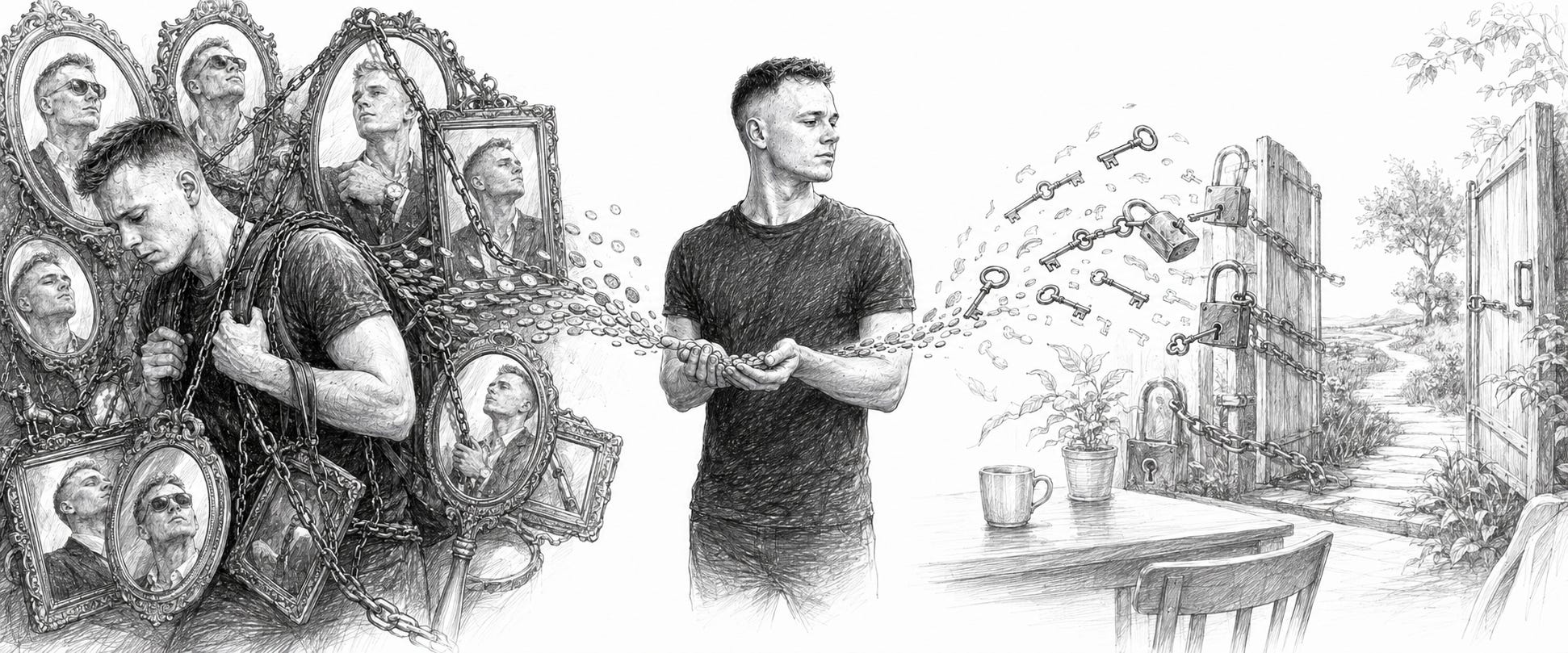
Mirrors must be carried, polished, defended, and checked on schedule, and every one you acquire adds weight to a life that was supposed to be getting lighter.
Keys open doors, and the quiet grace of a key is that you walk through and forget it ever existed. It asks for no maintenance and gathers no audience, just one more room of your life unlocked and aired out.
The hunt now becomes acquiring keys, so you can walk through doors, and one ordinary morning you’ll notice that all of life’s worries have gone silent in a way no purchase ever announced, and that silence my friend, the one you can finally hear your own life inside of, that’s the thing you were meant to acquire.
– Pascal
Things I work on outside this, in case any of them are useful:
@iampascio on Twitter, my profile where I post my experiments and numbers
@xgrowthpascal on Twitter, where I’m going from 0 to 10k followers in 3 months
@creatorpascal on Twitter, my personal brand where I share essays just like this one (currently doing 30 essays in 30 days. This is day 22).
Great article. People vastly overestimate how much they really need to feel free.
This was great. I’ve said for a long time that more than “stuff,” money buys freedom. I never really thought about it buying escape from worry, but that’s very true.