

My country pays $1,000/m to attend University
I still didn't go and here's the reason why.

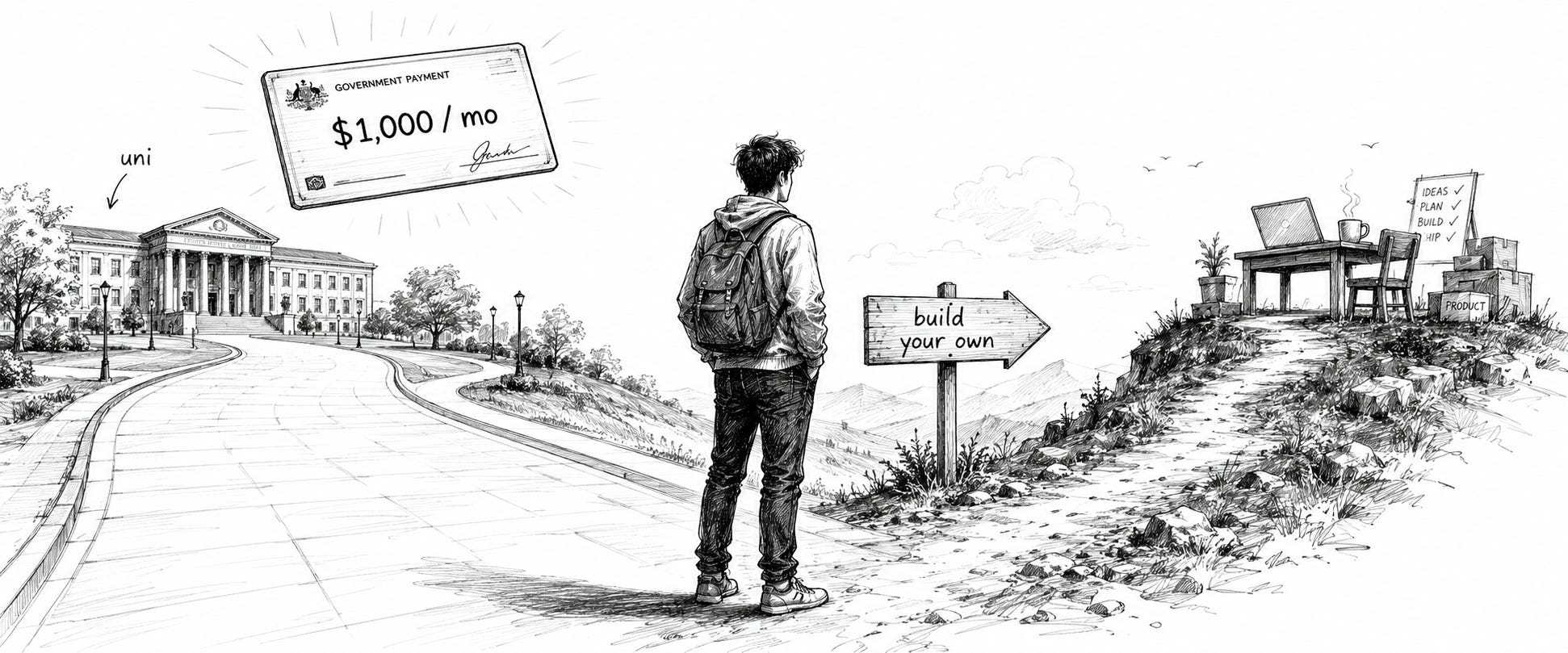
I’ve had this conversation maybe a hundred times now.
Someone asks me where I’m from. I say Denmark. They ask more questions about it. Somewhere in the conversation, I end up sharing that the Danish government pays university students roughly $1,000 a month to attend university, and that I turned it down. The reaction is so consistent at this point that I can almost mouth the words before they say them.
“Wait. They pay you? To go to school? Really? Nahhhh bro”
Yes. They pay you to go to school.
It’s called SU.
Statens Uddannelsesstøtte, if you want to be technical about it, which translates direclty to “the state’s educational support.”
Every Danish citizen who enrolls in a higher education program gets a monthly check from the government, no strings attached, no repayment required, no GPA cutoff that would make any reasonable person sweat. You just show up. You’re enrolled. And the money then lands in your account on the last business day of the month, the same way the sun lands on Copenhagen in July, which is to say reluctantly but reliably.
Not only that, but the tuition is also free. So is the healthcare. And more or less, so is the safety net underneath all of it. You can fall pretty hard in Denmark before anything actually breaks.
When I describe this to my buddies in the U.S., they look at me like I’ve just told them about a country where money grows out of the trees and the trees apologize for not producing more. From the outside, it sounds like a cheat code at first. But there’s more to it.
First, here’s why I personally didn’t take it.
And it’s not some sort of “I rebelled against the system” thing. And neither is it in this Dubai-bro type of way where I pretend Denmark is a dystopia and freedom only exists in places with no income tax. I love Denmark. I’d recommend living there to almost anyone.
The problem is what happens to a young person when the path of least resistance is also the path that pays.
Stick with me on this one.
A guaranteed monthly check is a contract you sign with a future version of yourself
Whatever is given for nothing is sold to you for your soul.
– Carl Jung (paraphrased)
Most people, when they hear about SU, react to the dollar amount. They either think it’s generous or they think it’s wasteful. Both reactions are missing the actual mechanism behind it.
The dollar amount is incidental. What truly matters is the agreement you’re entering into when you accept it.
Because that’s what SU really is. It’s a contract. You agree, implicitly, to spend the next three to five years of your life inside a specific kind of structure. You agree to wake up to a calendar somebody else built for you. You agree to be evaluated by a metric somebody else chose. You agree, most importantly, to receive a monthly amount of money that arrives whether you produced anything that month or not.
That last part is the one that quietly does the damage.
Money, when you boil it all the way down, is a feedback signal. It’s the world’s way of telling you whether what you just did was useful to other people. Earning money teaches you something specific about reality. Receiving money teaches you something else, something almost the opposite, and the lesson is being installed at the cellular level of your psyche during the exact years when your identity is hardening into its adult shape.
There’s a moment in your early twenties where the foundation gets poured.
Whatever beliefs are sitting in your head about money, work, value, and your relationship to all three, those beliefs are about to set into concrete. You can chip away at them later. Plenty of people do. But it’s a hell of a lot harder than getting them right the first time.
I watched what SU did to people I cared about, and I started to suspect that the foundation it was pouring inside them wasn’t the one I wanted poured inside me.
This isn’t a moral judgment of the people who took it at all, but rather a structural observation about what guaranteed money does to a young nervous system that hasn’t yet learned how to make its own.
Let’s go deeper.
The hidden cost of a wide, paved, well-lit path
Picture the Danish university experience for a second.
You’re 19, maybe 20. Your friends are all enrolled because that’s just what you do. Your parents, who are kind and supportive and entirely well-meaning, are gently pleased that you’re following the script. The state is depositing money into your account every month. The university is free. Your apartment, if you’re in Copenhagen, is subsidized through some opaque cooperative housing arrangement.
You are, on paper, in a paradise.
But there’s one small problem with paradise...
It doesn’t actually require anything of you.
This is the part nobody likes to talk about, because it sounds ungrateful. But the unfortunate truth is that environments without resistance produce people without spine.
When the path is wide, paved, and well-lit, you don’t develop the particular kind of muscle that gets developed by walking down a path that’s narrow, unpaved, dark and scary at its core. The first kind of walk is more pleasant. The second kind of walk is the one that actually changes who you are.
I’m not one of those people who thinks suffering is some kind of noble teacher and that everyone needs to grind through poverty to become real. That whole worldview is exhausting and mostly wrong, I agree.
But there is a specific kind of formative friction that happens when a young person has to figure out, for themselves, how to produce value that the world is willing to pay for. That friction is irreplaceable. You can’t manufacture it later, buy a course on it or fake it by taking on a “challenge” that has a built-in safety net. The friction has to be real, and it has to happen during the years when your identity is still soft enough to take its imprint.
The wide paved path doesn’t offer this friction. It can’t. That’s the whole reason it’s wide and paved.
So you graduate from the wide paved path five years later, and you’re a slightly older version of who you were at 19, except now you have a degree and an opinion about Foucault and absolutely no idea how to make money appear in the world without an institution telling you how to do it.
That’s the hidden trade-off.
That’s what SU is asking you to sign up for.
The check is very real indeed... but the check isn’t free.
The check is paid for by the version of yourself that never got built.
Why I chose not to go at all
I knew, somewhere underneath the noise, that if I enrolled I would never leave the system.
I’d watched enough people get pulled into the system to understand that the system has a kind of gravitational field, and the field is strong, and once you’re inside it the easiest possible action is the one that keeps you inside it for one more month, then one more semester, then one more year, until five years have evaporated and you’re sitting in a graduation gown wondering when, exactly, you stopped feeling like a person who had any sort of fire in him.
So I didn’t enroll.
I’d love to tell you this was a clean, confident decision. It wasn’t. I was 20, terrified, working a sales job I hated, watching everyone I knew start their “real life” while I sat alone in my apartment trying to convince myself that what I was doing was real life too. Nobody around me was doing what I was doing. My parents were patient but worried. My friends were politely confused. The cultural pressure to enroll was something I felt physically, in my chest, on bad days.
What I had instead of a plan was a hunch.
The hunch was that there was something I could build with my hands and my brain and an internet connection that would, eventually, replace whatever that government check would have been.
The hunch was right, but it took longer than I would have liked.
I started posting tweets. I made my first hundred dollars on the internet. I made my first thousand a few months after that. The numbers were laughable next to what SU would have paid me, but the numbers weren’t the point.
The point was that the money I was making was a different kind of money.
It was money that taught me something. Each dollar was the world tapping me on the shoulder and saying, “yes, this thing you just did, this is something other humans value, do more of this.” I had never received that feedback in my life. School had given me grades, which are a fake signal designed to make institutions feel useful.
The internet was giving me a real one.
So, I kept going. Kept following the signal. And by the time my friends were finishing their degrees, I was running the early version of the thing I run now, which I’d describe as a quiet one-person business that pays for my life and doesn’t ask me to be anywhere I don’t want to be.
That’s the part I want to talk about next.
What the solo empire actually is, and I believe everyone should build one
There’s this phrase I came up with to describe my business. A “solo empire.” It accurately describes what I do, but it also gets misunderstood, so let me clarify what I actually mean by it.
A solo empire is a small, tightly designed system that one person can run, which produces enough income to make money a non-issue, and that doesn’t require the operator to sacrifice their life to keep it running.
Mine is built out of a few things stacked on top of each other:
A body of writing that has been compounding for years. A steady accumulation of work that I’ve put into the world, week after week, that has slowly attracted an audience of people who actually pay attention to what I say.
A short list of products I’ve made for that audience. They solve specific problems and they don’t require me to be on a sales call to sell them. They run while I sleep, eat, travel, or stare at the ocean for two hours.
A skill set I trust. I can write. I can build offers. I can talk to humans through a screen in a way that makes them feel like a real person is on the other end. These skills are mine. Nobody can fire me from them. They survive any platform change, any economic downturn, any version of the future that arrives.
A daily rhythm I designed myself. I work when I work well. I rest when I’m done. I don’t have a manager. I don’t have a team meeting at 9 a.m. I don’t have a calendar full of other people’s priorities. The day belongs to me.
Notice what’s not on this list.
A degree isn’t on the here. A credential isn’t on it. A government check isn’t on it. A boss isn’t on it. A safety net provided by a third party isn’t on it either. None of the things SU was offering me are on the list, because none of them turned out to be the things that actually make this kind of life work.
What makes it work is the operating system underneath the surface. It’s the part of me that learned, slowly and through a lot of failure, that I could produce value in the world and that the world would pay me for it.
That operating system is the only real asset I have. The income, the audience, the products, all of those are downstream of it. If I lost everything tomorrow and had to start again with nothing, I’d rebuild within a couple of years, because the operating system is the part that wasn’t built on top of someone else’s foundation. It’s the foundation itself.
This is the inheritance I gave myself by not taking the one I was offered.
If you’re standing at the same fork I was standing at
I’m not going to tell you what to do here. Your situation isn’t mine. Neither is your country, your family or the shape of your fear.
But if you’re somewhere between 18 and 25 right now, and you’re staring at a version of the wide, paved, well-lit path, whether it’s SU in Denmark or a comfortable corporate job in the U.S. or a parent who’s offered to pay your rent for the foreseeable future, I want you to do something with the rest of this article.
Don’t make a decision today. Decisions made in the heat of reading something on the internet are usually bad. But sit with these questions. For a week. Maybe a month. Let them work on you.
Here are the questions:
If the support I’m being offered didn’t exist, what would I do? Don’t move on until you have an answer that feels real. The version of you that emerges in the answer to that question is the version you should probably be paying more attention to.
Is the path I’m about to walk down one I chose, or is it the path that was just sitting there waiting for me? These two paths can look identical from the inside, but they are not identical.
What would I want my 35-year-old self to thank me for? The 22-year-old version of you is making a decision right now that the 35-year-old version of you is going to live with. Treat that older person like a real person whose life you’re about to shape.
What’s one small thing I could start producing this week that would be entirely mine? Something small, embarrassing, real. A piece of writing. A video. A small product. The point isn’t the money, but the signal you’re sending to your own nervous system that you’re someone who creates, not someone who waits.
Am I afraid of the harder path because it’s actually wrong for me, or am I afraid of it because I’ve never been taught how to walk one? This is the question almost nobody asks themselves, and it’s the one that matters most.
If you answer those questions honestly and you still want to take the SU, take it. Use it well. Build something real inside the structure. There are people who do that, and they’re admirable.
But if you answer them honestly and you feel a small hot thing in your chest that won’t quite shut up, pay attention to that thing. That thing is the part of you that knows.
Build your own
Here’s where I’ll land.
The Danish state offered me $1,000 a month. I declined, and I built my own version of $1,000 a month, and then I built the version after that, and the version after that, and I kept going until the original number stopped being a meaningful frame of reference.
The dollar amount of the offer never mattered. What mattered was who I would become in the process of generating it for myself versus who I would become in the process of receiving it from somebody else. Those were two different humans, and only one of them was the human I actually wanted to be.
I think this is the lesson, if there is a lesson, of everything I’ve written above.
Whatever support is being offered to you, whatever wide paved path is sitting there with the lights on and the welcome mat out, run the math on who you’re going to become if you walk it. The identity math. Because the financial math is going to look like a no-brainer, and the identity math is the only math that actually matters in the long run.
Build your own thing.
Make it small at first.
Make it embarrassing.
Make it ugly.
Just make sure it’s yours.
The day comes, eventually, when you look at the thing you’ve built and you realize that nobody handed you any of it. That feeling is worth more than any amount of guaranteed monthly income any government on earth has ever offered.
I’d take it over the SU every single time.
– Pascal
Things I work on outside this, in case any of them are useful:
@iampascio on Twitter, my profile where I post my experiments and numbers
@xgrowthpascal on Twitter, where I’m going from 0 to 10k followers in 3 months
@creatorpascal on Twitter, my personal brand where I share essays just like this one (currently doing 30 essays in 30 days. This is day 15).