

The Anti-Guru Bet
And why this bet is the reason I’m writing 30 essays in 30 days (the answer isn’t what you think)

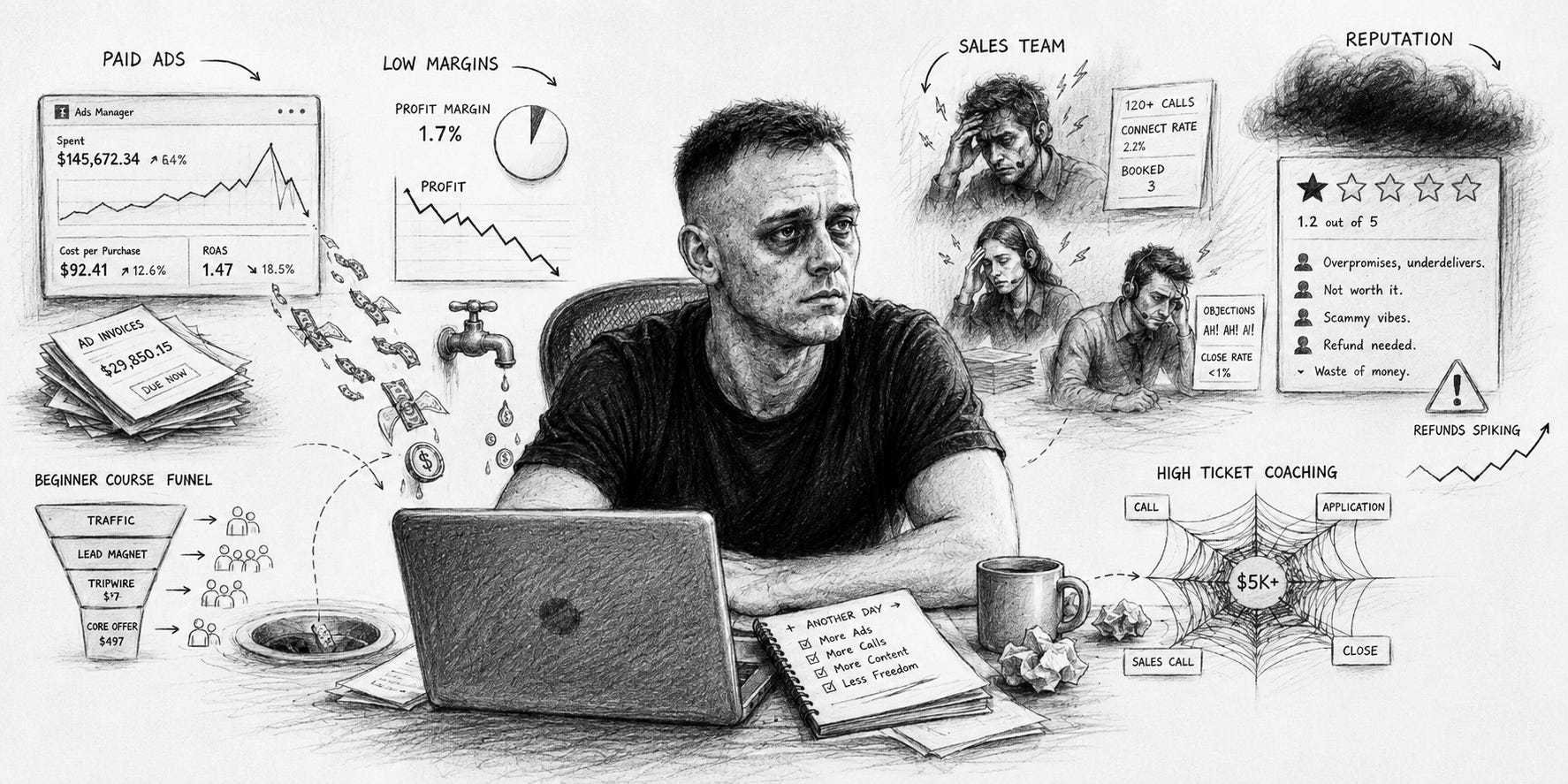
I used to believe the fastest way to build a name for yourself was to prove you’d already won.
Move to a flashy city, post the view from your apartment, build a course teaching people how to replicate the outcome you’re still figuring out yourself. The formula worked. Perfectly. And that’s what bothered me most about it. It worked because the internet runs on aspiration, and aspiration is the easiest emotion to package into a product. You find someone who is where you were eighteen months ago, you reverse-engineer the gap between their current life and the photo you just posted, and you sell the bridge.
I did this.
I moved to Dubai after succeeding with my Notion template business. I used the skyline as a backdrop for my Instagram reels. I launched a course for beginners who wanted to build an online income. And here’s the part I don’t hear enough creators say out loud: it sold well, and yet, I still didn’t go all in on it because something about the transaction left me hollow, and I couldn’t explain why for almost two years.
A friend asked me yesterday what the end goal of this 30-article challenge really is. The deeper play. He understands me well enough to know that I always have a plan for what I’m doing. So... what’s the strategic outcome of publishing a long-form article every day for a month on an account that could just as easily post “10 tools to make money” and grow faster?
The honest answer landed in my chest before it reached my mouth:
I want to be known for how I think.
That sentence is going to sound egotistical to some people and embarrassingly simple to others. But if you sit with it long enough, you’ll realize it’s a fundamentally different ambition than anything the creator economy usually rewards and it changes every downstream decision about what you build, who you serve, and what you refuse to sell.
Let me explain.
The “guru model” is a trap disguised as a business model
“The worst thing that can happen to a man who already has a pseudoself is to be given more money.” — James Baldwin
There is a well-worn playbook in the creator economy, and you’ve seen it a thousand times even if you’ve never named it. Someone gets a result: loses 30 pounds, makes their first $5K online, lands a remote job, whatever it is and within six months they’re selling a course on how to get that same result.
The economics look clean on paper:
You document your journey publicly
You attract people who want the same outcome
You package the process into a product
You sell the product to the audience you’ve already built
That’s four steps. A child could draw this funnel on a napkin. And the reason it dominates the internet is because it genuinely works at scale. There will always be more people at step zero than at step four, which means there will always be demand for the bridge.
But here’s the part that nobody tells you until you’re already deep inside this type of machine: the “guru model” traps you in the version of yourself that made the sale.
The moment your income depends on you being “the person who figured out X,” your identity calcifies around that single insight. You can’t evolve publicly without threatening your revenue and you can’t admit that you’ve changed your mind about the thing you teach because your customers bought certainty, and uncertainty is a refund request. So you stay frozen in time, locked in the same place for years and years. You keep posting the same frameworks, the same “here’s how I did it” threads, the same testimonial screenshots. You become a performer playing a character based on someone you used to be.
I know this because I lived it.
The Dubai version of me was real, but it was also a snapshot. One frame from a film that kept rolling. And the business I built around that snapshot meant I had a financial incentive to never update the picture.
Working with beginners taught me something I didn’t want to learn
“You can lead a horse to water, but you cannot make him drink.” — English proverb (that every course creator learns the hard way)
Let me be direct about something that might make me sound like a terrible person: I stopped enjoying working with beginners.
I need you to understand the specific texture of this. It wasn’t that beginners were lazy or bad people. Most of them were genuinely motivated. They’d paid money, they showed up to calls, they asked good questions.
The problem was... structural.
Out of every 100 people I gave a step-by-step system to (the same system that had worked for me, broken down into the simplest possible actions), maybe one person would actually execute it to completion simply because the gap between knowing what to do and reorganizing your identity around doing it is an abyss that no course can cross for you.
And what I realized, sitting on the other side of dozens of coaching calls, was that the transformation I was selling wasn’t something I could deliver. I could deliver information. Frameworks. Encouragement and support. But the actual shift, that moment where someone stops being a person who wants to build something and starts being a person who is building something, well... that’s an inside job, and no price point purchases it.
And before you come at me with the whole “but your product just sucked then!”, let me be absolutely clear: the 1-in-100 success rate wasn’t a failure of my product, but rather the base rate of human change when the stakes are real and the comfort zone is warm.
And once I saw that number clearly, I couldn’t unsee it.
The work started to feel like I was standing at the bottom of a mountain, handing out maps to people who hadn’t yet decided whether they actually wanted to climb. And the few who had already decided? They didn’t need my map. They would have figured out the route themselves. They always do.
The conversations that actually changed me happened at the top, not the bottom
Here’s where the shift started.
Every time I sat down with another entrepreneur, someone who was already running a business, already shipping products, already dealing with the real operational and psychological complexity of building something from nothing, the conversation was... electric. In the way that makes you pull out your phone and type three notes to yourself before the coffee gets cold.
These conversations were different from coaching calls in a way I couldn’t initially articulate. It took me months to find the word: parity.
When you’re coaching beginners, the knowledge transfer is vertical. You’re above, they’re below, and you’re handing things down. It’s inherently hierarchical, and that hierarchy flattens the conversation into a Q&A. They ask how. You answer how. Repeat.
When you’re talking with someone at your level (or frankly, above your level), the transfer is horizontal. You’re trading observations and you’re both looking at the same mountain from slightly different angles. The value isn’t in the answer but in the angle.
I started noticing that the ideas I was most proud of, the frameworks I found most original, the observations about business and identity and leverage that people told me were genuinely different from anything they’d heard before, those ideas never emerged from coaching calls. They emerged from peer conversations. From friction between two people who both know enough to disagree productively.
And I thought: if the best version of my thinking only shows up when I’m in dialogue with people who challenge me, why am I spending 90% of my time in rooms where nobody can challenge me? Why am I building a business that structurally prevents the very conversations that make me better?
“You think about things differently” is the most undervalued compliment in business
Over the years, across dozens of relationships, clients, peers, internet strangers who became real friends, one piece of feedback has shown up more consistently than any other: you think about things differently Pascal.
For a long time, I treated this as a nice thing people said. The way you’d tell a friend their outfit looks good. Surface-level and forgettable.
But when I started actually tracking where my leverage, where my energy was highest, where the work felt least like work, where people kept coming back... it almost always traced back to the same root: the way I process and articulate my ideas and mental models.
And I’m not talking about my specific tactics, or systems, or “7-step framework to grow your X account” (though I can do that too). No, the things that were genuinely mine, the things that I could offer that nobody else could replicate. That became my lens.
The creator economy has a hierarchy problem that nobody talks about honestly. At the bottom, you compete on information. At the middle, you compete on systems. At the top (the only level where you can’t be replaced by someone with a better thumbnail) you compete on how you see the world.
The reason most creators never reach that level is because it requires something the guru model actively discourages: you have to be willing to share ideas that don’t have a clear “how-to” attached. Ideas that make people think rather than act. Ideas that might not sell a course, but that change how someone frames their entire business and maybe even life.
That’s what this 30-article experiment is really about. I’m trying to get on record with my actual thinking. The stuff that comes out in conversations with people I respect, the stuff that lives in my notes app at 2am and the stuff I’ve been hoarding because it didn’t fit neatly into a tweet format or a course module.
The anti-guru bet means trading authority for intellectual honesty
“The only way to be truly satisfied is to do what you believe is great work, and the only way to do great work is to love what you do.” — Steve Jobs
There’s a version of my career where I lean fully into the guru model. I scale the beginner course, build the funnel, hire a sales team and post revenue screenshots to attract more beginners into my “high ticket coaching” spiderweb. I simply become “the guy who teaches you how to build an online business from scratch.” But the thing is this... I’ve seen that movie a hundred times, and I know exactly how it plays out. It’s solid income, a growing audience, and yet, a slow deadening behind the eyes that you can see in the later videos if you know what to look for.
The anti-guru bet is different, and I want to be transparent about why it’s a bet and not a guaranteed strategy.
The bet is this: if I spend 30 days publishing the deepest, most honest, most intellectually ambitious writing I’m capable of (not how-to guides, beginner tutorials or “10 steps to your first $1K”), but the actual ideas I carry around in my head about identity, leverage, business, content, ambition, and what it means to build something real
... then the right people will find me.
And I don’t need 100,000 people to become readers... I just need the right people, whether that is 10, 100 or 1,000. Other business owners and other creators who are already past the starting line. People who don’t need a map but who want a thinking partner. People who read something I wrote and think, “I’ve never heard anyone frame it that way before, but holy f*ck is this true!”
The trade-off of doing so is very real. I’m giving up the scalable guru income for something that doesn’t have a clean revenue model attached to it today.
But I want to be precise about why that doesn’t mean there’s no model.
Here’s what I know about myself after years of building my solo empire: the conversations that light me up, the rooms that make me sharper and the work that doesn’t drain me, all of it happens when I’m sitting across from someone who’s already built something and is trying to figure out the next layer. Another business owner staring at a positioning problem they can feel but can’t articulate. A creator who’s outgrown their original offer and knows the next move is strategic and not tactical. Someone who doesn’t need a playbook, but a thinking partner who sees the board differently.
That’s the offer I want to build later down the line.
A high-ticket consulting for business owners who already have traction and want to work through their product strategy, content strategy, positioning, and their leverage architecture with someone who brings a lens they haven’t encountered before. One-to-one or small group. To be decided. All I know is that I don’t want it to be a community with 4,000 members and a Slack channel nobody reads. No, it’ll be a real working relationship where the value comes from how I think, applied directly to their specific situation.
But, and this is the part most people get backwards, you can’t sell “how I think” as a service until people have experienced how you think as a body of work. Nobody hires a strategist because of a landing page. They hire a strategist because they read something that person wrote six months ago and it rearranged a belief they’d been carrying unchallenged for years.
The writing of an intellectual footprint comes first. The offer is downstream.
So these 30 articles are the foundation for every high-level relationship and opportunity I want to build over the next five to ten years. This is my legacy play that’s tied to my full legal name (and not a cartoon character).
The primary goal right now is intellectual positioning, which means going on record with the ideas that will make someone, eighteen months from now, send me a message that starts with “I’ve been reading your stuff for a while and I think you’d be the right person to help me with...”
I want my name attached to ideas and not more information, or hacks, or tips, or tricks, or “get rich quick” type stuff.
That’s a sentence I would have been afraid to say two years ago, because it sounds like something a person says when they can’t sell anything.
But I’ve sold plenty. I’ve built the funnels. I’ve run the launches. I’ve done the damn thing. And I’m telling you, from one business owner to another, the thing isn’t the point.
Why this matters for you (even if you never write a single essay yourself)
I owe you an outcome, because I refuse to write 2,000 words about my own journey without making it useful for yours.
The principle underneath everything I’ve just described is one that applies to every creator, every entrepreneur, every person building something in public: the work that builds your reputation should come from the same place as the work that energizes you, and if those two things are misaligned, no amount of revenue will fix the drift.
Let me make this concrete:
If you’re teaching something you no longer find interesting, you’re building a prison. The income feels good until you realize that your audience expects you to keep being excited about a topic you outgrew eighteen months ago. This is how creators burn out. From performing enthusiasm for something they’ve already moved past.
If your best thinking only comes out in private conversations, you have a distribution problem. Most smart people are undervalued because they reserve their sharpest observations for dinner tables and group chats. The 30-article experiment is my attempt to fix this for myself and to take the stuff I’d normally only say to three friends and say it to the internet.
If the people you most want to work with are already successful, your marketing should target their intellectual curiosity, not their pain points. Beginners buy solutions to problems. Experienced operators buy perspectives that reframe problems they didn’t know they had. The content you need to create for the second audience looks completely different from the content you’d create for the first.
If people keep telling you that you “think differently,” that’s a powerful signal, so treat it like one. Unique thinking is the last defensible moat in a world where AI can generate tactics and tutorials in seconds. The way you see things? That’s yours. Build around it before you build around anything else.
The real experiment: becoming the person whose ideas precede them
This challenge isn’t really about the 30 articles themselves. It’s a mechanism to launch my newsletter Becoming, and the 30-day frame is a constraint, the way a sonnet’s 14 lines are a constraint. It’s simply there to force compression, urgency, and honesty. You can’t be precious about your ideas when you need to ship one every 24 hours. There is no waiting until the framework is perfect or hiding behind “I’m still working on it.”
The deeper experiment is identity-level.
I’m trying to answer a question that most creators avoid because the answer might require them to dismantle something profitable: what would I build if I optimized for intellectual respect instead of revenue?
And the answer, so far, is this: I’d write. I’d write a lot. I’d put my actual thinking into the world. And with thinking, I do not mean the dumbed-down, beginner-friendly, algorithmically optimized version of it, but the real thing. Dense. Long. Philosophical. Sometimes uncomfortable. But always honest.
Because the end state I’m chasing is this: someone hears my name and their first association is, “Uuuh! It’s that guy who thinks about things in a way that changed how I think about things.”
Everything else, the consulting, the offers, the partnerships, is downstream of that. And downstream is the right direction to build from when you know, in your gut, that the source is the thing worth protecting.
If you’re reading this and something in your chest tightened... if you recognized the misalignment I described, the feeling of building a business around a version of yourself you’ve already outgrown, well then the challenge I’d leave you with is simple:
Figure out what you’d say to the world if the goal wasn’t to sell, but to be understood.
Then start saying that.
– Pascal
Things I work on outside this newsletter, in case any of them are useful:
@iampascio on Twitter, my profile where I post my experiments and numbers
@creatorpascal on Twitter, my personal brand where I share daily notes and ideas
@xgrowthpascal on Twitter, where I’m going from 0 to 10k followers in 3 months
Beautifully put, every word. I’ve never been interested in being the next internet guru, but I do want to be known as a great storyteller. Everything you said in this article struck a chord with me and I felt it deep within me, stoking a fire that’s been dwindling for too long (this and the previous article in the series). In both cases I looked at them through the lens of a storyteller and saw immense power in your words. 👏👏👏