

The Art Of Being Bored
The ability to be bored on purpose is the most underrated skill of the next decade

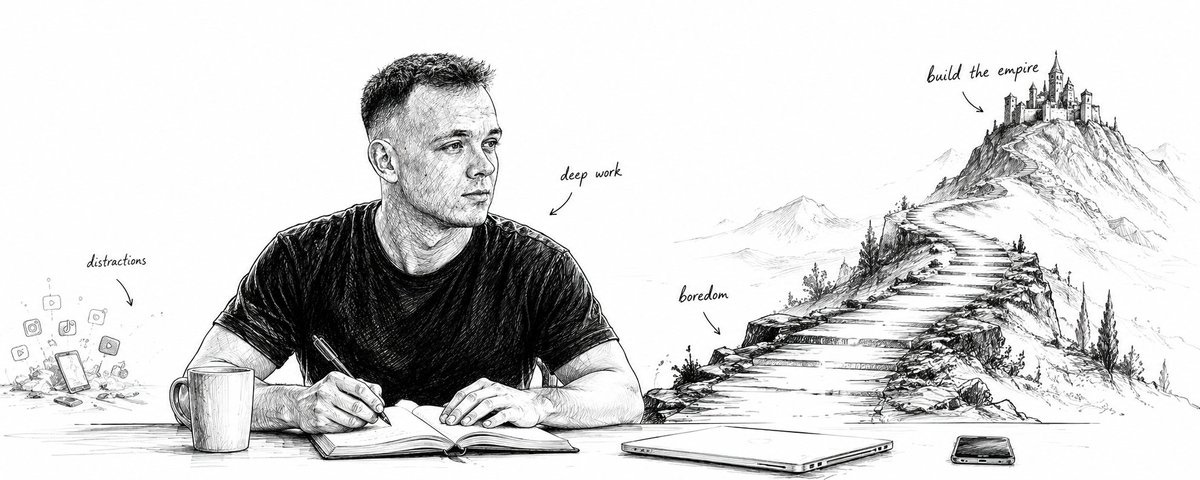
The only question is whether you’re willing to reframe it from a problem into a privilege.
Today everyone wants the empire, but almost nobody wants to suffer through the boredom that builds it in the first place and that’s the entire reason why less than 1% of the world’s population are not successful entrepreneurs.
We’ve been sold a version of success where the work itself is supposed to feel exciting, where every day is a flow state, where the lifestyle photos and the bottom line are somehow produced by the same activity. They aren’t. They’re produced by opposite activities, and confusing the two is the single biggest reason people who say they want to build something never actually do.
I’ve spent more years than I’d like to admit running from the boring parts of my own work. The unfortunate reality is that almost every meaningful piece of progress I’ve ever made sits on the other side of a long, dull, almost insulting stretch of doing nothing but the actual work.
So this letter is about that stretch. About why the people quietly building empires look almost monastic from the outside, while the people who seem to be winning are usually losing in slow motion.
Five ideas. Take notes if you’re the kind of person who takes notes.
Otherwise, just stick with me.
Boring people build empires while exciting people post Instagram stories
“The mass of men lead lives of quiet desperation.”
– Henry David Thoreau
Look at the people whose lives you actually want.
And no, I don’t mean the influencer personalities who go viral every other week with a new outfit, a new opinion or a new outrage. The ones whose work you respect. The ones who, if you’re being honest, you’d trade lives with in a heartbeat.
Almost without exception, their day-to-day is made up of boring actions.
They wake up at the same time, do the same focused work, eat similar meals, train, read, write and build. To an outside observer scrolling past, their life would look monastic, repetitive in a way that borders on dull.
Now look at the lives of the “exciting” people. The ones whose stories you watch out of habit. The ones with constant motion, constant novelty, constant content. Their feed is a blur of cocktails, plane wings, dance floors, and “you won’t believe what happened today” hooks.
Their actual life (their net worth, their work, their relationships, their body, their mental state) is almost always quietly falling apart underneath all that motion.
This is not a coincidence.
Excitement is the surface and boredom is the foundation. People who optimize for the surface end up with a rotting foundation, which is why the most exciting feed you follow probably belongs to someone whose actual life you would never want.
The trajectory of a person is not built in those moments of stimulation, but rather in the long, unglamorous stretches between them. The hours that nobody films, because there’s nothing to film.
That’s the thing I want you to sit with before we go any deeper here.
Boredom is the price of admission for anything that matters in the world
“All of humanity’s problems stem from man’s inability to sit quietly in a room alone.” – Blaise Pascal
Here’s how a person ends up where they want to be:
They identify the work that actually moves the needle.
They strip away everything that isn’t that work.
They sit with that work, alone, for long stretches, while their nervous system screams at them to do literally anything else.
They keep sitting with it until their nervous system gives up and the work becomes the path of least resistance.
They repeat this process for years.
That’s it. That’s the secret hack.
If this sounds boring, it’s because it is. And if you’re quietly hoping there’s a more interesting version somewhere, a version with more variety, more dopamine, more “creative” days where you’re “in flow,” I’d gently suggest you’re describing a hobby and a personality over an actual business.
The truth is that everything you say you want, the freedom, the wealth, the body, the depth of skill, sits on the other side of a wall of pure, uncomfortable, unstimulating focus. The wall isn’t tall, it’s just... long. And most people, when they walk up to it, immediately turn around and go look for a shorter wall (which doesn’t exist).
This may sound simple, but it’s the single most overlooked insight:
The people you envy are simply more comfortable being bored than you are.
Picture somebody successful in your field specifically.
A writer, a founder, an athlete, whoever you want. If you could watch a hidden camera of their last working day, you would not see what your imagination wants you to see. You wouldn’t see them brainstorming on a whiteboard with a beautiful soundtrack swelling in the background. You’d see them at a desk, in the same clothes they wore yesterday, doing one repetitive thing for an unreasonable number of hours, occasionally getting up to make coffee.
That’s what builds the empire.
To take it a layer deeper, your inability to be bored isn’t just a personality quirk either. It’s the results of years of conditioning. The lens of perception you bring to “an empty hour” was shaped by years of being told that an empty hour is a problem to be solved.
It isn’t. It’s the raw material your real life is made of.
Stimulation is the cheapest drug in the world, and you’ve been hooked since you could read
“The truly free individual is free only to the extent of his own self-mastery.” – Steven Pressfield
Most people don’t understand why they can’t focus.
They believe they’re lazy, think they’re broken or have this idea that there’s something specifically wrong with them, some chemical, some childhood, some ADHD diagnosis waiting in the wings, that explains why they can’t sit with a hard task for more than four minutes before reaching for their phone.
But none of that is the real reason. The truth is, you’ve just been training the opposite muscle for twenty, thirty or forty years.
Every time you reach for your phone in a quiet moment, you’re casting a vote. You’re telling your nervous system: “Boredom is a threat, and the correct response to it is stimulation.” Do that ten thousand times in a row, which, to be clear, you have, and you end up with a psyche that physically cannot tolerate a still moment without flinching.
It’s an operating system, and you installed it through habit.
Here’s what’s happening underneath the hood:
You feel a tiny pulse of boredom, a moment between tasks, a pause at a stoplight, a quiet stretch on the couch.
Your nervous system, conditioned to interpret that pulse as discomfort, releases a small spike of cortisol.
You reach for your phone. Not because you wanted to, but to make the pulse go away.
The phone delivers a hit of dopamine.
Your nervous system learns: “Boredom causes discomfort, and the phone is the cure.”
The next time boredom appears, the loop is faster. And tighter. And less conscious.
Multiply this across years and you’ve built what is essentially an internal forcefield against stillness. Anything that requires sustained focus, writing, training, deep thinking, building something real, feels physically intolerable, because all of those things start in the exact emotional state your nervous system has been trained to flee from.
I understood this early on and have tried to not carry my phone around with me all the time. I make it an effort to write and create before I open anything that could pull me sideways. I do not always enjoy this. But the version of me that can write an essay like this, run a solo business, and actually think a thought longer than 45 seconds is the version that built up a tolerance for the stillness underneath all of it.
The hack is to stop making boredom the enemy, but rather make it the gym.
The ability to be bored on purpose is the most underrated skill of the next decade
The first principle is that you must not fool yourself, and you are the easiest person to fool.– Richard Feynman
Pay attention to what’s about to happen over the next ten years.
The economy is splitting in two. On one side, a class of people who can be bored on purpose. People who can sit with a long-horizon problem, do focused work for hours at a time, and resist the gravitational pull of every novelty thrown at them. On the other side, a much, much larger class of people whose attention has been so fully colonized by short-form content that they will physically struggle to read a paragraph longer than this one.
I’ll let you guess which group ends up owning the assets.
The truth is that the entire modern economy is now built on extracting your attention and reselling it. Every app on your phone, every algorithm in your feed, every notification on your watch is built by people who are very, very good at making sure you never have to be bored ever again. And as long as you cooperate with that arrangement, you will be a customer of someone else’s empire instead of the architect of your own.
A person who cannot tolerate boredom cannot:
Read a long book.
Or write one for that matter
Sit with a hard problem long enough to find a non-obvious solution.
Train a skill past the awkward, ugly, “I’m bad at this” phase.
Stay in a relationship through the inevitable boring stretches.
Hold a strategy for longer than a quarter.
Build anything that compounds.
Notice that everything on that list is a thing that builds long-term wealth, in every sense of the word, financial, creative, relational, spiritual. Every one of them requires an internal muscle that almost nobody is training anymore.
This is the part where most people expect me to say something hopeful.
So here it is, in the only honest form I can give it: this is the best time in history to be a person who can be bored on purpose. Because the bar has never been lower, and the rewards have never been higher.
You are competing with the version of everyone whose attention has been hollowed out by a glowing rectangle. And if only you can outlast that version of them, which is honestly not that hard once you commit, the trajectory of your life starts to look very different from theirs.
The most boring version of you is the one quietly building everything you actually want
There’s a version of you that lives somewhere underneath the noise.
This version of you doesn’t have a content schedule. It doesn’t have an opinion about every news cycle. It isn’t refreshing anything. It isn’t waiting for something exciting to happen. It just sits down, every day, and works on the small set of things that compound into the life you actually want.
That version of you is not exciting.
That version of you would be, frankly, kind of boring to follow on social media. There’s not much to film. The day is repetitive. The wins are invisible from the outside. The only person who sees the trajectory clearly is you, and even you only see it in hindsight.
But that version of you is the one quietly building an empire. Everything that matters in your life over the next ten years will be built by the boring version of you, in unwitnessed hours, with nobody clapping.
The question isn’t whether boredom is uncomfortable. It is. The question is whether you’re willing to reframe it from a problem into a privilege. Into the rare, expensive, increasingly scarce state of mind that actually allows you to build something real.
Most people will not do this. They’ll keep filling every empty pocket of their day with a notification, a video, a tab, a snack, a scroll. They’ll keep telling themselves they’re going to “lock in” next month, next quarter, next year, right after this one last thing.
You will not be one of those people, because you’ve read this far, and the people who don’t have the muscle for this don’t read this far.
How to build the muscle of being bored
This is the protocol and it’s not complicated at all. It’s just uncomfortable as f*ck, which is the entire point in the first place.
1. Define the work that actually matters.
Most of what you call “work” is not the work. It’s email, admin, meetings, lurking, reacting, researching things you don’t need to research yet. The actual needle-moving work in any field is usually two or three specific actions. Find yours and write them down. If you can’t name them in one sentence each, you have a clarity problem dressed up as a focus problem.
2. Schedule a stretch of time where the only option is the work or nothing.
Most people fail at focus because they leave themselves an off-ramp. Phone in the room, too many tabs open and notifications on. The brain, faced with a hard task and an easy escape, will pick the easy escape every single time. Remove that escape and the brain will eventually, grudgingly, settle into the work.
3. Sit through the urge to leave.
Somewhere in the first twenty minutes of any focused session, you will feel an almost unbearable pull to do anything else. This is the moment. If you stand up, you’ve trained your nervous system that the discomfort wins. If you stay, you’ve trained it that the work wins. There is no third option, and there are no shortcuts. Every single person whose life you envy has sat through this moment thousands of times.
4. Reclaim your boredom in the small moments.
The empire is built in the in-between moments of focused sprints. The line at the coffee shop, the walk, the five minutes before the meeting, the elevator. Most people fill these with a phone. Stop filling them at all. Let the boredom sit there. Let your mind do what it was actually designed to do, which is wander, connect, think. Some of the best ideas you’ll ever have are on the other side of an unfilled five minutes.
5. Make boredom a feature of your identity instead of a bug
This is the reframe that holds the whole thing together. Stop apologizing for having a quiet life, stop feeling like you need to be more “interesting” and stop comparing your trajectory to people who optimize for the camera. The boring version of you is not the lesser version. The boring version of you is the version that wins.
A boring life is not a small life.
A boring life is just a life that has stopped paying rent to the attention economy and started building equity in itself.
The exciting people, the ones whose stories you watch out of habit, they’re paying rent. Every story, every reel, every reaction is rent paid to a system that gives them a few seconds of dopamine in exchange for the long-term trajectory of their life. They don’t see this, because the rent is invisible. They just feel, vaguely, that things aren’t working out the way they thought they would.
You see it now, which is the entire reason this article> exists.
The art of being bored is really the art of being so clear about what matters that everything else stops being a temptation. It’s the art of becoming the kind of person who can sit, alone, with a hard problem, for as long as it takes. Because you understand, all the way down to your bones, that this is the only state of mind in which anything real has ever been built.
Be the boring one.
Build the empire.
– Pascal
P.S.
Things I work on outside this, in case any of them are useful:
Follow me @xgrowthpascal where I’m documenting my journey from 0 to 10,000 followers in 90 days live and in public.Follow me
Follow me @iampascio where I share my build in public content, experiments and everything else I’m currently building or playing with
dropped a gem
https://substack.com/@atzyclink/note/p-200483378?r=45946r&utm_medium=ios&utm_source=notes-share-action
"The wins are invisible from the outside. The only person who sees the trajectory clearly is you - and even you only see it in hindsight." This is the most honest thing I've read about what building something real actually looks like. No clapping, no audience, no confirmation that it's working. Just you and the work and the quiet trust that it's compounding somewhere you can't yet see. Writing this down and keeping it close.