

The Art of Presentmaxxing
Don't listen to the dude telling you to "feel the sensation of fingernails".

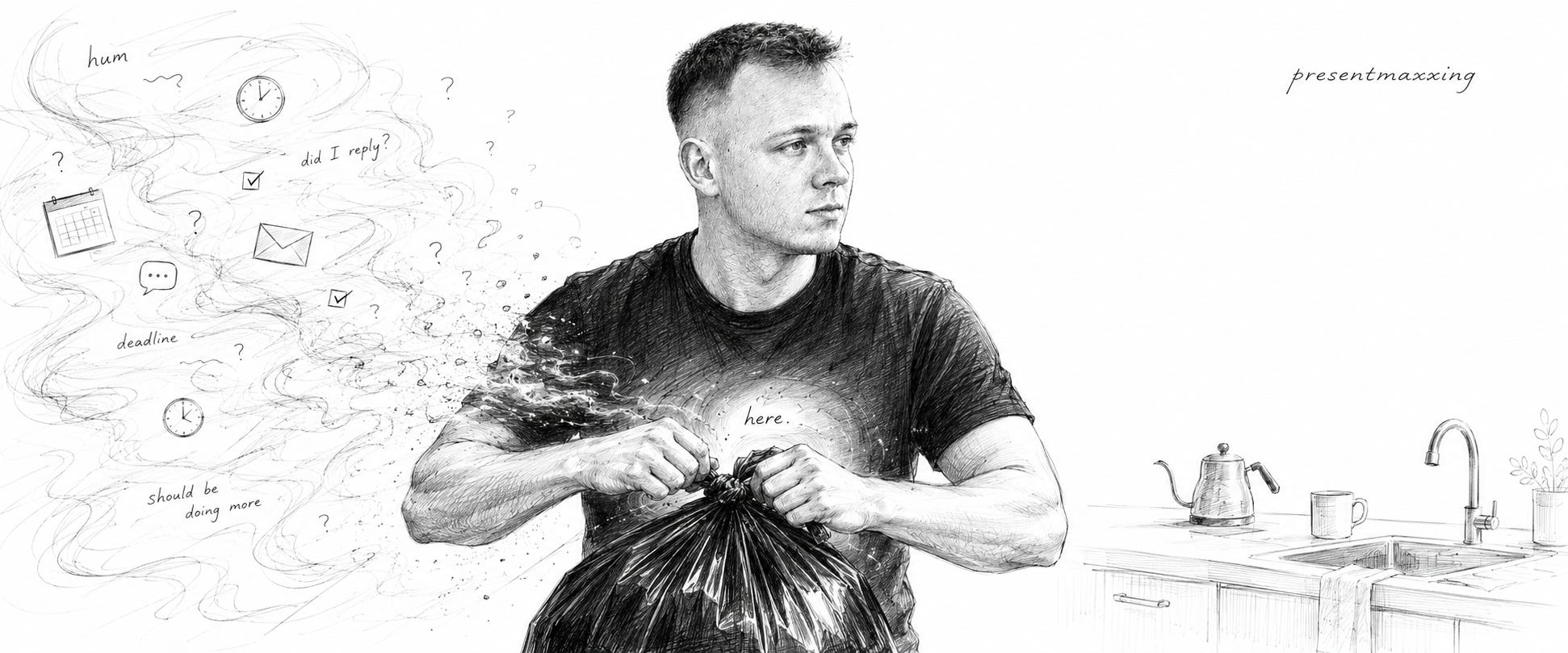
Nobody tells you that anxiety has a sound.
It’s this low, barely-there hum that sits underneath everything you do, like a refrigerator running in the next room. You stop noticing it after a while. You think it’s just... how things are. How you are. You wake up with it. You go to sleep with it. You carry it through your entire day and you never once think to ask: what is that annoying background noise, and where is it coming from?
I lived with that hum for years. Through routines, meditation practices, supplement stacks, journaling and the color-coded Notion systems that were supposed to organize my way into inner peace. Yet, the hum never stopped. It just got wallpapered over by powerful words like productivity, inner work, discipline and self development. The (very) comforting illusion that I was “working on myself”.
Then randomly one night I was tying a knot on a trash bag and the hum stopped for about three seconds.
Complete silence.
Those three seconds led me to something that has quietly restructured how I experience the experience of being alive. I know... very deep.
But hear me out.
It’s a mental model I’ve started calling presentmaxxing, and if you’re someone who does all the “right things” for your mental health but still feels like something is subtly, persistently off... this might be the thing you’re missing.
The twenty-minute lie
Let me preface the concept like this:
I used to have a regular meditation practice. And it’s the perfect example of how you can do something consistently for years and completely miss the point of it.
I would meditate every morning. Twenty minutes. Sat on the floor, crossed my legs, closed my eyes. I did body scans where a calm voice told me to “notice the sensations in your left foot” and I’d think “okay, I’m noticing my left foot” and then I’d immediately start thinking about whether I was noticing it correctly. I did breathwork sequences where I counted inhales and exhales and spent most of the session anxious about losing count.
As a true monk, I tracked my streaks. I logged my sessions. And I had a whole Notion template for it (because of course I did).
And yet, every morning the same thing happened. Twenty minutes of relative quiet. Then I’d open my eyes, pick up my phone, and within about a minute my brain was running the same loops it always ran. The thing I said wrong in a conversation three days ago. Whether that email I sent landed the way I intended. A project deadline that was two weeks away but somehow felt like it was breathing down my neck right now.
The meditation was a room I visited for twenty minutes.
Then I left the room and everything outside it was exactly as chaotic as before. Two years of this. Two full years of sitting on that floor every morning, convinced that if I just stayed consistent enough, the calm would eventually leak out into the rest of my day.
It never did.
And the reason it never did is something so simple that it almost made me angry when I finally understood it: I was treating presence like a task.
Something to do, complete, and move past. Another box to tick off on the tracker. I had turned the one practice that’s supposed to teach you how to be where you are into another thing I rushed through so I could get to the next thing on my schedule.
The meditation sessions weren’t failing because meditation doesn’t work. It does. It works very well if I am being honest. No, they were failing because I was meditating the same way I did everything else. On autopilot. Going through the motions. Performing the activity without absorbing what the activity was trying to teach me.
Tying the knot
So. The trash bag.
It was late, maybe 11PM on a random Thursday. I was taking the trash out because the bag was full and the kitchen smelled. I grabbed the bag, started twisting the top to tie it off, and something happened that I still can’t fully explain to this.
I felt the plastic.
I know, I know. A revelation, right? No, but hear me out here.
I felt the thin, cheap plastic twisting between my fingers and I noticed the resistance as the knot tightened. I heard the rustle of the bag shifting. And for a few seconds, maybe three, maybe five, the entire mental soundtrack playing in the background just... went silent.
I stood there in my kitchen holding a trash bag and for those few seconds I was more present than I’d ever been during two years of sitting on a meditation cushion with my eyes closed. There was no technique, no guided voice and no timer counting down. Just my hands on a bag and my brain, for once, in the same room as my body.
Then the thoughts came back and I walked the bag outside and threw it in the bin and went to bed. But I couldn’t stop thinking about those few seconds. Because something had happened in that tiny window that felt qualitatively different from anything my formal practice had ever produced.
It felt like what meditation was supposed to be, except it showed up uninvited while I was doing the most mundane thing imaginable.
I started paying attention after that. Paying attention to paying attention, if that makes sense. And I started noticing that these micro-windows of presence were available everywhere, all day long, in moments I’d been sleepwalking through for years.
Washing my hands. The temperature of the water. The slick friction of soap between my palms. The sound of the stream hitting the basin. Thirty seconds of full presence, right there, twelve times a day, and I’d been spending every single one of those thirty-second windows mentally rehearsing conversations that hadn’t happened yet.
Walking between rooms. The feeling of the floor under my feet. The shift in temperature between the hallway and the living room. The sound of my own footsteps. Ten seconds, maybe fifteen, dozens of times a day. All of them previously hijacked by mental noise.
Waiting for the kettle to boil. Opening a door. Putting on shoes. Chewing food without simultaneously watching a video and scrolling my phone and planning tomorrow’s workout. Each one a tiny gap in the day where presence was available if I just... took it.
None of these moments required any extra time. None of them required me to sit down, close my eyes, or add another block to my calendar. They were already in my day. They’d always been in my day.
I just hadn’t been in them.
The discovery that rewired everything
Here’s what started happening after about two weeks of me beginning to pay attention to paying attention, and I want to be very specific here because those vague “I felt more zen” descriptions are useless.
The lag started shrinking. That’s the best way I can describe it. There’s a delay between the moment your mind wanders and the moment you realize it has wandered. For most people, that delay is enormous. You can spend twenty, thirty, forty minutes lost in a thought loop before something snaps you out of it. A notification. Someone talking to you. The realization that you’ve been staring at the same paragraph for ten minutes without reading a word.
When I started treating mundane moments as presence reps, that delay started getting shorter. I wasn’t trying to necessarily “control” my thoughts (trying to control your thoughts is just another form of anxiety, and I’d already tried that approach for two years with spectacular non-results).
The delay shortened because I was building a pattern of noticing.
A hundred times a day, I’d catch my attention somewhere other than where my body was, and I’d bring it back to sensation. The temperature of something. The texture of something. The sound of something in the room I was actually standing in.
And after enough reps, the noticing started happening faster. The gap between “lost in a thought spiral” and “oh, I’m lost in a thought spiral” went from minutes to seconds. And every time I caught it, I’d just drop my attention to whatever my hands were touching or whatever my feet were standing on, and the spiral would break.
It literally felt like I had taken the same pill that guy from Limitless took.
Like superpowers.
And this is exactly what I mean by presentmaxxing.
Treating your entire day as a training ground for presence instead of isolating it into a twenty-minute session that has zero carryover into the other fifteen hours and forty minutes of your waking life. It’s taking every mundane, boring, forgettable moment and using it as a rep. And it compounds, quietly, until you realize one day that the background hum of anxiety has gotten noticeably quieter and you can’t pinpoint when it happened.
Which brings me to my second point.
Where “worry” actually lives
I want you to try something while you’re reading this.
Try to worry about something that’s happening right now. Right now, at this exact second, in the physical space you’re sitting in. The chair. The temperature. The sound of whatever’s around you. Try to find something to worry about in the raw sensory experience of this moment.
You can’t.
You can worry about what this moment means for your future.
You can worry about something that already happened. You can construct a scenario about next week that makes your chest tighten. But the present moment, the actual physical sensory reality of right now, is almost always completely fine. You’re sitting somewhere. Air is a certain temperature. Your body is doing what it does. There’s nothing in the raw “is-ness” of this second that contains worry. Worry requires you to mentally leave where you are and travel to a place that either already happened or hasn’t happened yet.
When I understood this (and I mean understood it experientially, in my body, through hundreds of trash-bag moments, and not just intellectually as a nice idea I read in a nice essay by a random dude I found online), the whole game changed. Because I realized that the anxiety I’d been carrying around for years wasn’t generated by my life. My life, in any given moment, was fine. The anxiety was generated by the stories my mind was telling about my life while my body sat in a perfectly safe room with a cup of coffee getting cold because I’d forgotten it was in my hand.
Every moment I spent lost in the future was a moment my nervous system was responding to threats that weren’t real. Every moment I spent replaying the past was a moment my body was re-experiencing stress that had already ended. And the only place where my nervous system could actually rest, the only state where the hum would go quiet, was the present. Which I was visiting for roughly ten minutes a day if you added it all up.
That math is insane when you actually stop and look at it. Ten minutes of presence in a sixteen-hour waking day. And I was wondering why I felt perpetually on edge.
The part about happiness that nobody really explains well
Harvard ran a study a few years back that tracked thousands of people throughout their day, pinging them at random intervals to ask three questions:
- What are you doing right now?
- What are you thinking about?
- How happy do you feel?
The finding that genuinely shook me: people who were doing an unpleasant task but fully present reported feeling happier than people who were doing a pleasant task but mentally somewhere else.
Sit with that for a second.
It means that washing dishes while actually washing dishes makes you happier than sitting on a beach while mentally running through your to-do list. It means that the variable that determines your happiness on any given day has almost nothing to do with what’s on your schedule and almost everything to do with whether you’re actually there for it.
I spent years trying to architect the perfect day. The right sequence of activities. The right balance of work and rest. The right inputs, the right outputs, the right habits stacked in the right order. And the whole time, happiness was available in every single moment I was rushing through to get to the next one. It was in the coffee I didn’t taste because I was reading the news. In the walk I didn’t feel because I was on a call. In the shower I didn’t experience because I was mentally drafting an email.
When I started presentmaxxing, I didn’t set out to become happier on purpose. I was honestly just trying to get background noise of anxiety to quiet down more often. But to my surprise, happiness started showing up as a side effect, because it turns out that when you actually inhabit the moment you’re living, the moment almost always feels better than you’d expect. Even the boring ones, mundane ones and the ones that look like nothing from the outside. There’s a texture and a weight to lived experience that completely vanishes the second your attention leaves.
I stopped trying to design a life worth living and started actually living the one I already had.
The difference was staggering.
How to presentmaxx (what I actually do every day)
I want to give you the exact protocol because I know from experience that “just be more present” is the kind of advice that sounds wise and produces absolutely zero behavioral change.
Pick three anchor moments. Choose three things you already do every day. Boring things. Automatic things. Brushing your teeth. Making coffee. Walking to your car. For one week, every time you do one of these, bring your full attention to the physical sensations involved. The bristles on your gums. The warmth of the mug. The sound of your footsteps on the pavement. When your mind wanders (it will, almost immediately), just bring it back.
That’s one rep. You’re going to do hundreds of these.
Use the feet-first rule. This is the fastest pattern-interrupt I’ve found for breaking a rumination spiral. When you catch yourself looping on something, drop your attention to your feet. Feel them on the ground. The pressure points. The temperature. The way your weight shifts when you move. Your feet are always in the present and your attention can only be in one place at a time.
Every time I do this, the spiral breaks within seconds.
Stack onto what’s already there. Please do not add “mindfulness block” to your calendar. You will turn it into another productivity ritual and that’s exactly how we got into this mess in the first place. Attach presence to things you’re already doing. You wash your hands a dozen times a day. You walk between rooms constantly. You wait for things to load, to heat, to boil.
Those dead moments are the practice. The raw material is already in your schedule. You just need to be there for it.
Watch the gap shrink. After a few days you’ll notice that you’re catching your mental drift sooner. The delay between “wandered off” and “oh, I wandered off” gets shorter and shorter. This is the actual metric. You’re building a faster feedback loop between losing presence and regaining it, and over time that loop gets so tight that presence starts to feel like your resting state instead of something you have to deliberately summon.
Protect the in-between moments. The transitions are gold. Walking from one room to another. Getting out of the car. The fifteen seconds between finishing a task and starting the next one. These micro-transitions are where your brain usually floods in with planning and worrying and replaying. Reclaim them. Feel your body move through space. Touch the door handle, the railing, the steering wheel. If you add up all the transition moments in a given day, they total more minutes than most people’s entire meditation practice.
And they’re already there, every day, for free.
What this means for you
If any of this resonated, I think I know why.
Because I think you’ve been where I was. Doing the right things on paper.
Meditating, journaling, tracking, optimizing. And still feeling that hum underneath all of it that you can’t quite name and can’t quite fix.
The hum is simply the distance between your mind and your body. That’s all it is. Your body is here, in this room, in this chair, in this moment. Your mind is three days from now in a meeting that might go badly, or four hours ago in a conversation you wish you could redo. And the distance between those two locations is where anxiety lives. It’s the only place anxiety can live.
Presentmaxxing closes that distance (for good).
Rep by rep, trash bag by trash bag, footstep by footstep. You stop leaving your own life and you start showing up for the moments you were already going to have anyway. And slowly, quietly, without any fanfare or biohack or $200 supplement protocol, the hum starts fading.
You already have everything you need for this. No need to wake up earlier to meditate or restructure your morning around mindfulness or buy a meditation cushion to sit on while you listen to a dude with a deep voice telling you to “feel the sensation of fingernails”.
You just need to feel your feet on the floor the next time you walk to the kitchen.
Start there.
- Pascal
Things I work on outside this, in case any of them are useful:
@iampascio on Twitter, my profile where I post my experiments and numbers
@xgrowthpascal on Twitter, where I’m going from 0 to 10k followers in 3 months
@creatorpascal on Twitter, my personal brand where I share essays just like this one (currently doing 30 essays in 30 days. This is day 19).
Presentmaxxing is such a powerful idea. Most people are physically somewhere but mentally everywhere else. Presence is becoming a real competitive advantage.