

The Case For "Becoming In Public"
Everyone online is building in public. Almost nobody is becoming in public.

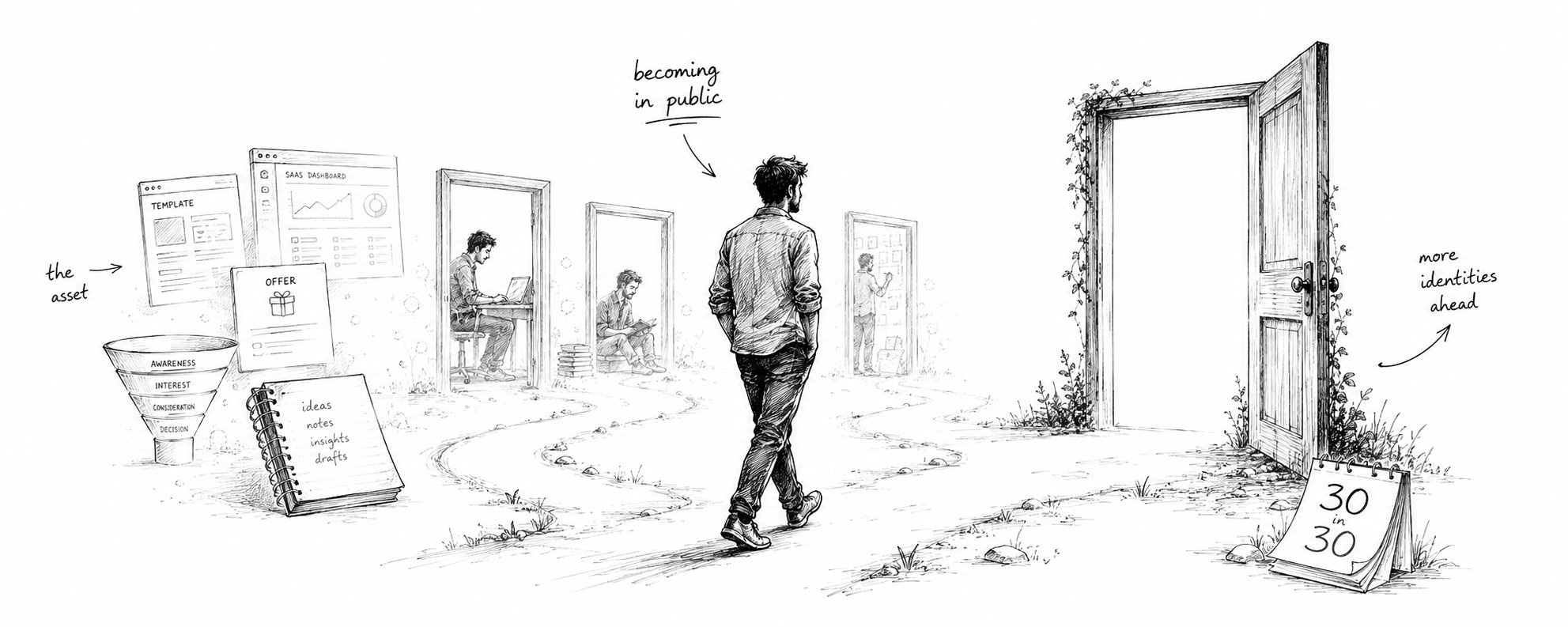
Open the timeline right now and you’ll see a thousand variations of the same post.
“Made $14k MRR this month. Shipped a new feature. Here’s my funnel. Here’s the dashboard. Here’s the screenshot of the Stripe notification. “
The whole genre runs on the same loop: pick a product, show the metrics, narrate the climb, hit refresh, do it again tomorrow.
I’ve posted those screenshots too. In fact, I still do. They work. Very well actually. But posting it is not really the problem. The problem is what this type of content leaves out.
Behind every product is an operator, and the operator is the actual variable. The product goes through changes. New features shipped, new marketing angles, new updates. But what’s never talked about is that the operator changes with it. Nobody documents this part, and most of the people building in public have no idea who they’re going to be when their current product is dead and they have to start the next one.
Building in public is the easy half. You point a camera at a thing outside of you. The MRR, the launch, the user count and you simply describe it. The thing just so happens to be separate from you. Which is why it’s so easy.
Becoming in public is the other half. The hard part. You point the camera at yourself and try to describe a thing that’s actively changing while you describe it. The identity you held last year doesn’t fit anymore. The one you’re moving toward doesn’t exist yet. Somehow, you’re in the middle, and the middle is the hardest part to document, where almost nobody writes from because it’s… embarrassing.
That’s what this newsletter is for.
The middle.
1. Your product will fail. But you won’t.
Here’s the thing nobody who started in 2021 will admit out loud.
Most of the products we built are going to die.
The Notion template businesses, the no-code apps, the agency funnels, the courses that printed money for two years, most of them are not the thing we’ll be doing in 2030. The market shifts. A platform changes. The thing that worked randomly stops working. A new wave comes in and resets the table. Anyone who’s been doing this for more than three years has lived through at least one of these resets and knows another one is always coming.
The product is mortal.
But the operator is the only thing that compounds.
I built a Notion template business that took me from zero to retiring my old life. I ran an agency that peaked near fifty thousand a month. I built courses, software, communities, and a personal brand on the back of all of it. Some of those things still print money. Some of them are dead. A few are on their way out and I know it. It’s a tough pill to swallow, albeit one that must be swallowed.
It becomes easier to digest when I consider that what survived every wave was me.
The version of me that exists now is built on top of all of those products, paid for by all of those products, taught by all of those products—but it’s not any of them. If you erased all of those products tomorrow, I would build a new set of them in eighteen months, because the operator is the asset and the asset upgraded itself over five years.
This is the part of the game nobody teaches.
And if I’m being quite honest, the build-in-public crowd has it backwards. They obsess over the product like it’s the thing. Picking the right niche, picking the right SaaS idea, picking the right offer, when all the product is, is downstream of who’s building it. Two operators given the same idea will produce wildly different businesses, because the constraint was never the idea, but the person.
You can copy my Notion templates. You cannot copy the version of me that knew how to sell them. You can clone my agency funnel. You cannot clone the version of me that knew which client to fire on day three.
This is the case for becoming in public.

If the operator is the asset, then the operator’s development is the single most important thing you could possibly document. Not the products, the metrics or the funnel. The slow, ongoing rebuild of the person at the center of all of it.
Almost no one is doing this. So I’m going to.
Divine compulsion if you will.
2. I’m five identities deep and I’ve stopped pretending it’ll ever stop
I dropped out at sixteen. I smoked weed for the next four years. I worked telemarketing rooms in Spain at eighteen, made more money than my friends in school, and decided sales was who I was. I rode that identity for five years through corporate jobs I hated, lost nine grand on a dropshipping store I didn’t believe in, and quietly became the kind of person who knew he was wasting his life, stuck in the eternal loop of wanting more, but without ever figuring out the how.
Then in 2021 I stumbled on Notion.
At first, I used it to turn my Google Drive folder system into a neat looking dashboard. Shared it with a few people on Reddit who all asked me to send it to them. One guy mentioned there was someone on Twitter selling these templates for a living.
That’s when something rewired in my head.
Within 6 months I was The Notion Guy (only secondary to the legend Easlo, IYKYK). I was Pascio. Notion templates, content, course. The whole thing. And this identity benefited me hard for two years… until it started getting itchy. By the time it peaked I was already half-out of it. I’d built an agency on the side that hit fifty thousand a month, and the agency taught me one thing. That I didn’t want to run an agency, and so I shut most of that down too.
Now, I’m shifting that same brand that was built around Notion templates to just be a sort of launchpad/product studio where I post my experiments and what I build. Products in motion, ship-and-iterate type stuff. But I’m also no longer just that person, because over the last twelve months I’ve been quietly building something underneath all of it that doesn’t really have a category yet.
That’s where this newsletter comes in.
I’m at the edge of another identity shift and I can feel the texture of it but I can’t name it yet. The Notion guy is dead. The build-in-public guy is alive but no longer the whole thing. What’s underneath both of them is something more honest and more me. A writer, a strategist, a person trying to build a body of work that’s worth leaving behind. Calling it a writer doesn’t quite fit either. The thing I’m becoming doesn’t have a label and I’ve stopped trying to invent one before it’s ready.
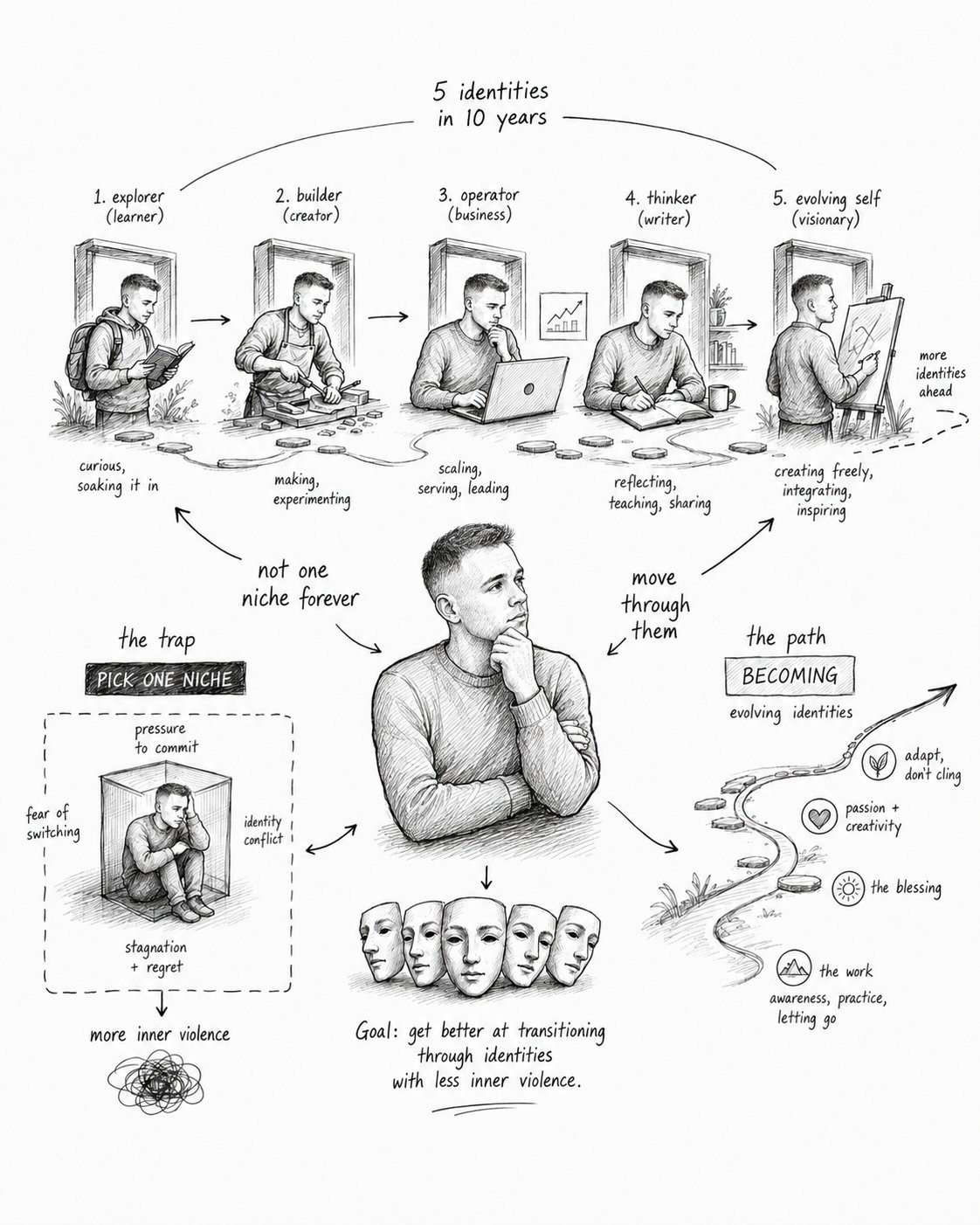
This is the fifth major identity I’ve moved through in ten years and I’ve stopped pretending it’ll stop. I’m not going to “find my niche” and live there for the rest of my life. The next ten years will have more identities, not fewer. The work isn’t to pick one and commit, but to get better at moving through them with less violence each time.
Most people don’t do this… at all.
Most just pick one identity at twenty-five and defend it until they die. They become the marketing guy or the founder or the X guru and the identity hardens into a costume they can’t take off without losing everything they built. I’ve watched it happen to people I respected. I’ve felt the gravitational pull of it myself.
The willingness to outgrow your own brand is the rarest skill in this industry. Nobody teaches it because nobody who has it is sitting around teaching anything. They’re simply too busy becoming the next version of themselves.
That’s the work this newsletter is going to chronicle.
3. Why the build-in-public people are missing the point
Build in public works because it’s legible. The metrics are external, measurable, screenshot-able. You can post your MRR and it either is or isn’t the number you said. The genre is honest in the narrow sense that the data is real.
It’s dishonest in a different sense.
When you only document the product, you imply the product is what matters. Your audience starts believing the same thing. They think the path to becoming you is to copy your product, when actually the path to becoming you was the five years of identity construction that produced the version of you that could build the product. The product is the artifact. The operator is the cause.
This is why the “I made $10k MRR” threads almost never produce more people who make $10k MRR. They produce more people who copy the surface and wonder why it doesn’t work for them.
The build-in-public crowd is also weirdly silent on the inner cost. The screenshots show the wins, but not the night you realized your product was eating away at your life. They don’t show the friendship that ended because the friend felt left behind or the morning you woke up next to your partner and realized you’d become someone they didn’t sign up to date. They don’t show the slow erosion of the version of you who wanted to do this for the love of it, replaced by a version who’s doing it for the audience now.
I’m not saying every public builder should turn into a confessional journalist. I’m saying the dominant genre has a blind spot the size of a planet, and the blind spot is the person doing the building.
Becoming In Public is the corrective.
The premise is simple. Document the operator as carefully as you document the product. Track the identity shifts. Name the seasons. Admit when you’ve outgrown a brand. Admit when a product is succeeding and the success is making you a worse person, or a better one, or a different one. Let the audience see the variable that actually drives the long-term game.
This is uncomfortable in a way build-in-public isn’t. The metrics protect you. They give you a shield to hide behind. The product is doing well, so I must be doing well. Becoming in public removes the shield. You have to look at yourself directly, and then you have to write about what you see, and then you have to keep doing it while strangers on the internet read along.
I don’t expect everyone to do this. I expect most builders to keep posting their dashboards and that’s fine. The dashboard genre will continue to dominate. But for a small audience of people who’ve sensed that the dashboard isn’t the whole story, who’ve felt the gap between who they’re performing and who they actually are, this newsletter will be for you.
4. What you’re actually subscribing to on Becoming
Let me describe the contract between you and me.
One essay a week, usually long, sometimes longer. The essays will be about identity, work, ambition, money, leverage, the inner mechanics of building a one-person business, and the seasons of becoming someone new on the back of all of it.
Some essays will be purely theoretical. Most will be personal. I’ll name names, products I built, products I killed, friendships that fell off, identities I outgrew, beliefs I held for years and finally let go of. I’ll show the wiring operator behind the operating system, not just the output it produces.
What I won’t do here:
I won’t post screenshots. I have other accounts for that. This is the place where I write about the person taking the screenshots, not the screenshots themselves.
I won’t sell you anything inside the essays. The work I sell lives elsewhere. The newsletter is the gift. There’s a small footer below this with links to the things I make, but the essays themselves aren’t pitches.
I won’t fake having figured it out. The whole point of becoming in public is to write from inside the process, not above it. If I knew exactly what I was doing, this would be a memoir. It’s not a memoir. It’s a dispatch.
The newsletter is free and will stay free. If it lands with you, the most useful thing you can do is share it with the one friend you have who’s wrestling with the same questions. Audiences for this kind of writing get built one reader at a time and I don’t have a paid acquisition strategy. The strategy is to write things worth forwarding.
5. If you’re still reading
You’re probably either three years into something and feeling the first signs of having outgrown it, or you’re early enough to want to avoid the trap of locking into the wrong identity for a decade. Either way, you’re in the right place.
Subscribe and stay, much more to come.
— Pascal
Things I work on outside this newsletter, in case any of them are useful:
@iampascio on Twitter, my profile where I post my experiments and numbers
@creatorpascal on Twitter, my personal brand where I share daily notes and ideas
@xgrowthpascal on Twitter, where I’m going from 0 to 10k followers in 3 months
This is really insightful and I'm looking forward to reading what the next 30 days produces. I think however that instead of shifting identities, what you've done is realised that each of those identities was a story that you told (and sold) to others.
To my mind what you're doing now is telling a more personal story that only you can tell, because the telling of the story changes the storyteller.
Gold!