

The Orange iPhone Problem
The most expensive tax in the world is entirely voluntary and most of us pay it willingly.

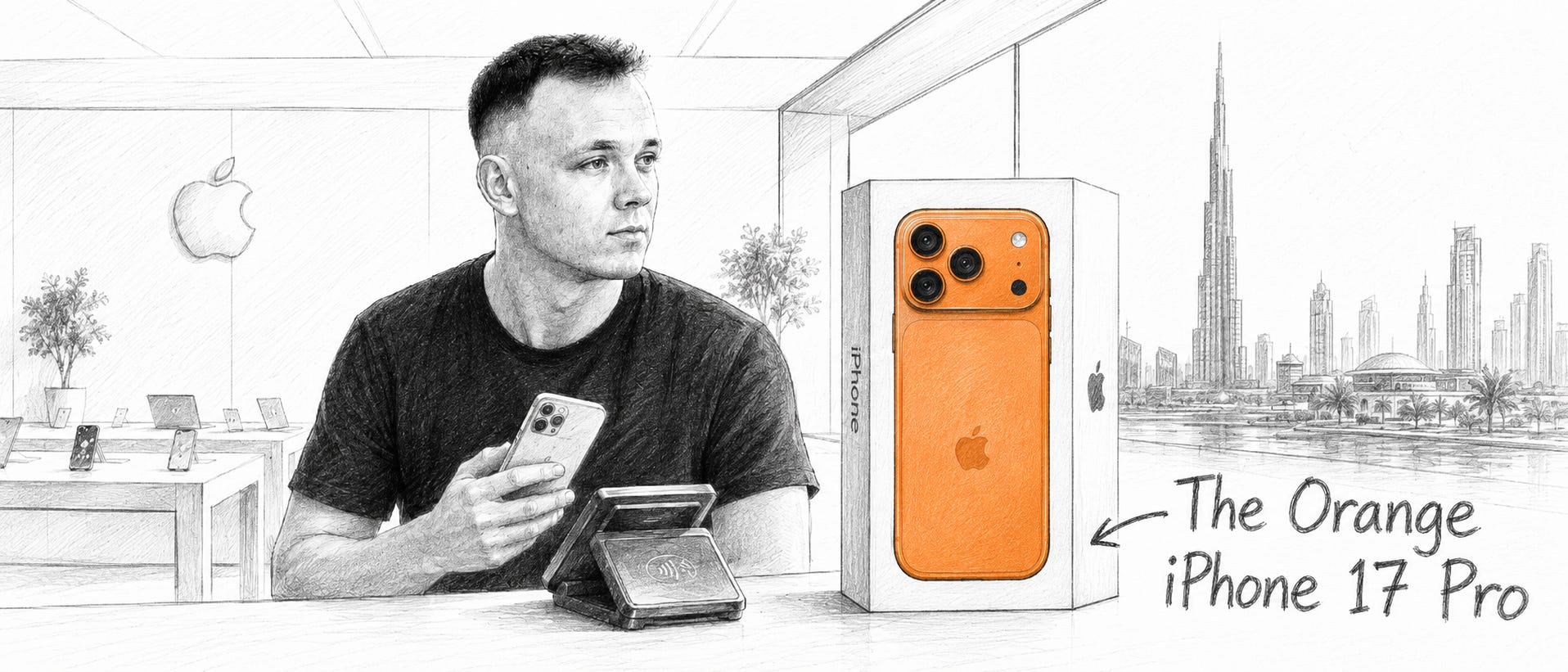
There I was, standing in Apple Store inside Dubai Mall sometime last year, and I had the new phone in my hand and the card machine in front of me ready to finalize the deal.
But something was holding me back.
The price tag of $1,500 for a new phone was hefty, sure. But the hesitation was something else. There I stood, about to swipe my card for the new iPhone 17 Pro 1TB I’d been waiting weeks for, and I just remember I kept thinking to myself over and over…
“Am I going to regret this? Is it really the right choice I’m making?”
Here’s the f*cked up thing about that.
I wasn’t debating the actual purchase of the iPhone. No, foolish as I was, I stood there contemplating if I should have bought the orange color iPhone instead of the blue one.
What I later came to learn is that the orange color of the new iPhone was released to serve a very specific purpose (and a very specific type of person). It’s purposely built in this excruciating eye-catching color that lets the people who buy it, flex that they have the newest model. A badge of honor they wear around the city, where when other people see “tHe OrAnGe iPhOnE”, they instantly know you got the newest phone before they did.
And this speaks to a much bigger thing I’ve been thinking about.
I’ve been living in the Dubai for the past 3 years.
The energy of this place draws you in. It pushes you to do more, be more, get more, achieve more. And once you do those things, it then pushes you to show others that you did them. I think this holds true for any place that is a “low-tax paradise” like Miami, Singapore, Monaco and so on.
While it took me a few years to really understand this, my hope is that you don’t have to go through the same. The thing about these places is that you move here in the first place to make more money by not paying any taxes. And then, funny enough, you just end up paying a different kind of tax instead.
A tax that I call Lifestyle Tax.
I want to share five ideas about it that you probably haven’t heard before, because once you see this tax clearly for what it is, you stop paying it. And once you stop paying it, your life changes in ways no tax accountant can ever calculate.
Grab a coffee. This one’s a long one.
The lifestyle tax is a tax on becoming someone you never wanted to be
Most people think a tax is something the government takes from your bank account.
Well, yeah, it is. But the truth is that the most expensive tax you’ll ever pay isn’t on your income directly. It’s on your identity. It’s the slow, daily withdrawal of who you were when you first arrived somewhere, replaced over time with someone you never actually agreed to become.
Here’s how the lifestyle tax works in places like Dubai, Miami, Singapore, Monaco, or any other “low-tax paradise”:
You move there to escape something. High taxes, slow growth, low energy, average ambition.
You arrive and your nervous system gets a hit. Buildings, supercars, watches, wealth visible everywhere.
Within months, your reference point for “normal” shifts. What used to be an aspiration becomes a baseline.
You start spending money not to enjoy your life, but to keep your status legible to the people around you.
You convince yourself this is “just what living here costs”, and you keep paying.
That’s the tax.
It doesn’t show up on a 1099. It shows up in the gap between the lifestyle you actually want and the lifestyle you’re now performing.
Let me give you a real example.
A guy moves to Dubai from Eastern Europe. Back home, his dream was a paid-off apartment, a small business, and the freedom to take his parents on a nice vacation once a year. Six months into Dubai, his dream has somehow become a Lamborghini Urus, a Palm apartment, and a girlfriend who looks good on his Instagram. He’ll tell you he “leveled up.” But if you ask him quietly, late at night, whether he’s actually happier than he was at home, most of the time the answer is no. He’s just more visible.
The lifestyle tax doesn’t only take your money. It takes your original dream and quietly swaps in someone else’s.
And the worst part is, you’ll defend the new dream like it was always yours.
The lifestyle tax is paid the moment you confuse aspiration with assimilation
There’s a difference between being inspired by a place and being absorbed by it.
Aspiration is when you walk past a $30 million penthouse and think, “Cool, that’s possible. I want to figure out the work that gets me there.” Assimilation is when you walk past it and immediately start hating the apartment you’re living in.
Most people who move to ambitious cities don’t aspire. They assimilate.
And there’s a reason for that.
Your brain is a pattern-recognition machine. The longer you spend somewhere, the more its symbols of “success” overwrite your own. You weren’t born wanting an orange iPhone. You weren’t born wanting a Patek. You weren’t born thinking that a Range Rover is the minimum acceptable vehicle. These are imported wants, installed by repeated exposure, and you didn’t even notice the install happening.
This is the part most people miss.
A wealthy environment doesn’t just raise your standards. It raises your baselines. And a raised baseline is a permanent withdrawal from the bank account of contentment.
An aspirational standard says: “I’d love to have that one day, and I’m at peace until I do.” An assimilated baseline says: “I need that now or I’m a loser.” The first one fuels you, and the second one taxes you for the rest of your life.
You can tell which one you’ve absorbed by watching what happens when you DON’T have something. If the absence makes you genuinely anxious, that’s the lifestyle tax compounding on you. If the absence is mostly neutral, you’re still operating from your own internal compass, which is rare and valuable.
I almost paid the Lifestyle Tax that morning at the Apple Store.
The blue iPhone was, objectively, the same phone as the orange one in every way that actually matters. The orange one was just $0 more for being seen. With the small print: “includes erosion of choosing things for me instead of for others”.
The lifestyle tax is highest where the actual tax is lowest
This is the cruel irony nobody mentions in the YouTube videos about “moving to Dubai to keep 100% of your income.”
The places that advertise themselves as tax havens are almost always status havens too. They have to be. A city’s brand has to attract people, and people are attracted to places where they can display their success without it getting stolen, taxed, or judged into the ground.
Dubai is a safe city. You can wear a $200K watch on Sheikh Zayed Road and nobody touches it. You can park your McLaren on the street and it’s still there in the morning. You can flash an orange iPhone 17 Pro and nobody’s snatching it off your wrist (try doing the same in central London and let me know how it goes lmao).
This is, on paper, a feature. In practice, it’s the engine of the lifestyle tax.
When displaying wealth has zero downside, the natural ceiling on showing off gets removed. And anything without a natural ceiling will be pushed by the market until it’s exhausting.
Think of it this way. Low actual tax means more disposable income. Safe environment means no risk to displaying that income. Status-driven population means social pressure to display it. Add those three things together and most of your “saved” tax money gets recycled straight back into displaying wealth.
In the end, you don’t end up saving money, you’re just sending it to a different government, one made up of valet attendants, watch dealers and rooftop bottle service.
This is why so many people who move to “save taxes” end up financially worse off than when they were paying 40% income tax in their home country. They saved on the tax line and got destroyed on every other line. Their net worth went down even as their net income went up, and most of them have no idea it’s happening until they actually run the numbers.
The actual tax is visible. The lifestyle tax is invisible until you check your savings rate three years later and realize you have less in the bank than when you arrived.
The lifestyle tax compounds in a direction nobody warns you about
Most people understand compound interest in terms of money. Far fewer understand it in terms of identity.
When you live somewhere for long enough, the people around you don’t just influence what you buy, they influence what you want. And what you want determines what you work toward. What you work toward determines who you become. Who you become determines what you pass on to your kids, your friends, your future self, and every relationship you’ll ever have.
This is where the lifestyle tax stops being a financial issue and becomes a soul issue.
You can recover from a $1,500 phone purchase in two weeks. You cannot easily recover from five years of having the wrong wants. Five years of chasing things you didn’t actually choose, on a treadmill someone else installed in your head while you were busy being impressed.
I’ve watched this happen to people in real time.
Guys who moved here three years ago with a clear vision (build a quiet business, train hard, marry someone real, raise good kids) and now they’re 40 lbs heavier, single by their own description “because I’m too busy”, and posting daily videos from yacht parties trying to convince their followers (and themselves) that this is the dream they always wanted.
Most of them know.
You can see it in their eyes when the camera turns off. The lifestyle tax has been compounding on them silently for years, and now they’re so far from their original self that going back feels like failure, when in reality going back to who they were is the first honest move they could make in a long time.
It is baffling how few people get this: the most expensive thing you can do is spend ten years optimizing for goals you didn’t actually want.
That’s the real tax. And it doesn’t refund.
The lifestyle tax is opt-in, but the opt-out is harder than it looks
Now here’s where most articles like this would tell you “but you have a choice!” and wrap up with a clean little lesson.
I’m not going to do that. Because while it’s technically true that you have a choice, the design of these environments is specifically built to make the right choice feel wrong, and the wrong choice feel inevitable.
When everyone around you is upgrading their car every year, NOT upgrading feels like falling behind. It doesn’t feel like a conscious choice, but like a quiet failure. Even if you know logically that the math is on your side, the social cost of going against the current is real. You’ll get fewer invites. People will assume you’re broke. Some women will swipe left on you for the watch you’re not wearing, and some “friends” will quietly drop off your roster.
The opt-out isn’t free.
The opt-out costs you the validation of the people you’re surrounded by, and humans are not designed to easily walk away from social validation. We’re tribal creatures, and the tribe’s approval used to mean literal survival. Your nervous system doesn’t know the difference between losing status in 2026 Dubai and getting kicked out of a tribe in 30,000 BC. It feels the same.
So if you’re going to opt out of the lifestyle tax, you need to know what you’re trading and what you’re getting.
Here’s what you trade:
The easy, automatic feeling of “fitting in” with high-status people
The dopamine hit of every new purchase
The Instagram-worthy moments that come from playing the game
The conversational shorthand of “look at my new thing”
Here’s what you get:
A savings rate that’s often 5–10x higher than your peers
A clear head, because you’re not constantly comparing
Real freedom, which is the ability to walk away from anything at any time
A version of yourself that is recognizably you, not a remix of the city you live in
It’s a real trade. I’d argue it’s the best trade most people will ever be offered in their lives. But it doesn’t feel that way in the moment, and pretending it does is dishonest.
How to opt out of the lifestyle tax
Alright. Now let’s get tactical.
If you’re reading this in Dubai, Miami, Singapore, Monaco, London, New York, or any other city that’s pulling you into spending more than you want to spend, here’s the protocol I’ve been using to stay on the right side of this.
1. Define your “minimum viable lifestyle” before you arrive (or right now if you’re already there)
Write down (actually write it down) what your dream daily life looked like before you got influenced by the city. What car would you drive? What apartment would you live in? What watch, if any, would you wear? What phone? Where would you eat? What would your weekends actually look like?
That document is your anchor. Whenever you’re tempted to upgrade, you compare the temptation against the anchor. If the upgrade doesn’t move you closer to the life you actually wrote down, it’s the lifestyle tax trying to collect from you.
2. Audit your wants and figure out which ones are actually yours
For every major thing you want right now (a car, a watch, an apartment, a relationship type), ask one question: “Did I want this before I moved here?” If the answer is no, sit with that for a minute before doing anything. You’re allowed to have new wants, that’s part of growing. But you should at least know which ones are actually yours and which ones your environment installed.
3. Curate your information diet ruthlessly
You become what you consume. If your feed is filled with luxury car edits, watch flexes, and yacht life, you will start wanting those things even if you didn’t before. Unfollow ruthlessly. Replace those accounts with people who model the life you actually want, not the life the algorithm thinks you should want.
4. Build at least one friendship with someone who could afford it all but doesn’t
This person is your living counterargument to the lifestyle tax. Watching them choose less when they could easily have more reprograms what “high status” means in your head. It’s one of the highest-leverage relationships you can have in a city like this, and most people don’t have a single one.
5. Run the “five-year compound” test on every big purchase
Before any major purchase, ask: “If I stop buying this for five years and invest the money instead, what does that turn into?” That orange iPhone over five years isn’t $1,500. It’s closer to $3,000 invested. Across every category of lifestyle inflation you resist, you’re talking about six figures, easily.
The money itself isn’t really the point though. The point is who you become while accumulating it. Someone who’s actually free, instead of someone performing freedom for an audience.
Treating your lifestyle like a tax return
Once a year, governments make you sit down and audit every dollar that came in and went out. They make you justify, with paperwork, where the money went. Most people hate it. But there’s something genuinely useful about being forced, once a year, to look at your finances honestly.
Almost nobody does the same with their lifestyle.
What if, once a year, you sat down and audited every major lifestyle decision you made? The car you drive, the apartment you live in, the watch on your wrist, the phone in your pocket, the friends you spent the most time with, the neighborhoods you gravitated to, the version of yourself you posted online for strangers to consume.
For each one, you’d ask: was this actually me, or was this the lifestyle tax?
Most people would discover that something like 60–80% of what they spend money on isn’t really for them. It’s tribute to a system they never consciously joined. It’s tax, paid voluntarily, to a government they didn’t elect, in exchange for the right to keep belonging to a tribe that doesn’t actually care about them.
The good news is that this is the only tax in the world that’s 100% optional.
You can stop paying it the moment you see it.
You don’t do it by leaving Dubai. You don’t do it by selling your car. You don’t do it by performing some austerity moment where you delete Instagram and move to a cabin in the woods (that’s just another costume, and a more annoying one). You stop paying it by simply, honestly asking yourself, every time you’re about to swipe, “Is this actually me, or is this the city talking through me?”
I asked that very question in the Apple Store.
And I ended up leaving with this:
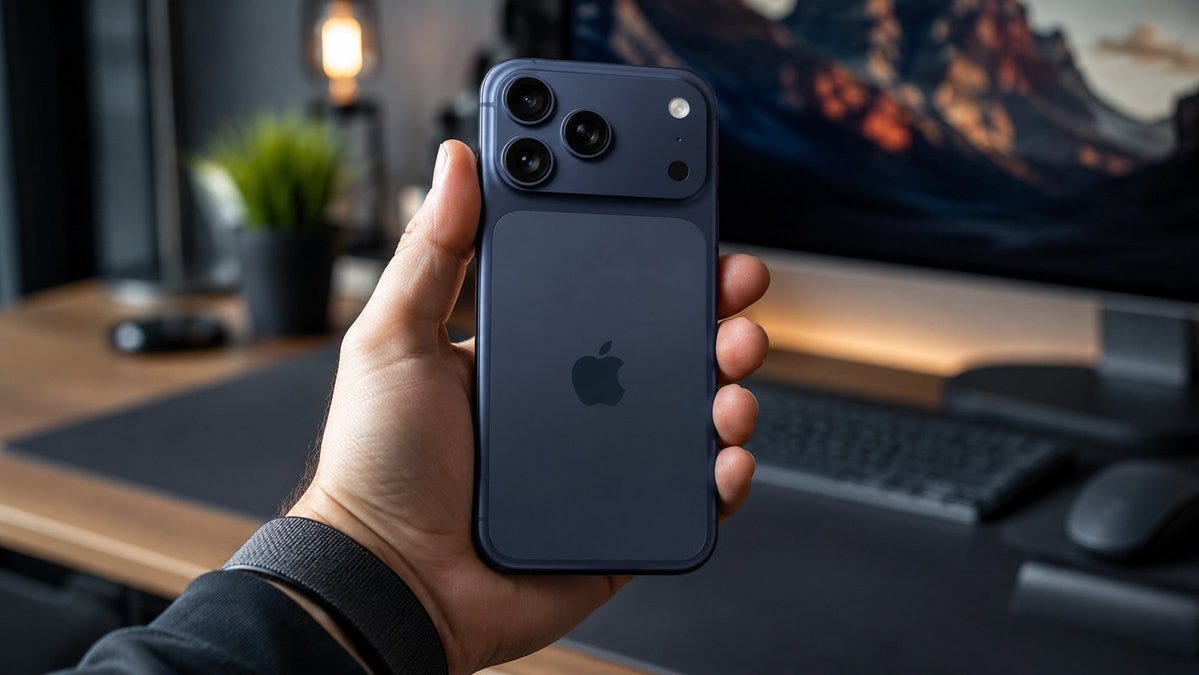
I’m not above wanting to be seen and pretending otherwise would be dishonest. I simply picked it because I’d rather be seen for the things I actually built than for the color of the phone I’m holding.
That’s the only opt-out that matters.
– Pascal
Things I work on outside this newsletter, in case any of them are useful:
Follow me @xgrowthpascal where I’m documenting my journey from 0 to 10,000 followers in 90 days live and in public
Follow me @iampascio where I share my build in public content, experiments and everything else I’m currently building or playing with
A Patek doesnt announce itself. The orange iPhone was designed to. The distinction between those two choices is the whole essay.
The lifestyle tax is real. The harder version of this question is whether the things we chose quietly, the ones nobody notices unless they already know are still doing the same work.
And yet, you still bought the new iPhone...