

Why no one will read this
(spoiler: you’re not going to finish this essay)

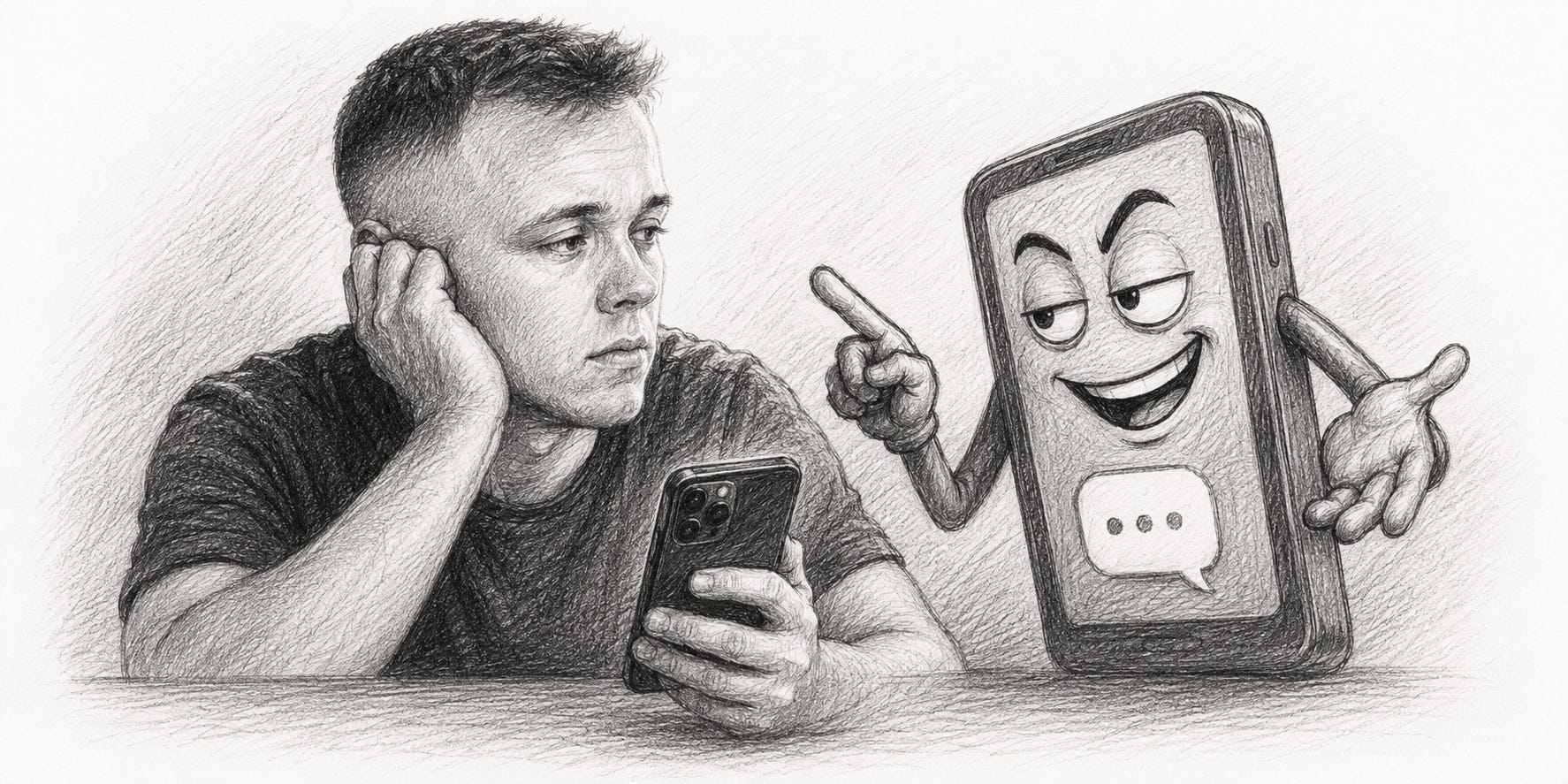
You already scanned the title, decided it was interesting enough to open, glanced at the first two paragraphs, and your finger is probably already hovering over the button to feed the rest to an AI for a summary. I’d bet on it. That’s what was about to happen, or it would have been, if I hadn’t called it out first.
I’m not judging you here. I do it all the time too.
And that’s exactly why we need to talk about it.
If you’re anything like me, you get annoyed at long texts. When AI gives you an answer thats too detailed or too long, you always skip over it or tell it to condense it. And even when someone sends you a document, you’d rather just have AI summarize it.
It’s not all bad. You can still get through a short text, tweet or caption, sure. But somewhere in the last few years, the thing you used to do without thinking: open a document, sit with it, take it in, has quietly stopped happening. You scan now. You’re a master skimmer. You feed things to AI and ask for the “gist” of it.
And the worst part is that no one seems to notice what’s happening.
I realized it a few weeks ago when I sent a client a one-pager with six recommendations on improvements we should make. I had used AI to help me condense the doc into the shortest possible version, because I knew how many balls he juggles and I wanted to respect his time.
He told me later on our weekly call that he had read the first few lines, then ran the rest through Claude to summarize it for him. My condensed and summarized one-pager was getting summarized again.
And that’s when it hit me... I do the exact same thing with one of my freelancers whenever he sends me weekly one-pager reports.
A few years ago, the cutoff for “too long to read” was a fifty-page contract. Then it became a ten-page proposal. Then a five-page brief. Now we’ve reached a one-pager, a single page of densely considered thinking, and even that is too much. We would rather pay a machine to digest it for us before we’ll digest it ourselves.
Something is seriously happening to the way we think, and I don’t believe it’s what most people are saying it is. I think it’s something entirely different. And I believe it’s something that is going to define the next decade of work, business, and frankly, who gets to think for a living and who doesn’t.
Now, a fair warning before we begin.
This isn’t one of those articles you read through and forget about (although, ironically, that’s exactly what most people will do with it).
No, this is going to be an uncomfortable read, so stick with me.
We’ve been told the wrong story about our attention
For ten years now we’ve heard the same explanation. The phones did it. The reels did it. TikTok rewired our brains. Our attention spans are shot. We’ve heard it so many times it’s become wallpaper, the kind of explanation everybody nods at and nobody actually examines.
I don’t think it’s wrong, exactly. I think it’s... lazy.
If this were really an attention problem, you’d be unable to focus on anything, but that isn’t what’s happening. You and I both know you can binge a 3-hour documentary. You can play a video game for nine hours straight. You can scroll for forty-five minutes without blinking. The attention is there. It hasn’t gone anywhere.
What’s gone is something else.
Let’s consider what those things have in common.
The documentary feeds you the meaning, you just have to sit there and take it in. The game gives you a clear loop of action and reward. Win. Lose. Retry. Win. Win. Lose. Win. The scroll asks nothing of you at all.
And most importantly, none of those activities require you to actually build anything in your head, they just require you to be present while something gets delivered to you. That’s the kind of attention you’ve kept. The other kind, the kind where you have to do the mental construction work yourself, that’s the one you’ve lost.
You have stopped being willing to spend attention on things that ask you to think. You’ll spend it on things that entertain you, validate you, or numb you, but the moment something requires you to actually sit with an idea, to construct meaning instead of receiving it pre-packaged, you bail. You hand it over to the machine. The reflex to outsource comprehension has become so automatic that we don’t even register it as a choice anymore.
This is a thinking problem.
And funnily enough, there’s a reason nobody calls it that. Because if it’s an “attention crisis,” you get to be the victim. The evil apps did it to you. The algorithm did it to you. You can keep your self-image intact and just blame the technology.
“sorry I can’t come to work today boss, I’m having an attention crisis”
But if it’s a thinking crisis, the responsibility lands somewhere uncomfortable, and most of us would rather not put it there. So we keep using the comfortable framing, and the actual problem keeps getting worse underneath it.
The frame I want to give you before we dig even deeper is pretty simple. No matter what you’ve been told, this is not an attention crisis. You’ve been hearing it for a decade and it’s only half right. What we’re actually living through is something stranger, and more revealing about who we are.
The asymmetry nobody wants to admit
Here’s the part I think is genuinely ugly, and I’ll say it plainly.
We all want our work to be read. Our emails answered properly. Our proposals studied. Our writing absorbed. Our ideas understood. When we put thought into something, we expect that thought to be honored on the other end. We just don’t offer the same thing back anymore, and most of us haven’t even noticed.
I want you to sit with how absurd that is for a second, because if you don’t see how strange it is, you can’t see what it’s actually doing to you. We’ve quietly developed a collective expectation that our own output deserves comprehension while everybody else’s output deserves compression. We summarize their proposal, skim their article, paste their email into a bot, and then we sit down to write our own and assume the reader is going to give us the depth of attention we just refused to give somebody else.
Underneath it is something close to arrogance, the kind we haven’t seen on this scale in human history up until now. Let’s take hand-written letters as an example. They used to be reciprocal. Somebody would sit at a desk for two hours composing one. On the other end, somebody would receive that letter, sit down with a cup of tea, and read it slowly, sometimes more than once. The exchange was even. Now it isn’t. Now one person spends real time crafting something, and the other person spends six seconds asking a machine what it said.
We’ve quietly decided that our time is more valuable than the time of the person on the other end. That our output deserves comprehension while theirs deserves compression. The more we do this, the more it compounds, until eventually nobody is really reading anybody, they’re just exchanging summaries of summaries, like a long game of telephone where the original meaning gets thinner with every pass.
The strangest part is that we don’t even notice the imbalance because we’re sitting on both sides of it. We’re all writing things we hope will be read carefully. We’re also all refusing to read what other people write carefully. Everyone is the protagonist in their own story and the rude reader in someone else’s, simultaneously, and nobody talks about it, because talking about it would mean admitting something pretty unflattering about how we treat each other now.
The people you respect most notice when you’ve clearly skimmed their work, by the way. They notice when your reply doesn’t address what they actually said. They notice when your response on their proposal is obviously a one-line takeaway from a summary tool. You can’t really hide it. The depth, or the absence of it, leaks out of every word you say afterward, and the people who can read carefully can also tell when someone else hasn’t.
And the people you respect least are doing it to you, and you know it, and it makes you angry, and then you turn around and do it to somebody else.
That’s the loop. The thing nobody is naming. And Ii this doesn’t make sense yet, stick with me, because the cost of it is bigger than it sounds.
AI didn’t cause this, but it just removed the last excuse
For most of history, if you wanted the meaning of something, you had to actually go through it. There was no shortcut. You read the contract. You worked through the philosophy book a page at a time. The friction wasn’t a flaw in the process, the friction was the process. It was where understanding got built.
Then the internet made information cheap. Google gave you the gist of almost anything in a search bar. We adjusted to that. Reading didn’t die, it just sped up.
What’s happening now is different in kind, not just in degree.
AI didn’t make information cheap, it made the appearance of understanding cheap, and those two things feel identical from the inside. That’s why almost nobody can detect the difference in themselves. The mechanism is pretty simple when you watch it play out. Someone sends you a document. Your brain registers the cognitive cost of actually reading it. Instead of paying that cost, you paste it into a model. You get back a five-second summary. You walk away feeling like you understood something.
You didn’t, though. What you understood was a model’s compression of someone else’s thinking, which is a very different thing. You got the conclusions without the construction. The what without the why, and the why was always the only part that mattered. Anyone can hold a conclusion. Almost nobody can build one. The ability to construct understanding from raw material is the rarest and most valuable cognitive skill there is, and it’s the one we are actively training ourselves out of, every day, one summary at a time.
Reading was never information transfer in the first place, that’s the misunderstanding underneath all of this. Reading is the slow process of letting another mind shape yours, sentence by sentence. It’s where you build frames, wrestle with structure, where one paragraph reframes the previous one and suddenly you understand something you didn’t a minute ago. That whole process, the actual thinking part, happens while you read. Not before, not after, while.
When you skip the reading, you skip the thinking. The worst part is that you don’t know you skipped it. You walk away with the vocabulary of understanding without any of the structure underneath, and you sound like someone who read it without ever being able to actually be someone who read it.
That’s the trick AI is playing on us, and almost nobody is calling it out.
You are quietly losing the ability to think for yourself
This is the section that scares me the most, so I’ll just be direct.
If you don’t sit with hard ideas, you lose the ability to produce them. Reading is a rep. Writing is a rep. Sitting with confusion long enough for clarity to emerge is a rep. These are muscles, they atrophy, and they atrophy quickly.
What you’ll notice happening, if you watch yourself honestly, goes something like this. Your ability to recognize good thinking stays sharp, you can still tell when something is well-argued. You can still tell when somebody else has thought hard about a problem. You can spot quality. But your ability to produce good thinking quietly degrades, because you’ve stopped doing the work that builds it. You become a fluent consumer and a clumsy producer. You can identify a smart strategy but you can’t construct one. You can recognize a strong piece of writing but you can’t write one. You can spot original thought but you can’t generate it. The gap between what you can taste and what you can make widens, and at some point it becomes humiliating to even try.
There’s also a strange new confidence that emerges from this, and you’ve probably seen it. People who have skimmed summaries of fifty books speak as though they’ve read fifty books. They reference the ideas. They use the vocabulary. They sound well-read. Press them on any single one of those ideas, though, and the whole thing falls apart, because there’s nothing underneath the words. The ideas have no roots. They’re floating.
What troubles me most about this is that we’re producing a generation of people who sound educated and can’t actually think. People who can pattern-match the surface of intelligence without doing the underlying work. People who can string together impressive references without being able to defend a single one of them. I’ve started watching for it now, and I see it everywhere, in meetings, in writing, in conversations. The vocabulary of depth with nothing actually deep underneath. People who can quote three thinkers from a podcast they didn’t fully listen to. People who can summarize a strategy they don’t actually understand.
I have to implicate myself here too, because I do this. I catch myself doing it. I’ll reference an idea from a book I half-read and feel a small pang knowing that if anybody pressed me on it, I’d be exposed within thirty seconds. We’re all doing this, we’re all pretending we’re not, and the cost of it is going to come due eventually.
Where this leads is not where you think
I want to project forward a little, because I think the trajectory of all this is bigger than most people realize.
If we keep going the way we’re going, and there’s no obvious force pulling us back, communication itself starts to change shape. Documents stop being written for human readers, they start being written for AI readers. People will use AI to write the document, AI on the other end will summarize the document, and a human will glance at the summary. The actual humans are barely in the loop of their own conversation. This isn’t a far-future prediction. It’s happening right now, in offices, on Slack channels, in inboxes, and we’re calling it efficiency.
Three things happen next, and they happen at the same time.
The first is a flattening. Everything starts to sound the same. If everyone writes through AI and reads through AI, the variance between people gets sanded down. The weird, sharp, specific way one person thinks gets compressed into the same shape as everybody else’s thinking. We lose the texture of individual minds. Everything reads like it was written by a smart, slightly bland committee, because increasingly, it is.
The second is a separation. A small group of people will refuse to do this. They’ll keep reading deeply, keep writing carefully, keep doing the slow cognitive work everybody else has handed off. Those people will pull ahead, not because they’re smarter, but because they’re still doing the reps. In ten years they’ll seem almost like a different species. They’ll see things others can’t see, build things others can’t imitate, make decisions others can’t reverse-engineer. The output gap between deep readers and shallow scanners is about to become enormous, and it’s going to show up in business, in writing, in art, in everything that requires real thought.
And the third is the most interesting one to me.
Deep readers and deep thinkers are about to become rare and valuable in a way they haven’t been in centuries, kind of like artisans in the industrial age. The mass-production of understanding through AI is going to create real demand for the actual thing, the person who can sit with a problem, read the source material, and produce a genuinely original synthesis. That person will be worth a hundred people who can prompt their way to the same generic gist.
The frame I’d hold here is that we’re not losing attention, we’re sorting people. The sort is happening right now, this year, in real time. The people who keep their attention are about to become very valuable. The people who don’t are increasingly going to be doing work that AI can already do better than them, and they won’t see it coming, because they’ll be too busy summarizing the warning signs to notice them.
Nobody is going to tell you which side of the sort you’re on. You have to figure that out yourself, and you have to figure it out now.
Becoming the person who still reads
So what do you actually do about it?
The honest answer is: less than you’d hope, and harder than you’d want. There’s no five-step system here, no productivity hack. The thing being asked of you is small in concept and brutal in practice, you have to be willing to sit with things that ask you to think, when every reflex in your body is telling you to skip the work and grab the summary.
The friction is the point.
That’s the whole sentence, and if you only remember one thing from this article, it should probably be that. When you reach for the AI summary, you’re not saving time, you’re spending the very thing you were trying to save. You’re spending the part of yourself that does the actual work, the part that builds understanding, the part that compounds into judgment, the part that ten years from now separates the people who can still think from the people who can’t. That’s what the trade actually is, and almost nobody is doing the math honestly.
The next time you’re about to paste something into a model for a summary, pause for a second. Ask yourself one question, am I doing this because I’m genuinely time-constrained, or because I’m avoiding the work of thinking? It will be the second answer more often than you’d want to admit (it is for me). You won’t always choose the harder path, that’s fine. You should at least know when you’re choosing the easier one. Most people don’t even know they’re choosing.
When you write something yourself, when you sit down to put words on a page that you actually want somebody else to read, write it tight enough that it deserves to be read. Make every line earn its place. Write so the document itself resists shortcutting, where the value lives in the construction and not just the conclusions. That’s the contract that’s been keeping writers and readers honest for centuries. It still works, you just have to write something worth the trade.
I’m not anti-AI, by the way. I literally used it to help condense the one-pager that started this whole train of thought. The tool is incredible. The misuse is treating it as a replacement for your own mind instead of an extension of it. Use it to draft, to challenge, to explore. Don’t use it to outsource the part of you that’s supposed to be doing the thinking. The people who figure out where that line is, and hold it, are going to inherit the next decade.
Attention is the last real currency
Here’s the reframe I want to leave you with, because I think it’s the thing nobody is saying out loud yet.
For the last twenty years we’ve been told attention is a personal problem.
Your focus, your phone, your productivity. A whole industry was built around fixing it as if it were a private issue, like flossing. It isn’t personal anymore. It’s structural. What’s actually happening right now is that we’re quietly redistributing who gets to be a thinker and who doesn’t, and almost nobody is paying attention to the redistribution because everyone is too busy summarizing the news about it.
The people who keep reading deeply are about to inherit a wildly disproportionate share of the next decade because they kept doing the slow, quiet, unfashionable work of letting other minds shape theirs, the work everybody else has handed off to a machine.
I think about that one-pager I sent now, and I genuinely don’t blame the person on the other end. He was being efficient. He was doing what most people do, what most people in his position genuinely do, including me. The point of this piece was never that he was wrong. The point is that the thing he did is so common, so reflexive, so frictionless, that we’ve all stopped seeing it as a choice. It is a choice, though, and the people who choose differently, even some of the time, are going to be the ones who can still think their way through a problem when AI hands the same generic answer to everybody else.
The whole game now comes down to whether you’re willing to be a little slower. A little more uncomfortable. A little more willing to sit with one page of someone’s actual thinking instead of a paragraph summarizing it.
Because in the end, attention isn’t really about focus, it’s about respect, for other people’s minds and for your own. And the people who still have it are about to be very, very hard to compete with.
- Pascal
Things I work on outside this newsletter, in case any of them are useful:
@xgrowthpascal where I’m documenting my journey from 0 to 10,000 followers in 90 days live and in public.
@iampascio where I share my build in public content, experiments and everything else I’m currently building or playing with
I didn’t finished this article; but I love how we don’t always do enough deep reading, and deep thinking.
That’s the part all of us should be working on.
I read to the end and agreed with every single word. In fact it was like getting a good neck workout at the gym my head was nodding so much.
Like I said in the restack - it’s the journey not the destination that’s the point. The reward of the destination is proportional to the effort of the journey. 👏👏👏