

You don't need a unique idea to get rich
Stop trying to reinvent electricity and just do this instead

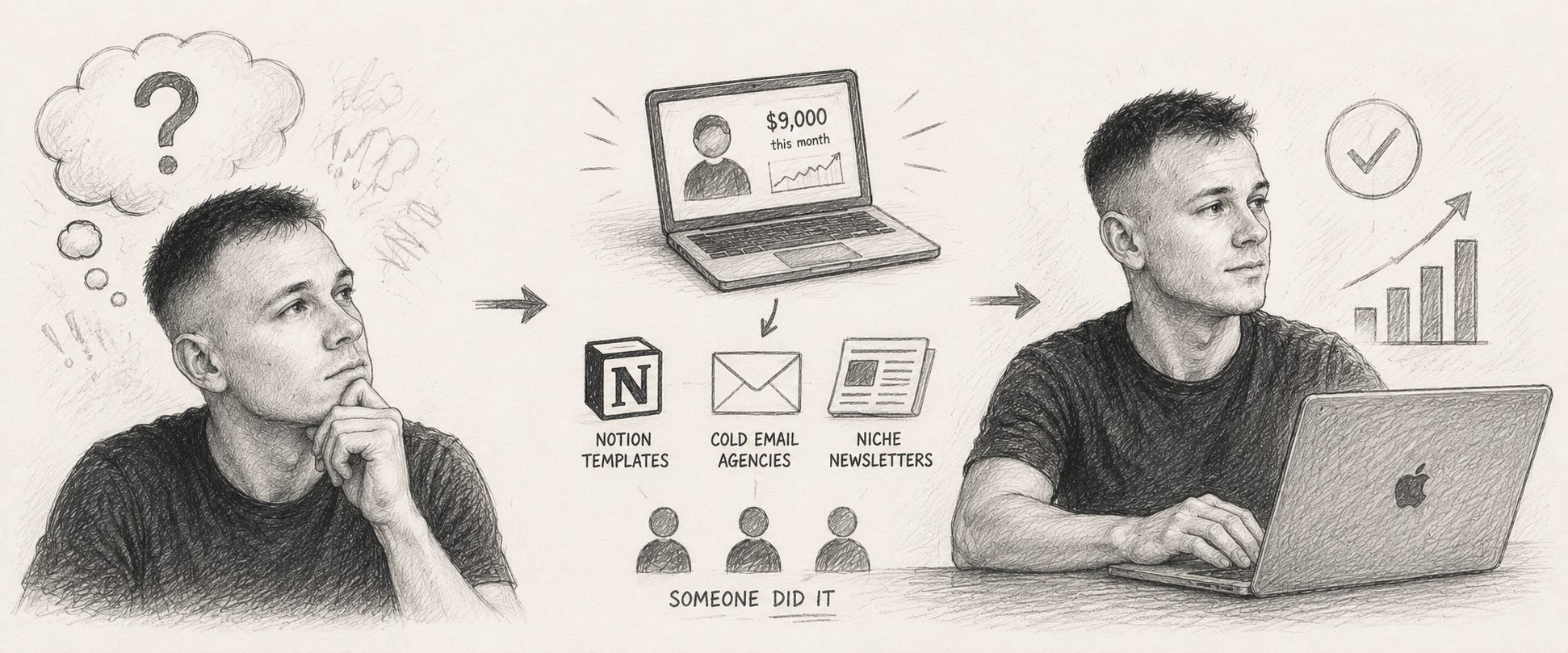
If you’re anything like me, you’ve spent way too much time hunting for the “perfect” business idea. The unicorn. The blue ocean nobody has touched or even thought of yet.
And if you’re really anything like me, you’ve also quietly judged the people making money off ideas that look almost embarrassingly simple from the outside (the Notion templates, the cold email agencies, the niche newsletters) while you were busy trying to invent something nobody had ever seen before.
I’m not here to talk down on you. I did this for years. I had notebooks full of ideas that were supposed to be “the one.” I had a graveyard of half-built products that nobody asked for, all because I was convinced that the only path to a meaningful income was to stumble onto something nobody had ever stumbled onto before.
The unfortunate reality is that this belief is the single biggest thing that keeps people broke.
Because while you’re trying to invent electricity for the second time, the person two steps ahead of you is just plugging things into the wall.
This essay is something I actually want you to sit with, because it changed the entire trajectory of my life when it finally clicked.
Let’s begin.
If it is humanly possible, it is possible for you
“We become what we behold. We shape our tools, and thereafter our tools shape us”. – Marshall McLuhan
About four years ago I was scrolling Twitter and stumbled on this guy with a faceless profile picture casually tweeting that he’d made $9,000 that month from selling Notion templates.
At the time I had no idea what that even was. I clicked his profile out of pure curiosity, and that single click ended up being the day my entire life changed.
Because here was this random guy, no different from me in any meaningful way, just sharing his journey, occasionally dropping products, and printing money in the process.
The truth is that I’ve always operated from one core belief that has shaped just about every decision I’ve made since I was a teenager:
If it is humanly possible, it is possible for me too.
Anything a human can do, I can do.
This sounds like a Pinterest quote, but I want you to actually sit with it for a second, because most people read this kind of line and nod along without ever internalizing what it actually means.
Let’s run through an example.
Take Usain Bolt. For 15 years he has been the only human being to run 100m in 9.58 seconds. By any conventional logic, the belief I should hold is that I will never beat that record. He’s the fastest. End of conversation.
But hear me out on this one (call me a disillusioned egomaniac if you want), if I truly decided I wanted to beat his record, I genuinely believe I could.
And yes, I’m 28 next year and I’d be the first to admit my window for sprinting is probably already closed. But in theory? If I put in double the training he did over the years, why couldn’t I? If I dedicated my entire existence to it. If I structured every meal, every recovery session, every micro-decision around that one outcome, the math says it’s possible.
That’s the belief I have.
“Another human did this, therefore another human can do it.”
And when I looked at this faceless guy on Twitter (Easlo) through that exact lens, the question that came up wasn’t “wow, how did he figure that out.”
The question was much simpler:
“What the f*ck is he doing that I can’t do?”
The answer, frankly, was nothing.
So that very same day I started a faceless profile of my own. I built my own Notion templates. I started tweeting my journey. And four years later, here we are.
That leads us into the next section perfectly.
You don’t need a unique idea, you need a model
“Good artists copy, great artists steal.”– Pablo Picasso
Most people set out to build something nobody has ever built before. They want to be the first. The original. The pioneer.
The truth is that being a pioneer is the most expensive, exhausting, low-probability path to success that exists.
Pioneers eat arrows. That’s the line.
The unfortunate reality is that the people you admire, the ones who seem to have it all figured out, almost none of them are pioneers. They’re just slightly better executors of an idea that already worked for someone else.
To take it a layer deeper, here’s how almost every successful online business actually gets built:
Someone, somewhere, proves a model works in public
A second wave of people sees it and goes “wait, that’s possible?”
They study the model, not to copy it word for word, but to understand the why behind why it works.
They put their own spin on it (different niche, style, angle)
They execute consistently for long enough to compound
They become the next reference point for the third wave
That’s the loop.
Notion templates didn’t start with Easlo. They didn’t start with me. They will not end with us either. The entire ecosystem is one massive concentric circle of people learning from people who learned from people.
Think of somebody successful in any space you actually pay attention to.
The fitness creator who built an empire on minimalist training didn’t invent minimalism. The newsletter writer pulling six figures a year didn’t invent newsletters. The coach charging $20K a client didn’t invent coaching.
They just looked at someone two steps ahead, said I can do that, and then went and did it with their own twist. This may sound simple, but it is genuinely baffling how many people refuse to accept it.
I think it’s because admitting this requires giving up a fantasy. The fantasy that there’s some genius idea out there waiting for you to discover it. The fantasy that your big break is one shower-thought away.
I hate to break it to you, but it isn’t.
Your big break is sitting two steps ahead of you in the form of someone already doing what you want to do.
Your only job is to study them and start.
The myth of the unique unicorn idea
“There is nothing new under the sun.” – Ecclesiastes
I want to drag this idea into the light a little more, because I think the “unique idea” myth is the single most common reason people stay stuck for years.
You’ve probably been told some version of this:
“Find a niche nobody is in.”
“Build something nobody else can build.”
“Differentiate or die.”
On the surface this advice isn’t wrong. Differentiation matters. The way most people interpret it, however, is catastrophic.
They hear “differentiate” and they translate it into “invent something nobody has ever seen before.”
So they sit at their desks for months (sometimes years) trying to brainstorm the next unicorn. They reject every idea they have because “someone is already doing it”, convince themselves that competition equals failure and continually mistake an empty market for an opportunity instead of what it usually is, which is a graveyard.
I was guilty of this for years before I stumbled on Notion templates.
The actual truth about competition is the opposite of what most beginners believe. Competition is the single best signal you can possibly find. If multiple people are making money in a space, that means there is real demand, the buyers exist and are reachable, the pricing has been validated by the market, the format works, and you don’t have to educate the market from scratch.
An empty market almost always means one of three things: nobody wants the thing, nobody can afford the thing, or someone tried and quietly went broke.
So when I tell you to find someone two steps ahead of you and follow in their footsteps, I’m not telling you to be a copycat, but to use the most reliable signal of opportunity that exists, which is proof of concept by another human.
Stop trying to find the most unique business idea in the world.
Find a working business idea, and become the most unique version of you executing it.
This is the way.
Why “modeling” is not the same as copying
“Imitation is the sincerest form of flattery that mediocrity can pay to greatness.” – Oscar Wilde
I can already feel some of you tensing up, because the word “copy” makes most people uncomfortable. Nobody wants to be the cheap knockoff.
So let me be absolutely clear about this.
There’s a massive difference between copying and modeling. If you don’t understand this difference, you’re going to either reinvent the wheel forever or become a forgettable clone.
Copying is taking someone’s product, language, design, and offer, and pasting it under your own name. The market punishes this almost immediately because audiences can smell a clone from a mile away.
Modeling is something completely different.
Modeling is studying why something works (the underlying mechanism) and then rebuilding the same mechanism in your own voice, your own style, your own niche, with your own perspective on top.
Here’s what that modeling actually looks like in practice:
You identify someone two steps ahead of you who has results you want
You study their format, the structure of how they deliver value
You study their positioning, who they’re talking to and why those people care
You study their offers, the price points, the bundles, the upsells
You study their content, not the words, but the underlying patterns and angles
You ignore everything that’s surface level (their colors, their fonts, their exact phrasing) and focus only on the structural skeleton of why it works
You take that skeleton and pour your own perspective, voice, and life into it
The output is something that shares DNA with what they built but feels unmistakably yours.
When I started building Notion templates, the format was the same as Easlo’s. It was a template. Sold on Gumroad. Promoted via a faceless Twitter account. The skeleton was identical because the skeleton worked.
But the actual templates? They were in different niches with different aesthetics. I also had a different voice in the marketing. And overall different positioning. Same exact model, but... different execution.
That’s the line you walk.
If this doesn’t make sense, here’s a simpler way to think about it.
McDonald’s didn’t invent burgers. Burger King didn’t either. Five Guys didn’t either. Shake Shack didn’t either. Every one of them is running a roughly similar model (fast service, beef patty, bun, fries) and every one of them has found a way to make billions inside that model by adjusting positioning, quality, atmosphere, and audience.
None of them are sitting in a boardroom going “we need to invent a new food format that nobody has ever tried before.”
They just compete on execution inside an already-proven model.
Why your ego is the bottleneck
“The first principle is that you must not fool yourself, and you are the easiest person to fool.” – Richard Feynman
I want to take this a layer deeper, because there’s a hidden reason most people refuse to do what I’m describing, and it has nothing to do with strategy.
It’s ego.
The unfortunate reality is that most of the people stuck searching for a unique idea aren’t stuck from lack of creativity, but rather because their ego cannot tolerate the idea of doing something someone else thought of first.
They want to be the genius. The one who saw it before everyone else. The pioneer in the case study, not the one studying the case study.
This is a quiet kind of arrogance, and it costs people years.
I’ve seen it in friends, in clients, in people in my DMs. Someone shows them a working model and instead of going “oh, that’s the move, let me start,” they go “yeah but that’s been done.” As if the fact that it has been done by another human, profitably, is somehow a reason not to do it.
It is, in fact, the strongest possible reason to do it.
Ego doesn’t see it that way though.
Ego wants to be special.
Ego wants to be first.
I had to confront this in myself, by the way. When I first looked at Easlo, there was a part of me that didn’t want to admit he was further ahead. There was a part of me that wanted to find a reason his model didn’t apply to me, to invent something new just so I wouldn’t have to follow.
But I sat with it. I let the ego cool off. And I asked myself the only question that actually matters in moments like that:
Do I want to be right, or do I want to be free?
Because those are usually the only two options.
You can be right about how unique your idea has to be, and stay broke for another decade. Or you can be humble enough to learn from someone two steps ahead of you, and actually build a life that looks the way you’ve always said you wanted it to look.
I know which one I picked.
How to find the person two steps ahead of you (the protocol)
I want to make this practical now, because I don’t want you to walk away with a nice feeling and zero next move.
Here’s the actual protocol I would run if I had to start from scratch tomorrow with no audience, no product, and no idea.
1. Pick a domain you’re genuinely curious about
Not a domain you think will make money, but one you’d happily talk about for free. The reason this matters is simple: you’re going to need to do this for years before it compounds, and curiosity is the only fuel that lasts that long. Money runs out as motivation. Curiosity doesn’t.
2. Find 3 people who are roughly two steps ahead of you in that domain
Not Elon or Jeff Bezos or someone so far ahead that their playbook no longer applies to your reality. You want someone close enough that their last 12-24 months of moves are still relevant to where you are right now. Three is enough. Any more and you’ll get analysis paralysis.
3. Reverse-engineer their model
For each of these three people, ask:
What format are they using to deliver value? (Newsletter, templates, agency, coaching, software, content)
Who are they talking to? (The actual avatar, not the surface niche)
How are they making money? (Where the actual revenue comes from)
What does their content pattern look like? (Threads, long-form, short-form, mix)
What’s their unique angle inside the model? (The thing that makes them them)
Write all of this down. Not a mental note, but on actual paper or in a doc. The act of writing forces clarity that your brain alone won’t give you.
4. Steal the skeleton, build your own body on top of it
Take the structural elements that show up across all three (the model, the format, the offer structure) and treat that as your starting skeleton. Then layer your own life, voice, taste, and angle on top of it.
This is where you stop being a copycat and start being a competitor.
5. Start before you feel ready
This is the step everybody skips. They study, and study, and study, and never actually post, build, or sell anything. The truth is that no amount of additional studying will replace what you’ll learn from one week of actually putting work into the world.
Start ugly. Start without permission.
6. Adjust based on real-world feedback, not your own theories
The market will tell you what works. Your brain will not. Most of your assumptions will be wrong, and you only find out which ones by shipping. The people two steps ahead of you didn’t get there by being right the first time. They got there by being wrong publicly enough times to figure out what was actually right.
7. Compound for longer than feels reasonable
This is the move nobody talks about because it’s not sexy. The model works. Your execution will eventually work. It just takes way longer than anyone wants to admit. The people you envy were quietly compounding for two, three, sometimes five years before anyone noticed.
If you can do this for longer than the average person can stomach, you win by default.
Stop trying to invent electricity
The frame I want to leave you with is simple, and I want you to actually internalize it, not just nod at it.
You don’t need to reinvent electricity to live a great life.
Neither do you need to discover a new element or invent an entirely new business model. You just need to plug into something that’s already working, and run with it longer and harder than the next person.
Easlo didn’t invent Notion templates. Notion didn’t invent productivity software. Productivity software didn’t invent the idea of organizing your life. Every single layer of what made his business possible was built by someone before him. He just took the existing infrastructure and put his own twist on it.
I did the same thing with him as my reference point.
Someone reading this right now is going to do the same thing with me as their reference point. And in five years, someone is going to do it with that person as their reference point.
This is how the world works. Every empire, every business, every artist, every athlete, every creator you’ve ever admired is a remix of something that came before them. The illusion of pure originality is just that, an illusion sold to people too proud to participate in the real game.
So the next time you catch yourself searching for the perfect, unique, never-been-done-before idea, I want you to remember this:
If it is humanly possible, it is possible for you.
Another human’s success is not a reason to give up. It’s a permission slip. Their working model is the proven path and the person two steps ahead of you is your map.
Your only real job is to look at what’s already working in the world, ask yourself the simple, almost arrogant question (what are they doing that I can’t do?) and then go answer it with the next four years of your life.
That’s the game plan. Now act on it.
You got this.
– Pascal
Things I work on outside this, in case any of them are useful:
Follow me @xgrowthpascal where I’m documenting my journey from 0 to 10,000 followers in 90 days live and in public.
Follow me @iampascio where I share my build in public content, experiments and everything else I’m currently building or playing with
Wow. What are we, like three or four days into this 30 day experiment and each essay has hit harder than the one before. There’s so much actionable advice in each one that by the end of the month it’ll be like a full MBA on life.
I’ve watched Easlo (and you) from afar for a few years and been amazed at how both your businesses have grown from such humble beginnings.
Kudos to you and here’s to the next twenty odd days.
The whole time I was reading this I had this feeling that maybe we're all a lot less broken than we think we are. We just forget ourselves sometimes. I enjoyed this! Thank you 🙏😊