

You Think You Want To Be An Entrepreneur
(but the truth is... you really don't)

This is a letter for a very specific person.
The dreamer. The one who knows they’re meant for bigger things. The person who wants to be an entrepreneur, but have no idea how to do it.
Before we dive on, this is essay 2 out of 30 that I’ll be publishing over the next 30 days. If you missed the first one, click here to read it first
The thing about entrepreneurship is... you think you want it. But 99% of the time, you really don’t. See, most of us imagine entrepreneurship the same way we imagine this perfect sunrise. Soft light, calm mornings, effortless days. We picture freedom drifting into our lives because we chose “a different path”. We imagine money showing up while we sleep. We imagine ourselves speaking confidently about the life we built. And we attach meaning to that image... only because everyone else does.
It becomes a social script instead of a lived truth.
Let’s be honest for a second.
You want that image because you hate something about your current life.
You want out, you want change and you want a chance to live with intensity instead of obligation. That’s natural. I’ve felt that many times. I’ve also chased ideas that fell apart within months. Walked away from businesses that drained me. And I’ve tried to step into this world without understanding what it actually demands.
Most people do this exact thing.
They want the fantasy, only to collapse when they meet the real thing.
Even if the fantasy is wrong, it’s smart to examine the tension that pulls you toward entrepreneurship, because that tension is a message. It shows you what you can’t tolerate anymore. The life you want to escape and the person you want to become.
This letter is for that person.
The one inside you who keeps knocking.
This will be long and it will be dense. And I guarantee that you will need time to sit with it, but if you do the full protocol at the end, you will understand why entrepreneurship feels impossible at first, why almost every beginner quits, and why the life you imagine only appears after you survive the hard parts that no one talks about.
Let’s begin.
You aren’t living the entrepreneurial life because your current identity cannot sustain it
Most people treat entrepreneurship like a to-do list. Build a product, write a post, create an offer, make some money. They focus on the behavior, not the identity. And they don’t understand that identity is the engine. Behavior is just the exhaust. If the identity cannot support the goal, the behavior will never last.
Think of someone who has built a real business. Someone who survived the early chaos, created systems, and reached a point where the business pays them for the person they became. Do you think they need motivation to wake up and lead? Do you think they negotiate with themselves before doing the work? You might imagine they do, because that’s how you feel.
But they don’t.
They have become someone who cannot imagine life without building.
From the outside, it looks intense. Inside their mind, it feels natural. When friends say, “Relax, take a break, enjoy life,” they nod, but a quiet thought sits underneath. They are already enjoying life. The work is the enjoyment. And that truth feels strange until you experience it yourself.
Here is the idea almost no one understands.
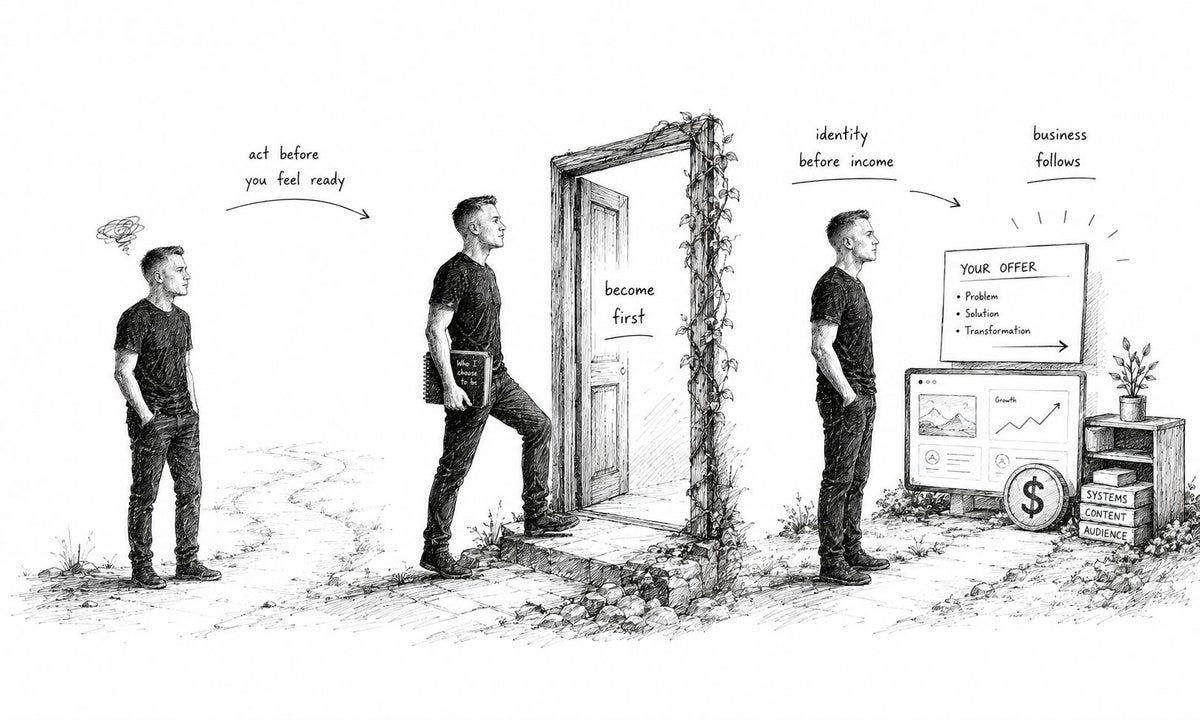
You must become the entrepreneur before the business exists, you must build the identity before the income appears and you must act like the person who wins long before you feel like that person.
People say they want freedom or money and independence. Then they act like someone playing a simulation of entrepreneurship rather than the real thing. There is always a reason for this. It sits below awareness.
And you must bring it into the light.
You aren’t where you want to be because part of you doesn’t want the entrepreneurial life at all
Your behavior speaks the truth, always. Your words do not.
Entrepreneurship exposes this quickly. You say you want to build a business. Then you avoid the work that would create it. You say you want to sell. Then you hide your offer. You say you want momentum. Then you spend days in preparation loops that feel productive but change nothing.
Most people call this procrastination, but it isn’t. It’s protection.
Your mind pursues goals you never chose consciously. You try to stay safe. You try to avoid judgment. You try to maintain an identity that feels predictable. You try to prevent the embarrassment that comes from trying and failing. And because these unconscious goals run deeper than your stated goals, they win.
If you want change, you must shift the goal that shapes your perception.
That single idea will save you years. The mind moves toward what it believes matters. It notices patterns that reinforce those beliefs. It filters out anything that threatens them. Until the goal changes, the behavior repeats.
Entrepreneurship demands that you rewire the goals you live from. Not the surface ones you write in a notebook. The ones that operate quietly.
When those goals shift, your entire world changes with them.
You aren’t living the entrepreneurial life because your identity is afraid of what it demands
Entrepreneurship is not a strategy you apply. It is an identity transformation you undergo. And most people underestimate this. They imagine that learning skills is enough. They believe a course or a mentor or a new tool will do the heavy lifting. They don’t understand what they’re really stepping into.
Identity evolvement follows a very simple process.
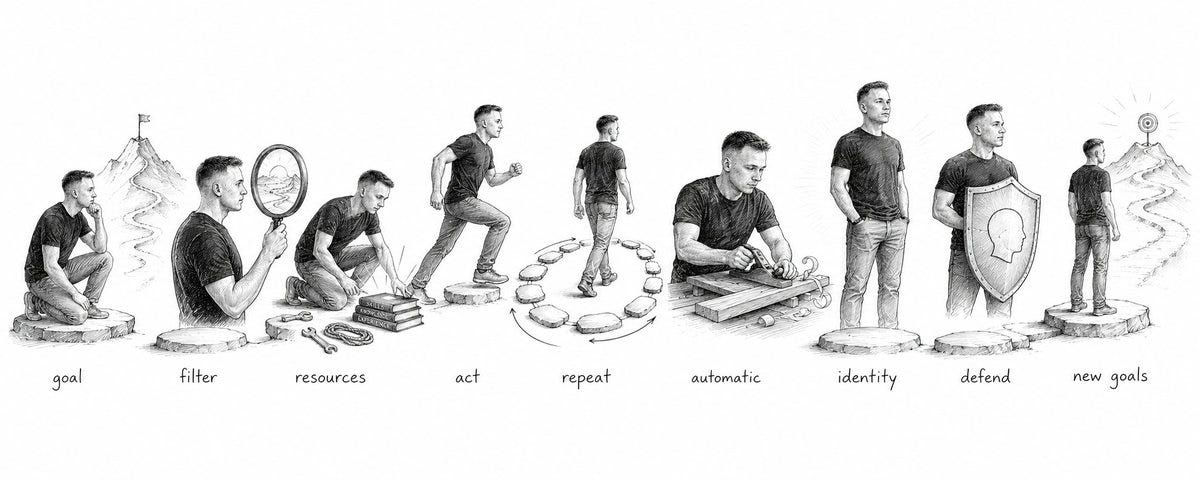
You choose a goal.
You filter reality through that goal.
You notice resources that match it.
You act.
You repeat the action.
It becomes automatic.
It becomes identity.
You defend the identity.
The identity shapes new goals.
This cycle runs your entire life. It is the reason you behave the way you do. It is the reason your patterns feel stubborn. It is the reason entrepreneurship triggers so much emotional turbulence. When you try to change your life, you are not fighting the business world, but the old identity that kept you safe.
Your early life taught you to avoid risk, school taught you to follow instructions, your job taught you to listen, not create and your environment rewarded comfort over uncertainty.
And now you want to build something that requires the opposite traits.
Of course that feels threatening. Your identity sees entrepreneurship as a danger to your current comfortable existence. This is why you freeze.
The entrepreneurial journey starts when you outgrow the identity that kept you comfortable. And that moment feels like death before it feels like freedom.
The entrepreneurial life becomes possible only when your mind reaches a certain level of development
People evolve psychologically over time. They move from survival, to conformity, to self-awareness, to independence, to complexity, to creative freedom. Entrepreneurship requires a mind that can hold complexity and uncertainty without falling apart.
Let me explain the pattern simply.
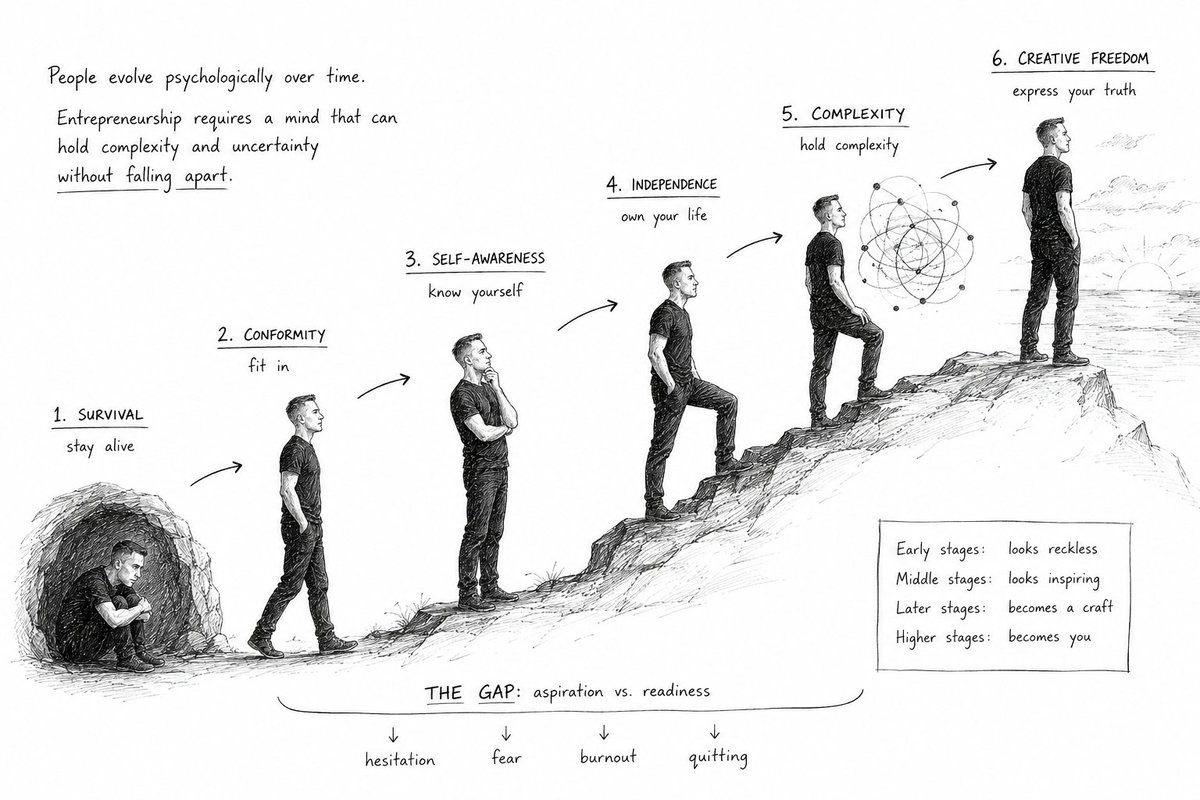
At early stages, entrepreneurship looks reckless.
At middle stages, it looks inspiring but confusing.
At later stages, it becomes a craft that you master.
At higher stages, it becomes a natural expression of who you are.
Most people who chase entrepreneurship live between aspiration and readiness. They feel the pull toward something bigger. They feel out of place in their current life. They feel like they are meant for more. But they do not yet have the internal stability to handle risk, ambiguity, or responsibility.
This gap explains everything. The hesitation, fear, burnout and the quitting.
Entrepreneurship requires a mind that can withstand friction. You build that mind through tension. Through questioning. Through identity upgrades. Through stepping into challenges you used to avoid. This is the part people skip, and it’s why they never reach the version of entrepreneurship that feels effortless.
Real entrepreneurial intelligence is the ability to steer your life toward the vision you want
Entrepreneurship rewards one kind of intelligence.
The ability to steer, adjust, persist and to see the big picture even when the short-term feels chaotic. And that intelligence isn’t a magic talent you’re born with. It comes from cybernetic awareness. Meaning you act, sense, compare, and adjust. You move even when results lag behind. You continue even when identity feels shaky. You learn to interpret failure as data.
Entrepreneurs interpret the same event differently. They ask what the feedback means. They adjust the system. They refine the process. They speed up their iteration cycle. And they keep moving.
When you understand this, you stop seeing entrepreneurship as luck and start seeing it as an intelligent system you learn to operate.
This is the skill that separates those who quit from those who reach leverage.
How to reset your entrepreneurial path in a single day
Every leap in my entrepreneurial life came after disgust. The kind that forces clarity, interrupts autopilot, and makes you look at your own path and decide you refuse to keep living this way.
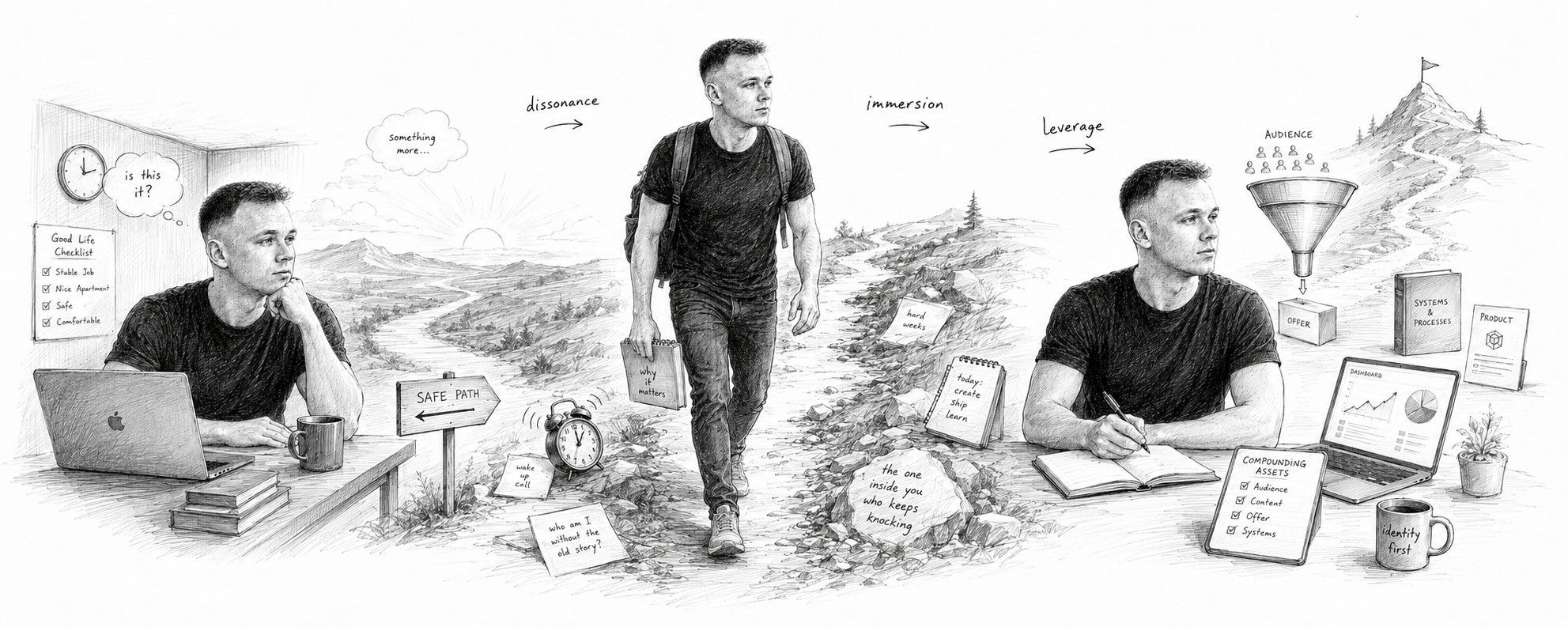
People enter entrepreneurship through 3 phases.
1. Dissonance: you feel misaligned with your life.
2. Immersion: you work with intensity, often inefficiently, but the momentum begins to change you.
3. Leverage: you discover the systems, tools, and compounding assets that make everything lighter.
Most people quit during dissonance or immersion. They never reach leverage, which means they never reach the phase where entrepreneurship becomes enjoyable. The part that actually looks like freedom from the outside.
This protocol is designed to walk you through those phases with accuracy. It demands honesty, attention, and a full day of your life. Give it those three things and the rest takes care of itself.
Part 1 - Morning
Excavation and honest self-inquiry
You need to build a new frame for your mind before you build a business. A new shell that feels too big at first and slowly becomes familiar. Most people skip this part and they jump straight into tactics without changing the identity that runs them, which is why the same outcome shows up every time: a few weeks of effort, a drop in energy, and the quiet return to whatever life they were trying to escape.
So sit down in the morning with a pen, paper, and the kind of space that allows you to actually think. You are going to dig into the motives you have been hiding from yourself, and this step matters more than any strategy you will ever learn.
Write slowly. Push past the first answer, because the first answer is almost always the rehearsed one.
What is the dull frustration you have learned to tolerate? The emotion that never explodes but never leaves either.
What do you complain about but never change? Write down the three complaints you say most often.
What would someone conclude about your ambitions if they watched how you behaved this year, rather than how you spoke about it?
What truth about your work ethic would feel embarrassing to admit to someone who respects you?
Those questions reveal the cracks. The next set turns those cracks into the picture of the life you refuse to live.
If nothing changed for the next five years, describe your average Tuesday. Where do you wake up, what do you think about first, how does your body feel, what work fills the hours between morning and night, and what emotion sits underneath all of it.
Then stretch the timeline to ten years. What opportunities have disappeared by then. What dreams became unrealistic. Who stopped expecting anything from you. Who already lives the future you fear.
Then turn the lens on identity itself.
What part of yourself would you need to let go of in order to escape this trajectory?
What is the most uncomfortable reason you have not started your entrepreneurial life already?
What are you protecting by staying the same, and how much is that protection costing you?
If you wrote honestly, you will feel a strange mixture of clarity and discomfort. That discomfort is the point. It is the pressure that creates movement.
Now turn toward the life you actually want. Ignore practicality for a moment. Imagine a version of yourself three years from now who already built the entrepreneurial life you keep thinking about. What does an average Tuesday look like for that person, how do they move through the day, how do they make decisions, what feels normal to them that would feel ambitious to you today.
Write down the beliefs they live from. Finish the sentence, “I am the type of person who...” Then write down one action that version of you would take this week without hesitation.
You now have a truth map for your mind. You know the life you fear, the life you want, and the person who lives in the gap between them. That is enough for the morning.
Part 2 - Daytime
Interrupting autopilot and breaking unconscious patterns
Morning reflection reveals the truth. Daytime reflection reshapes it. You need interruptions throughout the day that pull you out of your old patterns, because those patterns will spend the next twelve hours trying to reclaim your mind. They always do.
So you build in timed questions that shake you out of autopilot. Set alarms on your phone with these as the alert text, spaced across the day so they catch you when your guard is down.
11:00 - What am I avoiding right now?
1:30 - If someone watched the last two hours of my life, what would they think my goal was?
3:15 - Am I moving toward the life I want, or drifting back into the life I fear?
5:00 - What important thing did I pretend was unimportant today?
7:30 - What did I do today out of ego protection rather than genuine desire?
9:00 - When did I feel alive today, and when did I feel drained?
These questions work because they interrupt identity. Your mind runs on loops that keep you safe and also keep you small, and when you disrupt them consistently the loops weaken until new ones begin forming in their place.
Add deeper questions for the in-between moments where you walk, commute, or sit without stimulation. What changes if you stop needing anyone to approve of your ambition. Where are you choosing comfort over growth. What is the smallest version of your future entrepreneurial self that you could actually become tomorrow.
These create micro-awakenings throughout the day. They drag the unconscious into awareness, and that alone is often enough to begin shifting the trajectory.
Part 3 - Evening
Synthesizing insight and shaping the next chapter
Night is for integration. You spent the day pulling hidden motives to the surface, and now you have to make sense of what you found. This is the step that actually locks in a new trajectory, because it compresses scattered reflections into a single clear direction.
Sit down again and answer the following.
After today, what feels most true about why you have been stuck?
Name the internal pattern that weakens you most consistently.
Write one sentence describing the life you refuse to live.
Write one sentence describing the life you are moving toward.
Once those are written, build three lenses that determine how you make decisions from this point forward. These lenses are how you shape the way you see time itself.
The one-year lens answers what must be true in twelve months for you to know you broke the old pattern. The one-month lens answers what must be true thirty days from now in order for the one-year outcome to remain possible. And the daily lens answers which two or three actions you can complete tomorrow that align with the identity you are trying to embody.
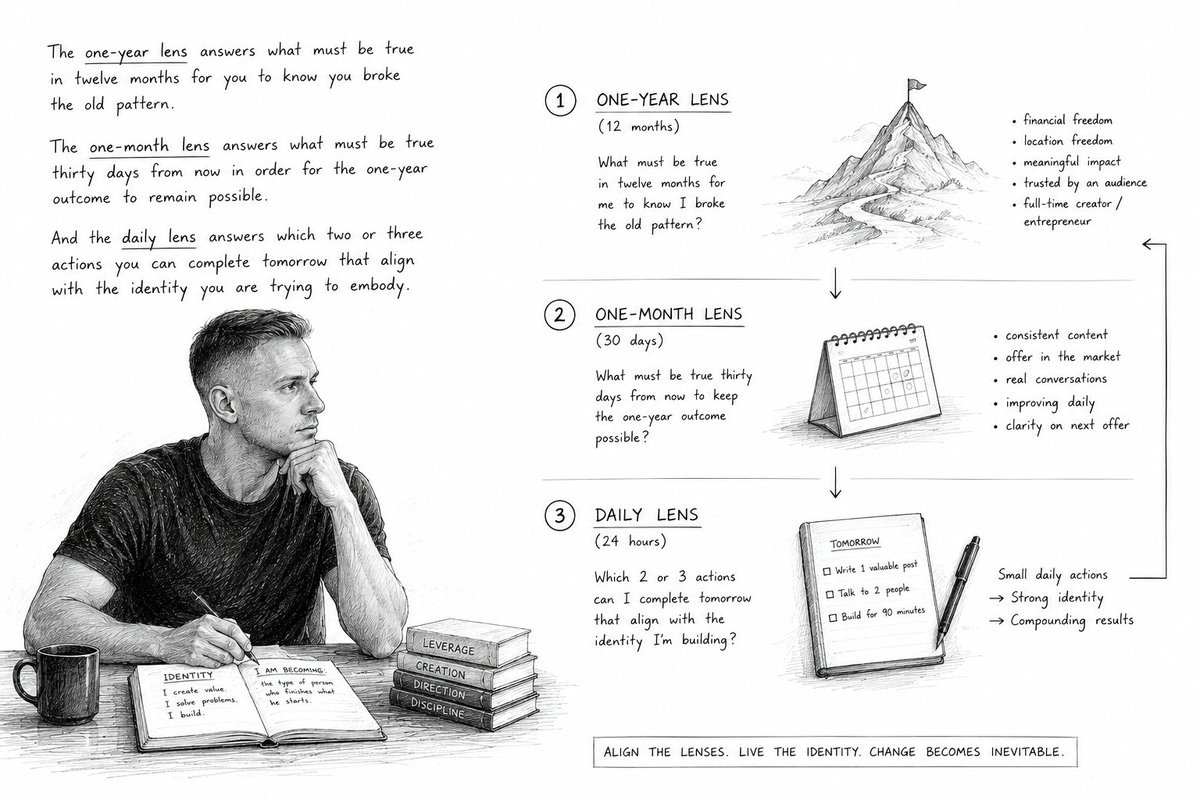
These lenses dissolve the illusion of overwhelm while also killing the fantasy of overnight results. Entrepreneurship becomes obvious the moment you have a direction, a near-term milestone, and a set of actions that advance both at once.
This is the moment your life begins to shift.
Turn entrepreneurship into a game
Games absorb your attention because they give you structure. Clear missions, clear rewards, clear consequences. Entrepreneurship feels chaotic right up until you build the same structure around it, and once you do, you become absorbed in your own progress in a way that makes drifting and hesitating much harder to do.
Write down these six components on a fresh page.
Anti-vision - the life you refuse to repeat.
Vision - the life that feels worth the effort.
One-year goal - the shift that proves you actually changed.
One-month project - the challenge that forces skill growth right now.
Daily levers - the two or three actions that compound when repeated.
Constraints - the rules you will not break while building this life.
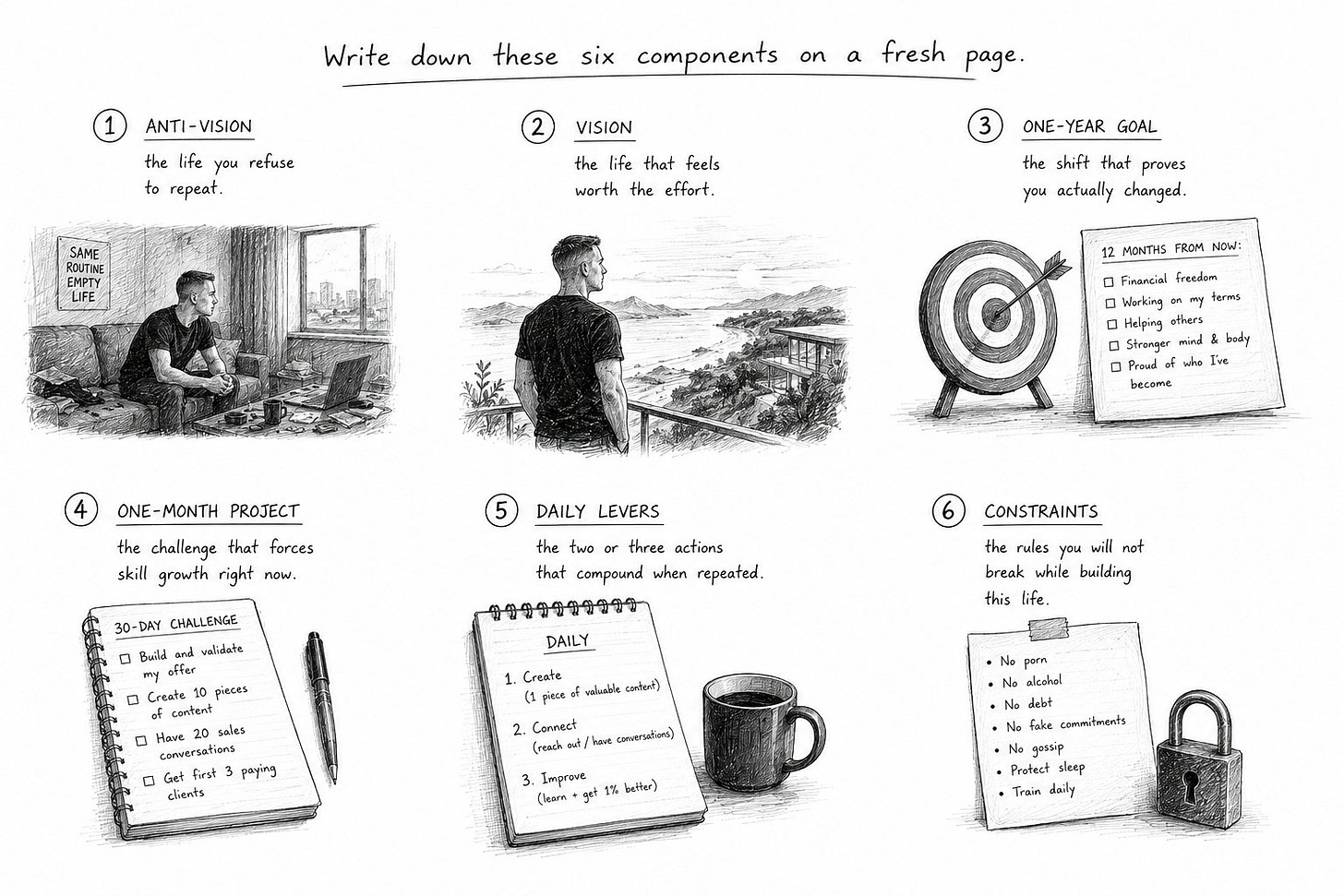
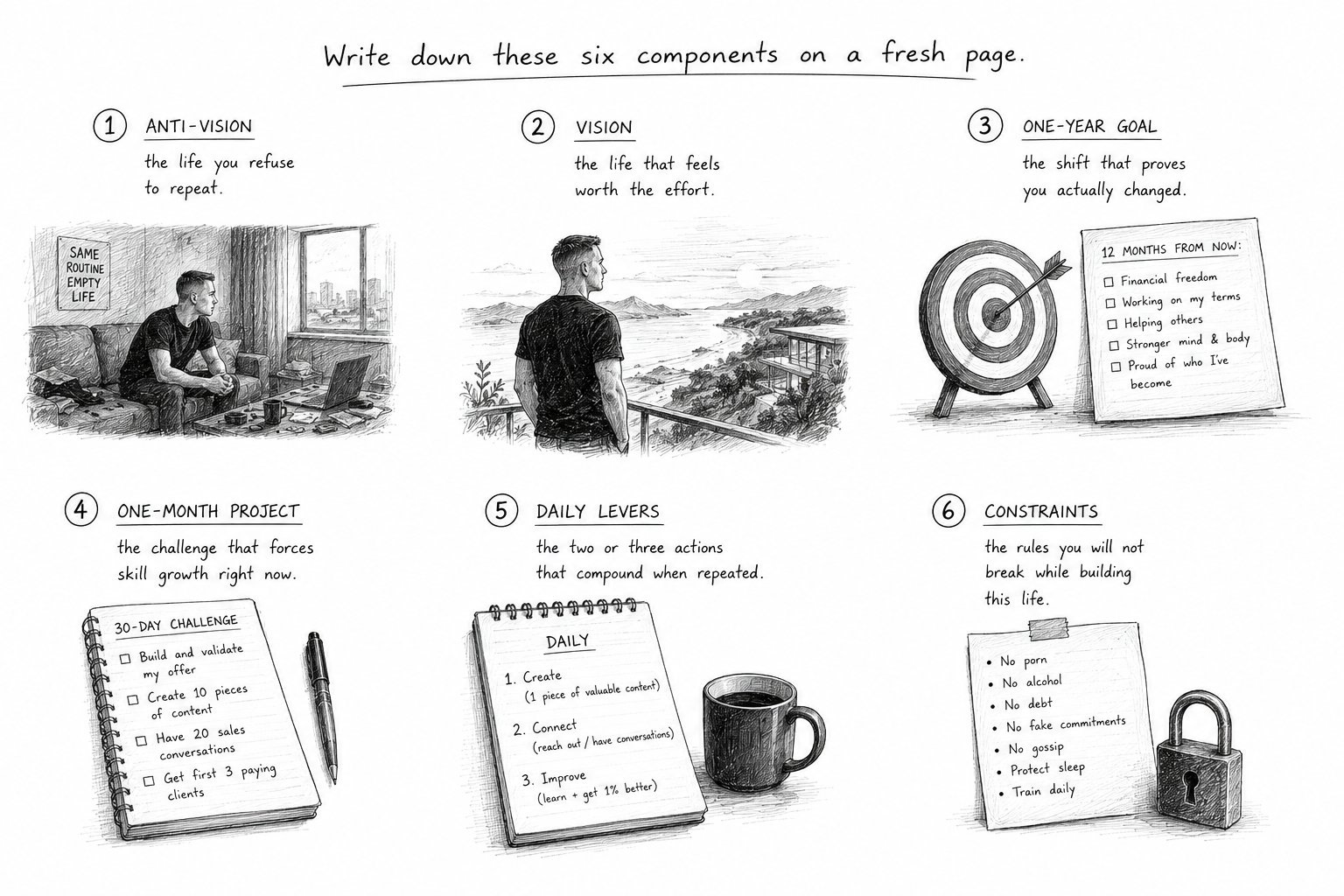
These six components together create your personal game world. A world with stakes, rewards, missions, and rules. Once it exists on paper, it begins to exist in your mind, and once it exists in your mind, it starts shaping your decisions without you having to force anything.
That is when obsession stops feeling like discipline and starts feeling like the natural response to being alive. Distractions lose their grip. The work pulls you in rather than you having to drag yourself toward it.
Which brings us to the part most people never reach.
Entrepreneurship is genuinely awful in the beginning. It breaks you, confuses you, challenges every story you told yourself about who you were, and strips away the illusions you built to protect a softer version of you. That phase has no shortcut, and pretending otherwise is the fastest way to quit.
But if you stay long enough, it shifts. Dissonance gives way to immersion, immersion gives way to the search for leverage, and leverage is where the tools, systems, and assets finally start multiplying the effort you have been putting in for months. Money begins flowing from the structure you built rather than the hours you traded, and the whole thing starts to feel like the life you imagined back at the start.
Most people quit long before that shift arrives. They quit somewhere in dissonance or immersion and never get within sight of leverage, which means they never get to experience the version of entrepreneurship that feels almost effortless once you reach it.
If you stay on the path, though, you eventually cross a line you cannot un-cross. The line where confusion becomes control, where hesitation turns into momentum, and where you stop waiting for permission and start generating outcomes on your own terms. Entrepreneurship becomes enjoyable the moment you stop being the old version of yourself, and that moment is almost always closer than you think it is.
The fantasy you have been holding onto is what ends here. The real life begins on the other side of it, and the real life is the one worth showing up for.
– Pascal
P.S.
Things I work on outside this, in case any of them are useful:
Follow me @xgrowthpascal where I’m documenting my journey from 0 to 10,000 followers in 90 days live and in public.
Follow me @iampascio where I share my build in public content, experiments and everything else I’m currently building or playing with
Join the Becoming newsletter where I’ll share my writings on creativity, ambition, identity and creation every week (as well as all 30 articles in this challenge)
There's a lot to unpack here and this deserves several re-reads. It's going to be interesting to see how in telling this story the storyteller will be forever changed.