

Your biggest disadvantage was always your biggest advantage
And why starting with nothing is the real cheat code

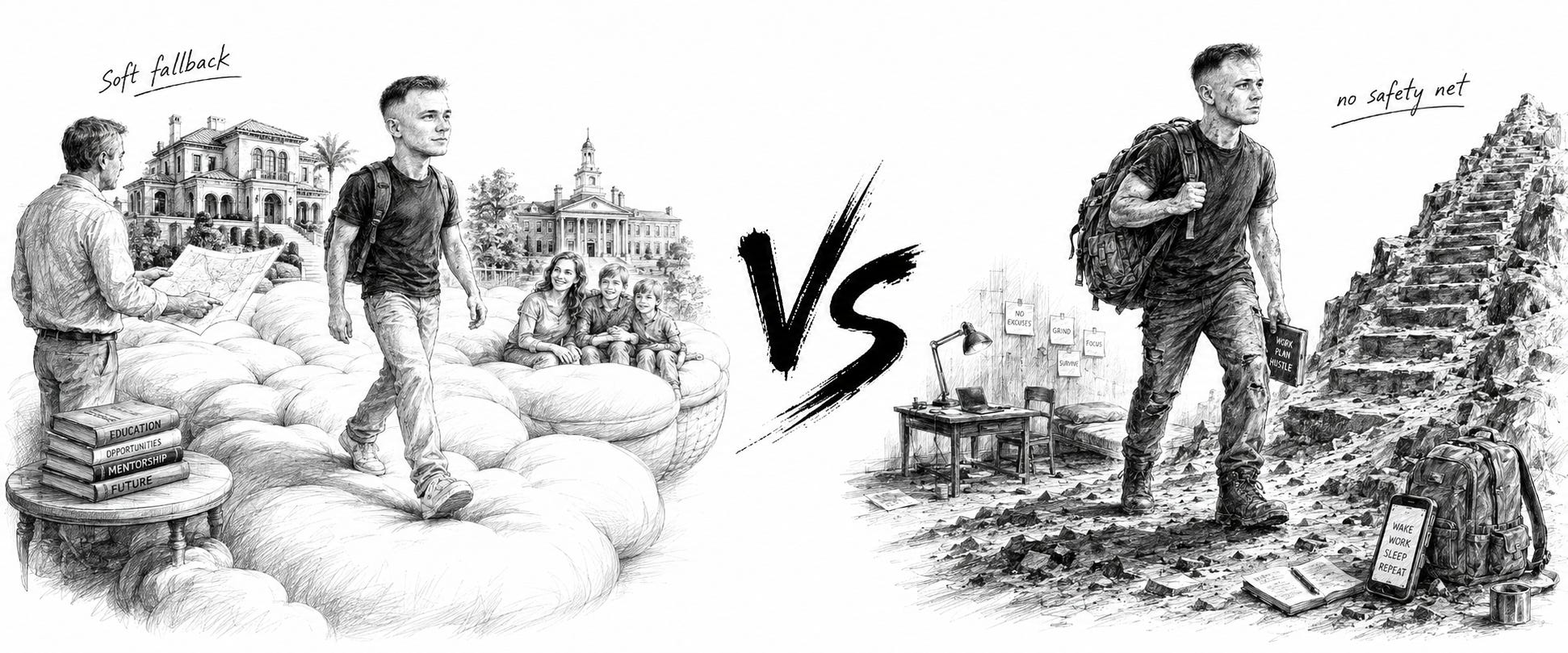
The biggest advantage I have today was statistically supposed to be my biggest disadvantage.
I grew up with no money, no connections, and no one to show me the way. For most of my twenties I was certain that was the reason things weren’t working, that I’d been left out of some inheritance everyone else quietly received. I had it exactly backwards, and it took me years to see how badly.
Let me start with the part that’s true, because skipping it would be telling you a lie. A head start does work wonders. You’ll see why soon. And by head start, I mean growing up with a stable father who shows you the way, lessons handed across the dinner table before you’re old enough to know you’re getting them, a net stretched beneath you so a bad year becomes a story instead of a catastrophe, all of which genuinely raises your odds.
Yes, statistically, people who start with those things are more likely to succeed, and pretending otherwise to make anyone feel better is a lie.
So let’s not do that.
Here is what almost no one tells you though:
That same head start quietly takes something from you on the way in. And the people who begin with nothing end up holding the one advantage that was never available for purchase.
The day I stopped blaming myself
For a long time I studied the people who made it and used them as evidence against myself.
I’d watch people who started near where I started pull away and build real things, and then I’d look back at my own life, where the same hours and the same effort kept turning into a fraction of the result, and I’d arrive at the only explanation that seemed to fit. They had a gear I didn’t. Some discipline, some talent, some wiring that got handed out in a room I wasn’t in.
So I did what you most likely do too.
I took the notes, ran their playbooks, followed the advice from every voice that had already arrived. And it would compound for them and stall for me, and every time it stalled the same quiet sentence would rise up from somewhere underneath.
“You’re just not built for this the way they are, Pascal”.
I believed that sentence for years.
Alex Hormozi was a big one for me. I used to study him the way some people study scripture. The man is a brilliant operator, and he earned it the hard way, sleeping on the floor of his first gym for months and nearly going bankrupt at twenty-six. I respect every bit of it.
But I did also have an existential realization not too long ago.
It took me a couple of years to notice it. The one thing this kind of story tends to leave in the background. In his specific case, that his father was a doctor. And that he went through one of the better prep schools in the country and graduated near the top of his class at Vanderbilt.
There was a foundation underneath the grind.
Once I saw it in him, I started seeing it everywhere, all the way to the very top. Bill Gates had a lawyer for a father and a mother who sat on corporate boards, and he went to a private school that somehow had a computer in 1968, back when most universities didn’t have one half as good. Morgan Housel ran the actual numbers on that and called it a one-in-a-million head start. Gates has said himself that without that school, there is no Microsoft.
Warren Buffett had a father who was a stockbroker and then a four-term congressman, a man who had nine-year-old Warren chalking stock prices on the blackboard in his brokerage and took him to see Wall Street as a boy. The most famous investor who ever lived was raised by someone who walked him directly into the world he would eventually rule.
I want to be careful here, because the easy thing to do now is to curdle this into resentment, and resentment would be a lie. None of this makes them frauds. These people are exceptional. The work they’ve done was real, and a head start builds nothing on its own.
But the head start was real too, and the day I let myself feel how much it mattered, the weight I’d been carrying finally made sense. The relief of that realization is hard to describe. I’d been running a far steeper version of the same race, alone, with no coach beside me and no map in my hand, and then blaming myself for being slower than people who started near the finish line.
If you’ve ever felt that exact thing, watching everyone around you seem to move through life on rails while you push uphill, sit with this before you read another word:
You are not the problem.
Most likely, you’re just running a harder course than the people you’ve been measuring yourself against, and mistaking the difficulty for a verdict on who you are as a person.
You may not know it, but often if you look deep enough, you’ll realize that a large percentage of the entrepreneurs you look up to and learn from are teaching you how to swim, and they’re teaching it beautifully. What they fail to mention is that, figuratively speaking of course, almost every one of them grew up with a pool in the backyard.
So let me tell you where my course actually started, because the place I was ashamed of turned out to be the source of everything.
Sixteen, with a set of keys
I moved out when I was sixteen.
I’ll spare you the details, because they aren’t mine to put on the internet, and the reasons aren’t the point anyway. What matters is that at sixteen, when most kids are negotiating curfews, I was holding keys to a 20m² studio apartment and a life that nobody was going to fund but me.
Luckily... my mom raised me well.
This turned out to come in real handy when I was sat there, alone in my studio at 16, forced to stand on my own. Growing up I remember always complaining about “child slavery” (lmao) because she would force me to clean the dishes, wash my clothes, cook, clean and so on. Only to realize later that it was her teaching me how to adult.
Today, I’m forever grateful that she made me do those things (you’d be surprised how many grownups don’t know how to cook or clean). Learning how to handle my business was the greatest gift I could’ve ever received, bar none. She taught me how to carry myself, how to treat people, all the things that actually hold a person together when everything else is uncertain. The values I run on today were directly instilled through grit and determination by her, and whatever character I’ve built sits on a foundation she poured.
What I didn’t have was the other kind of foundation.
The financial one. The structural foundation. The net that catches you when you fall. There was love, and there was nobody to call if rent came due and the money wasn’t there. Those are two different things, and I learned the difference at an age when most people are still decades away from spending a single night fully responsible for themselves.
Two years later I moved again, this time out of my home country, to Spain, a country where I didn’t even speak the language. And I did so to work a telemarketing floor, cold-calling strangers, knowing nothing about sales.
Before the first week was over, I was the best on the floor. People assumed I had done sales before. Others just said I was a natural. It was neither.
I won because I had nothing to protect.
The strange advantage of having nothing to protect
The others on that floor carried a quiet sense of dignity about the work. Standards about what they would and wouldn’t do, an ego that needed managing, a feeling that the job was a little beneath them. I had rent due and an empty account, and that combination burns away everything that slows a person down. I wasn’t precious about going off script. I felt no embarrassment about the work, although “the telemarketing guys from Spain” had the same rep that “crypto guys in Dubai” have today.
I just needed it to land, and when you need something to land and there’s no soft cushion behind you, you reach for an edge that people with a soft place rarely have to find.
This is the part those who grew up comfortable genuinely struggle to teach, because they’ve never had to live inside it. Growing up with a net hands you a beautiful and useful belief that trying is safe and failing is survivable. You carry it everywhere, and it makes you brave in a casual, low-stakes way. It works wonderfully, right until the moment it teaches you to hold a little in reserve. To keep your dignity intact or t protect the version of yourself that still has options.
I never learned to hold anything in reserve, because reserve was a luxury I couldn’t afford. I learned to move before I felt ready, to trust an instinct I couldn’t put into words, and to commit all the way to things that came with zero guarantees, because hesitation was something other people got to do.
That instinct turned into the most valuable thing I own today (secondary to knowing how to cook and clean, naturally). And it was forged entirely in the place I used to be ashamed of.
Stick with me here as we go a layer deeper.
What “having nothing” actually teaches you
This sounds like a consolation prize until you’ve lived it.
The first is the ceiling. When a stable parent shows you the way, they hand you their map of the world, and that map is a gift. It also has edges. The places they never went, the doors they assumed were locked, the limit of their own imagination drawn in as though it were the edge of the territory itself. You inherit their direction and their ceiling in the same envelope, and most people spend their whole lives tracing a slightly upgraded version of the path their parents walked.
I was handed no map, which feels like a loss right up until you realize no ceiling came with it. I never absorbed a clear sense of what wasn’t possible, so I kept walking through doors the people with maps had been taught to walk past.
The second is fear. Almost everyone is quietly governed by the fear of losing what they have, and that fear shows up loudest in the exact moments when boldness is what pays. When you start at the bottom and live through it, something permanent shifts. The bottom stops being a threat, because you’ve already been there and walked back out. Nobody can frighten you with a fall you’ve already taken.
That immunity is worth more than starting capital, because it lets you move freely in the rooms that freeze everyone with more to lose.
The third matters more every year that passes. The comfortable have lived a single life and have never once had to rebuild it from scratch. So when the ground moves under them, when a market turns or an industry gets rewritten in eighteen months or a business they poured years into quietly falls apart, they lock up, because starting over from nothing is the one skill nobody ever forced them to develop.
I have rebuilt my entire life from zero more than once. New country, new language, new circumstances, beginning again with my hands. The thing the comfortable fear most is the thing I have the most repetitions at, and in a world that keeps rewriting itself faster, that stops being a scar and starts being the whole game.
None of this can be bought, downloaded, or faked. It gets installed exactly one way: by having no other option. The people teaching you mostly arrived with the map, the net, and the certainty, and they skipped the part that builds this.
You’re then being handed the part that builds this and told it’s the thing holding you back.
What it really is, is a blessing in disguise.
What I keep at a respectful distance
There’s a certain flavor of advice I’ve grown cautious of, and I want to describe it carefully, because the people giving it are often talented and I have no interest in pretending otherwise.
It’s the advice that tells you to quit your job and bet on yourself, delivered by someone who had three months of savings and a degree waiting in a drawer. The instruction to go all in, from a person who has only ever observed what “all in with nothing behind you” actually costs. The starting line gets treated as the floor, when for an enormous number of people that starting line sits a long way above where they’re standing.
“Bet on yourself” is a thrilling sentence when losing the bet means moving back home for a while. It becomes a very different sentence when there is no home to move back to. I think about the sixteen-year-old in his first apartment hearing that phrase, and how the same five words land in two completely different universes depending on whether anyone is standing behind you.
I’m not interested in building on top of what any of these guys have built.
I came up from underneath it. And that gives me one thing their vantage point structurally can’t, which is the ability to actually see the person at the very bottom, because I was once standing exactly where that person is standing, and nobody near the top was looking down.
Most of the successful people in this space are, without quite realizing it, speaking to a slightly less successful version of themselves. People who already have the foundation and simply need the blueprint. I find that the least interesting audience to serve, because the foundation was always going to carry them most of the way. They were going to be fine.
Which brings me to the point of this essay in the first place.
Who I’m actually writing for
I write for the person reading this from a room that feels a size too small, on a phone, carrying a feeling in their chest they’ve never said out loud, because the people around them stopped imagining a different kind of life a long time ago.
I write for the person who came up without a net. Who has been figuring it out alone since before they were old enough to drive. Who reads the polished advice online and senses the invisible asterisk on every sentence, the one that says this works beautifully if you already have somewhere to land.
And here’s what I most want that person to walk away with:
The absence of a safety net is the heaviest thing you will ever carry, but it is also turning you into someone the comfortable will never become.
While they’re collecting frameworks, you’re being forged. While they’re keeping a backdoor open, you’re learning to go all the way in, because all the way in is the only road open to you. That capacity, the willingness to commit completely with nothing behind you, is the most powerful trait you can ever acquire.
The blueprint is everywhere now. The strategy, the tools, the systems, all of it is searchable, and I’ll happily teach you every piece. But the very thing that actually decides whether you make it lives somewhere beneath the strategy, in a place that only gets built through continued hardship. Most of the people teaching you arrived with the blueprint and skipped the forging.
You’re being handed the forging and you just need the blueprint.
That’s a far better trade than it feels like from where you’re sitting. It’s the one I made, and it’s the reason I’m writing this after years running a solo empire that’s done well over $1M in profit... instead of still cold-calling strangers on a floor in Spain from a small studio apartment.
I write for people with nothing because nothing is where I started, and because no one was writing for me when I was there.
Think of this as the letter I needed back then and never got.
I hope it’s useful for you.
- Pascal
Things I work on outside this, in case any of them are useful:
@iampascio on Twitter, my profile where I post my experiments and numbers
@xgrowthpascal on Twitter, where I’m going from 0 to 10k followers in 3 months
@creatorpascal on Twitter, my personal brand where I share essays just like this one (currently doing 30 essays in 30 days. This is day 20).
Your biggest disadvantage often becomes your biggest edge once you stop fighting it and start owning it.