

You're not free. You just escaped.
I wish more founders knew about The Freedom Pyramid.

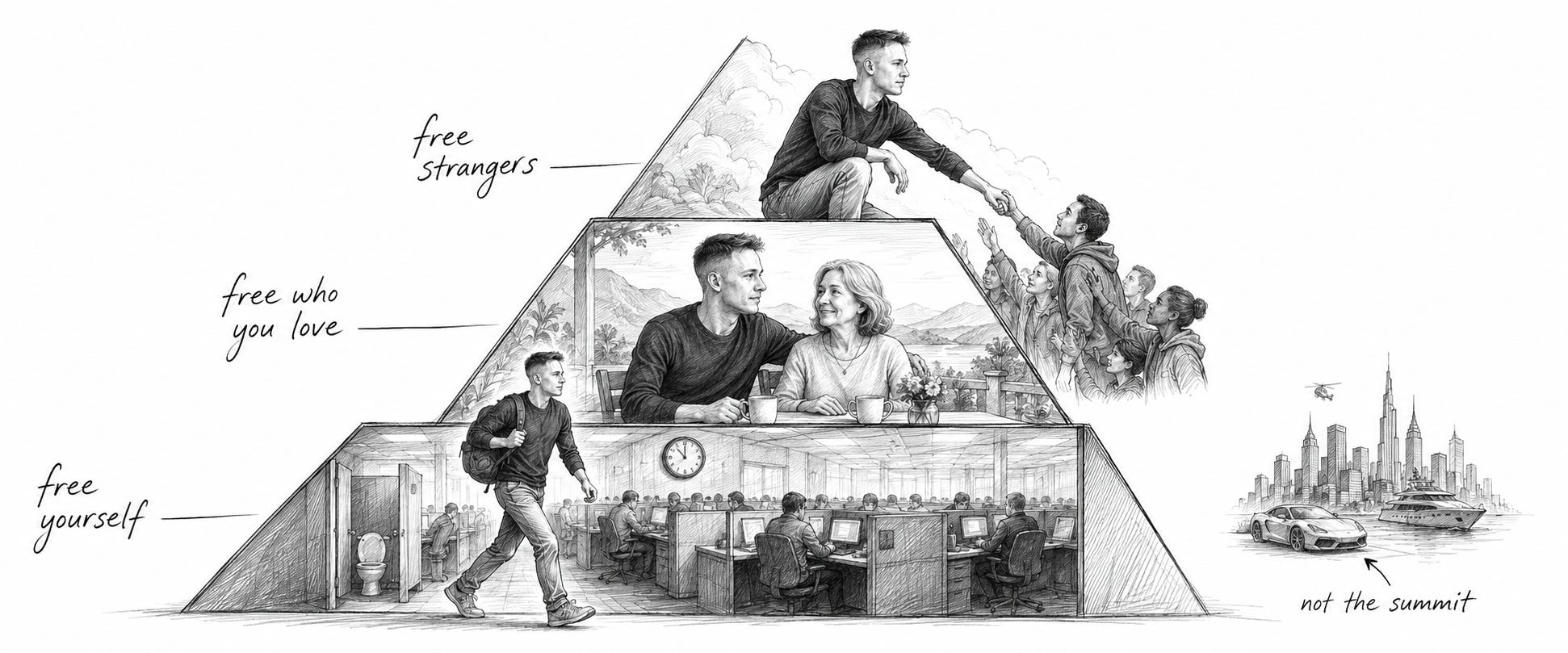
Most “free” people I know are just better-paid prisoners.
They quit the job, hit the income number and moved to the tax-friendly city. But if you sit across from them at dinner long enough, you can see it in their eyes: the quiet realization that whatever they thought they were running toward isn’t actually here.
I know this because I was one of them for the last few years. And I only figured it out after my mom died last year and I stopped having anyone left to perform for.
But before I get to that, let me take you back to where this all started for me.
Specifically, a toilet stall.
When I had my 9-5, my boss timed my bathroom breaks. I’m not exaggerating. She’d actually clock how long I’d been gone, and if it crossed some threshold she’d decided on, there’d be a passive-aggressive comment when I came back. The funny part, in hindsight, is that I was using those breaks to build my business in secret while pretending I had stomach issues for the better part of a year. To anyone I worked with at the time who’s reading this, that’s where I was going. I wasn’t sick at all lmao. I was building a side hustle while pretending to be on the toilet.
That’s where my pursuit of “freedom” began.
On a toilet seat in an open-plan office in 2021, with a phone in my hand and a boss timing me from her desk.
Fast forward five years. I had the income. I had the apartment in Dubai. I had the time freedom, the location freedom, the financial freedom. Every variable on the entrepreneur vision board, checked. And by every metric the internet sells you on, I “made it”.
And yet I’ve packed my stuff and left Dubai for good, because somewhere along the way I figured out that what I’d actually built wasn’t “freedom”.
It was a much nicer cage.
This piece is about the difference between the two. I’m going to walk you through a framework I call The Freedom Pyramid. It has three levels. Almost everyone reading this is on level one without knowing the other two exist. And there’s a deadline on level two that nobody warns you about, which is the regret I’ll be carrying for the rest of my life.
If you’re already further along, this will name some things you’ve been quietly feeling. If you’re not, this is going to save you ten years.
Take your time with it.
Freedom is really a stack of three things.
Most people use “freedom” the way a kid uses “rich.” Vaguely, emotionally, and without stopping to define the word.
You can’t pursue something you can’t define. And freedom in the abstract is just a feeling, usually the feeling of not this anymore. Not this job, this commute, this apartment... or this version of me.
Strip the romance away and freedom is actually structural. Three layers, climbed in order whether you like it or not:
You free yourself first.
You then free the people you love.
Eventually, you end up freeing strangers.
And the order in which these must happen is very particular. You can’t free anyone else from inside a cage you haven’t escaped yourself, or as the good old airlines like to say: “Put the mask on yourself first”.
Most people get stuck at level one and never figure out there are other levels. A smaller group makes it to level two and treats it as the finish line. Almost nobody reaches level three with anything resembling a soul still attached, because by then they’ve usually traded their inner life for the climb.
The trap at every level is the same trap wearing different clothes.
You start chasing a level for one reason. You hit it. Then you keep chasing it on autopilot long after the original reason has expired. And then you wonder why the wins stopped feeling like wins.
That’s what I want to walk you through. One level at a time.
Level 1: the cage and the toilet stall
The first level is what every business guru on the internet sells you on.
“Free yourself”
The classic trinity: time, location, money. You quit the job. You set your own hours. You stop checking the price tag at restaurants. You take the flight without doing the math twice. Money goes from being the thing that runs your life to being a tool you occasionally pick up to live it better.
I started here (like everyone else).
It started in that toilet stall, but skip ahead a few years and the cage I was sitting in had become the trigger for everything that came next. That kind of frustration, the boss, the timer, the cubicle, the rented hours, that’s what pushes most people into entrepreneurship. Just the deep, animal sense that this can’t be the rest of my life. The cage is the whole motivator.
Eventually I escaped the cage. Time, location, money. I had it all.
But here’s what the YouTube videos don’t prepare you for: First, it works, it’s real. And then, slowly and quietly, it stops being enough.
Freedom at level one is fundamentally about removing things. You’re stripping constraints away. The boss. The commute. The financial anxiety. The obligations. The worry. And once you’ve stripped enough of them, you wake up one morning in the apartment you used to dream about, drinking coffee from the $2,000 Espresso machine you used to dream about, opening the newest Macbook Pro you used to dream about, and there’s a quiet hum of is this it?
This is where most successful people get stuck.
They try to fill the empty space with more removal. More money so they can work less. More travel so they’re tied down less. More options so they’re committed to less. Negative goals stacked on negative goals, until one day you notice you’re more “free” than you’ve ever been and somehow lonelier than the day you sat in that cubicle.
Removal is the engine that gets you to level one. It’s also the engine that traps you there if you don’t realize it’s run out of fuel.
Level 2: the deadline you don’t control
The second level is the one nobody talks about online, and it’s the most important one in this entire piece.
Most online business founders stop at level one. The whole narrative is here’s how I escaped, here’s how I retired at 30, here’s how I made my first million, as if the personal escape were the whole game.
But it’s not. It’s simply the prologue.
Once you’ve actually freed yourself, your nervous system starts asking a different question. Might take a year. Might take five. But it always shows up. Some version of: now what? What do I do with this?
This is the moment your soul rotates outward. You stop building for yourself and start building for the people you love. You want to retire your mum so she stops waking up at 6am to a job she’s hated for thirty years. You want your dad to stop worrying about the boiler. You want your sister to stop calculating whether the dental work is worth it. You want your partner to take the gig they actually want, not the one they need because you’re broke.
It’s the layer that surprises people the most. You build, you grind, you escape, and then your inner gravity quietly shifts. The mission simply changes without announcing it to you.
For me, level two was my mum.
When I freed myself, retiring her became the next goal. I wanted her to never check a price tag again. I wanted her to wake up slow, travel often, and look at her old life, the early shifts, the small worries, the budgeting, the way I now look at my old cubicle.
I never quite got her there.
She passed last year before I could fully retire her. I did fly her out to Dubai a handful of times, all expenses paid, suite with sea view, the works. We ate at restaurants she’d never have walked into otherwise. She rested. She tried things. She got to see what I’d built. More importantly, she got to be proud of me while she was still here to be proud.
But I never crossed the finish line on her, and that’s a weight I’ll carry the rest of my life.
What I want you to absorb, and I’m only writing this because I lived the wrong side of it, is that level two has a deadline you don’t get to negotiate.
Level one is patient. Your bank account doesn’t expire. The freedom you build for yourself will still be there in twenty years if you keep showing up.
The people on your level-two list will not.
Internalize that one fact and your calendar reorganizes itself. If you’ve already escaped, if you’re past the point of actual personal need, and the people you love are still trapped, every year you spend stacking another zero in You’re not free. You just escaped.
Most “free” people I know are just better-paid prisoners.
They quit the job, hit the income number and moved to the tax-friendly city. But if you sit across from them at dinner long enough, you can see it in their eyes: the quiet realization that whatever they thought they were running toward isn’t actually here.
I know this because I was one of them for the last few years. And I only figured it out after my mom died last year and I stopped having anyone left to perform for.
But before I get to that, let me take you back to where this all started for me.
Specifically, a toilet stall.
When I had my 9-5, my boss timed my bathroom breaks. I’m not exaggerating. She’d actually clock how long I’d been gone, and if it crossed some threshold she’d decided on, there’d be a passive-aggressive comment when I came back. The funny part, in hindsight, is that I was using those breaks to build my business in secret while pretending I had stomach issues for the better part of a year. To anyone I worked with at the time who’s reading this, that’s where I was going. I wasn’t sick. I was building a side hustle on the toilet.
That’s where my pursuit of “freedom” began. On a toilet seat in an open-plan office in 2017, with a phone in my hand and a boss timing me from her desk.
Fast forward seven years. I have the income. I have the apartment in Dubai. I have the time freedom, the location freedom, the financial freedom — every variable on the entrepreneur vision board, checked. By every metric the internet sells you on, I made it.
And yet I’m packing boxes right now to leave Dubai for good, because somewhere along the way I figured out that what I’d actually built wasn’t freedom. It was a much nicer cage.
This piece is about the difference. I’m going to walk you through a framework I call the freedom pyramid. It has three levels. Almost everyone reading this is on level one without knowing the other two exist. And there’s a deadline on level two that nobody warns you about, which is the regret I’ll be carrying for the rest of my life.
If you’re already further along, this will name some things you’ve been quietly feeling. If you’re not, this is going to save you ten years.
Take your time with it.
Level 3: the part of the climb almost nobody reaches
The top of the pyramid is the level I’m not on. I’ll say that upfront.
But the strange thing about climbing this thing honestly is that you can usually see the shape of the level above you long before you arrive at it. You feel the gravitational pull. You can tell, from where you’re standing, what’s quietly waiting for you when you’re done with where you are.
Level three is what happens when level two runs out of people.
Eventually, if you’re successful enough and patient enough, your inner circle is taken care of. Parents, siblings, partner, kids if you have them. Everyone who ever woke you up at 3am with worry is now sleeping fine. And you still have money coming in.
This is the moment most “winners” reveal what they actually believe about life.
Some buy more supercars. Some collect houses they never live in. Some collect women they don’t love. Some buy the third yacht because the second one got too small. The size of the toy keeps going up, the joy returned per dollar keeps going down, and at some point they’re spending eight figures a year to feel almost as alive as they did when they were 25 and broke.
To outsiders this looks like winning.
From the inside, I suspect it feels like an itch you can’t quite reach.
The way out, and the people who’ve actually made it through this stage seem to agree on this, isn’t more consumption. It’s giving. Funding causes. Building schools. Lifting strangers you’ll never meet onto a baseline of dignity you take for granted. Tony Robbins talks about this constantly, and it sounds like a Hallmark card until you actually look at the mechanics of it.
Giving works at level three for the same reason removal works at level one.
They both restore movement to a system that’s stalled out.
Level one removes external constraints. Level two removes them for the people you love. Level three is where you finally turn inward and remove the part of yourself that thinks meaning comes from accumulation.
That last move is the hardest one. Most people will never make it, and not because they don’t have the money, but simply because they lack the inner architecture for abundance to leave them unwarped. By the time they could be giving, they’ve spent two decades training their nervous system to acquire, and acquisition has become their identity entirely.
You don’t dismantle that with a donation, but by living long enough at the top of the pyramid that the smaller game stops fitting you.
I haven’t been there. But I’ve been around enough people who have, and I’ve watched my own psychology shift just enough at my current stage to recognize what they’re describing. The pull toward something larger is a developmental stage, the same way puberty is a developmental stage, or grief, or a midlife crisis. You don’t choose it. It just arrives at your doorstep.
You can either grow into it or you spend the rest of your life buying things to drown it out.
The descent
Here’s the part of the freedom pyramid no one warns you about.
It’s not a one-way climb.
You don’t escape your job, retire your mum, fund a charity, and then ride off into the sunset like the credits are rolling. You go up. You go back down. Sometimes by choice, more often because life kicks you down a level and forces you to redefine what the rung actually meant.
I’ve been up and down this thing several times.
The most recent descent is the reason I’m leaving Dubai for good.
When I first arrived, Dubai was the trophy case for level one. The skyline. The cars. The tax structure. The kinetic energy of ambitious people from every continent stacking on top of each other in a desert. It was the perfect external mirror for what I thought freedom was at the time.
Then my mum passed.
In the silence that followed, I started asking the question I’d been avoiding for years.
What is freedom, actually?
Was it living in the most aspirational city on earth, building a bigger business, making more money, moving into a bigger apartment, achieving more, doing more, becoming more? Because that’s what I was doing. That’s what I was telling myself was the point for years on end.
I’m now realizing, and it’s uncomfortable to write this, that I always wanted to fulfill that potential to please someone else. To prove a thing. To make my mum proud of me. To show some imagined version of the people who doubted me that I had it in me all along.
When the person you most wanted to make proud is gone, the whole performance loses its audience.
What’s left is a strange kind of clarity.
Freedom today means something completely different to me than it did three years ago. Freedom is the ability to build, and to settle. I came to understand that nothing in Dubai is ever really yours. You move from rental to rental every twelve months. You never fully become a citizen. You never put down anything resembling roots. Freedom is the smell of fresh rain on a foggy spring morning. The slow, soul-feeding stuff that doesn’t show up on a balance sheet.
So I climbed back down to level one and discovered I’d defined level one wrong the entire time.
I’d defined it as the removal of constraints. What I actually needed was the right kind of constraints. Roots. A home. A neighborhood with a smell. A pace that lets a Tuesday feel different from a Saturday.
That sounds obvious as you’re reading it. It’s the kind of obvious that costs half a decade and one specific loss to actually understand.
The 50/50 rule, applied to the wrong thing
What happened in Dubai reminds me of how I think about money.
I save 50% of what I make like I’m going to live another hundred years.
I spend 50% of it like I’m going to die tomorrow.
You can’t take money into the grave, so what’s the point of hoarding all of it? At the same time, you don’t want to be 80, broke, regretting that one trip to Vegas at 32. So you split the difference. Half for the version of you that might live forever. Half for the version of you that might not see Sunday.
I’ve run this principle on my money for years. It works. It keeps me sane. It lets me enjoy the present without bankrupting the future and lets me build the future without starving the present.
The unfortunate part is that I forgot to apply it to my actual life.
I spent almost all my time working. Building the business bigger. Making more money. Climbing toward more freedom and more security in an abstract future I never quite arrived at.
In life-terms, I was 100% saving and 0% spending. I just wasn’t saving money, but days. Banking weeks and years against some future ledger that nobody actually pays out on. Telling myself I’d enjoy it later, after the next milestone, after the next launch, after the next thing.
Instead of just being where I was. Calling my mum more often. Sitting with the rain. Noticing the city while I was actually in it. Letting a Sunday feel like a f*cking Sunday.
The freedom pyramid is structurally correct. You really do free yourself, then your loved ones, then strangers, in that order, and the order doesn’t bend. But the climb itself is meaningless if you treat the present moment like a tax you’re paying to access the future.
That’s the lesson I keep relearning, one descent at a time.
How to actually use this
If you want to take the pyramid and apply it instead of nodding and closing the tab, here’s the protocol I’d run.
1. Define each level in concrete terms.“Free yourself” means nothing on a vision board. What does it actually look like? What’s the monthly income, from what sources, with what kind of obligations attached?
Write it as a number and a description (not a feeling).
2. Put names on level two. Who, specifically, are you freeing? Mum? Dad? Partner? Sibling? Write the actual names. Then write what “free” looks like for each of them. Paid-off mortgage. A specific monthly transfer. Healthcare covered. Retirement funded.
Vagueness at this level is what costs people the most.
3. Set a level-two deadline that’s shorter than feels comfortable. The people on your level-two list have a clock you don’t control. Whatever date you came up with for “when I’ll retire my parents,” cut it in half.
You can always be early. You can’t be late.
4. Stop overshooting level one. This is where successful people sabotage themselves. They build to the point of personal freedom and then keep building for personal freedom because that’s the muscle they’ve trained. Past a certain point, the marginal joy of the next $100k for yourself is basically zero. The marginal joy of $100k spent on level two is enormous.
Reallocate accordingly.
5. Live each level instead of just funding it. Level one isn’t hitting the income number. It’s actually using the freedom. Taking that trip. Having the slow morning. Sitting with the rain. If you’ve hit level one financially but you’re not living it, you’ve built a beautiful house and refused to move in.
Avoid at all costs.
6. Treat the descent as part of the climb. You’ll get knocked down. Loss, illness, breakups, business collapses, identity crises. When it happens, don’t read it as failure. Read it as the pyramid forcing you to redefine the level you thought you’d already mastered.
The people who rebuild after losing it all almost always come back with a much truer version of level one than they had the first time.
7. Apply the 50/50 rule to your life, not just your money. Save half of it like you’ll live another hundred years. Spend half of it like you’ll die tomorrow. If you can look at this week’s calendar and not find the “spend” half, you’re saving days you’re never going to cash in.
The Freedom Pyramid is a map for a climb that has no summit.
You start at the bottom because you have to. You can’t free anyone else from inside a cage. You move up because once you’re out, the cage stops being interesting and the people still inside it start to matter more than the view from outside. You eventually move higher still, because at a certain altitude, the only people left to free are people you’ll never meet.
But none of that climbing matters if you forget to actually be there for it.
That’s the part I forgot and it’s the part I’m rebuilding actively now. And if anything, that’s the part I want you to take from this piece.
Long before life decides to teach it to you the way it taught me.
– Pascal
Things I work on outside this, in case any of them are useful:
@iampascio on Twitter, my profile where I post my experiments and numbers
@xgrowthpascal on Twitter, where I’m going from 0 to 10k followers in 3 months
@creatorprascal on Twitter, where I share essays just like this one (currently doing 30 essays in 30 days. This is day 14).
Thank you for sharing this insightful and obviously very personal article, however I think it might need a bit of editing as there seems to be a massively repeated section in the middle. 👍
Effort mode is genuinely underused, but the framing here buries the real issue. most people don't hit a quality ceiling because of settings, they hit it because their prompts are vague. opus on high effort with a bad prompt still hallucinates confidently.