

Grand Theft Attention
Your attention is being stolen.

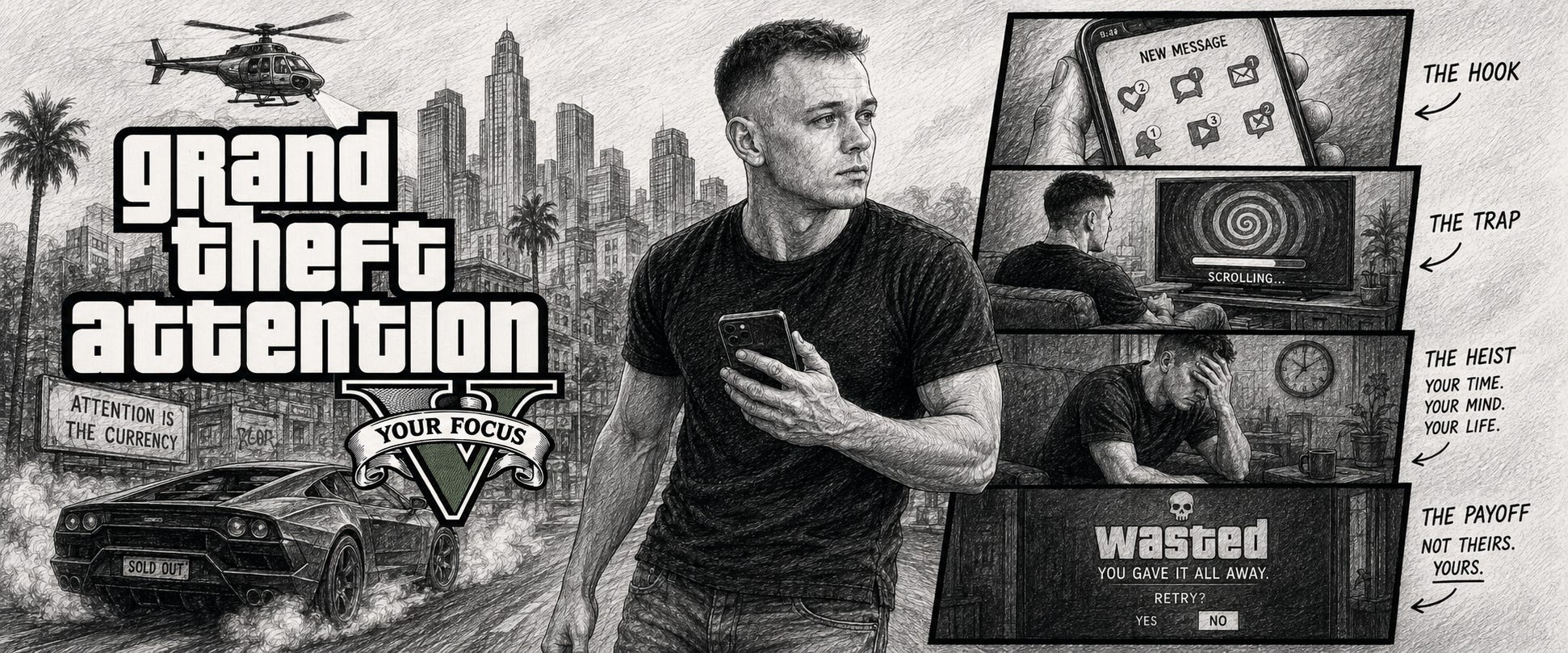
There’s a thing that’s been happening to all of us, slowly, for about fifteen years now, and I think you’ve noticed it but haven’t fully understood what it is.
I hadn’t either, until recently.
For context, the past 12 days, I’ve been running an experiment of forcing myself to sit down and write 30 long form essays in 30 days just to see what the f*ck happens. And during this experiment, I’ve finally reached a conclusion.
Let me explain.
There is a tiny percentile of people who love reading this kind of long form content. But then... there’s the other majority. And it’s by writing these essays that I’ve finally understood to what extent this problem have really gone to. See, when I asked a few close friends, and even my girlfriend, to read specific essays that I thought would apply to them...
Each and every time I asked them, “so did you finish it?”
The answer would be: “I tried, but it’s just so long!”
This was the final nail in the coffin that cemented the idea that I’d had up until now.
That if even the closest people next to me cannot even finish one long form essay
... something is terribly wrong.
So I want to walk you through it the way I walked through it myself, because once you see this clearly, you can’t go back to not seeing it, and I think that’s a good thing even though it’s going to be very uncomfortable.
You’ve probably felt this.
You sit down to work on something that matters to you. A project, a piece of writing, a business plan, something you actually care about. And within minutes your brain starts itching. This low-grade pull toward something else. Your hand reaches for your phone before you’ve consciously decided to pick it up. You open an app, scroll for what feels like thirty seconds, and when you look at the clock twenty minutes have passed. You put the phone down, try to refocus, and the itch comes back almost immediately. It’s like trying to hold water in your hands.
And at some point, probably in the last few years, you started to believe something about yourself because of this. You started to think that you’re the problem. That you lack discipline. That your attention span is broken. That something is wrong with you specifically, because other people seem to manage just fine and you can’t sit with a single task for an hour without your brain crawling out of your skull.
I believed this about myself for a long time. I genuinely thought I had some kind of deficit. I bought books about focus, tried every productivity system, deleted apps and redownloaded them, set screen time limits and blew past them. I told myself I was weak, undisciplined, scattered and I compared myself to people who seemed to have it together and assumed I was just wired differently.
Then I started learning about how the technology I was using every day was actually built, and what it was built to do. And I realized that what I thought was a personal failing was actually an engineered outcome. My attention span wasn’t broken. It was being stolen. Systematically, deliberately, by some of the most well-funded and intelligent companies in the history of the world.
And they were doing it on purpose.
The thing nobody explains to you
Just so we’re in the clear, this is not going to be an anti-technology rant.
I build digital products for a living. I make my money online. I’m not going to tell you to move to a cabin in the woods and read leather-bound books by candlelight. That’s not realistic and it’s not the point I’m trying to get across.
The point is that there is an enormous gap between what most people think their phone is doing and what it’s actually doing, and that gap is ruining people’s ability to think clearly, work deeply, and build anything meaningful. And almost nobody talks about it honestly because the companies responsible for it are also the platforms where all the talking happens.
Here’s what I mean exactly:
Every major social media platform, every app that makes money from advertising, every notification system on your phone... they all employ teams of engineers and designers whose entire job is to make you spend more time on the app. Their only goal is to engineer how to capture more of your attention, because your attention is what they sell to advertisers.
This isn’t a conspiracy theory either. This is their published business model. When a product is free, you are the product. You’ve heard that before. But I don’t think most people have actually sat with what it means in practice.
It means that some of the most brilliant engineers alive (people who could be working on medicine, energy, infrastructure, anything else), are spending their careers figuring out exactly which shade of red makes you tap a notification icon more reliably. Which scroll speed keeps you swiping longest. Which combination of content, timing, and reward makes you come back most frequently. They run thousands of experiments, on millions of people, constantly, to optimize one metric: time spent on platform.
And they’ve gotten extraordinarily good at it.
The average person now picks up their phone somewhere between 80 and 150 times a day because the device in their pocket was designed by a team of people who studied behavioral psychology, addiction mechanics, and variable reward schedules. The same principles that make slot machines work. And they applied all of it to the thing you carry with you every waking moment of your life.
What this is actually costing you
We need to talk about what this does to you in practice, because I lived inside it for years without understanding the real cost. And the cost isn’t just “I waste time on my phone.” That’s the surface-level version, and it dramatically understates the problem.
The real cost is what happens to your brain chemistry when it’s being interrupted hundreds of times a day.
There’s this concept in cognitive science called “attention residue”. When you switch from one task to another (say you’re writing something and then check your phone and then go back to writing), your brain doesn’t switch cleanly. A piece of your attention stays behind with the thing you just looked at. It lingers. And that residue accumulates throughout the day, so by afternoon you’re no longer operating with 100% of your cognitive capacity. You’re just operating with whatever’s left after a hundred tiny interruptions each took a small piece and didn’t give it back.
This is why you feel exhausted at the end of a day where you didn’t actually do much. Your brain was shredded by a thousand micro-distractions that each seemed harmless in the moment but collectively left you running on fumes by 3PM.
And here’s the part that really got to me when I finally understood it: the things that matter most in your life whether building a business, creating something meaningful, thinking deeply about a problem, being truly present with someone you love, these all require sustained attention. They require your brain to stay with one thing, uninterrupted, for long stretches.
That capacity is exactly what’s being stolen from you, all day, every day.
The ability to think deeply is not a personality trait that some people and others don’t. It’s a resource. And it’s finite. Every time your phone buzzes, every time you check a feed, every time an app pulls you in for “just a second,” you’re spending that resource on something that gives you nothing back. And when you sit down to do the thing that actually matters, the account is empty. You already spent your attention budget on things that were engineered to take it from you.
I spent years thinking I had a focus problem.
I’ve now come to the realization that the only problem I has was being stuck in an environment that was designed, down to the pixel, to prevent me from focusing. And I was blaming myself for the result.
What I actually did
I didn’t delete everything, or go off the grid, or do any of the dramatic things people usually do when they write essays like this. I did something much simpler and much more effective: I redesigned my environment so that distraction required effort instead of attention requiring effort.
One more time for the people in the back:
I redesigned my environment so that distraction required effort instead of attention requiring effort.
To put it simply, I removed all social media apps from my phone. Not from my life, just from my phone. That means if I want to check Instagram or Twitter, I have to open a browser, go to the website, and log in. That one layer of friction (maybe fifteen seconds of effort), eliminated about 80% of my mindless scrolling overnight. I realized that my scrolling was never intentional. It was merely a reflex. And reflexes need a frictionless path.
Add even a tiny obstacle and the reflex dies.
I also turned off every notification except calls and messages from actual humans. Every app notification, every news alert, every “someone liked your post” ping... gone. My phone became a communication device again instead of an interruption machine. The silence, the first day, was almost eerie. I kept reaching for my phone expecting something to be there. Nothing was. And after about a week, the reaching stopped and the itch died down.
I started putting my phone in another room during the first four hours of my day too. Not on my desk face-down next to me or on silent in my pocket, but in another room, behind a closed door. Out of sight, out of reach, out of mind. Those four hours became the most productive hours of my day by such a wide margin that it was almost laughable. It was like discovering I’d been trying to run a race with a backpack full of rocks and someone finally told me I could take it off.
None of this required discipline. That’s the part I want you to understand.
I didn’t magically wake up one day and become a disciplined person, but I did stop putting myself in a fight I was guaranteed to lose. You, or no one else for that matter, cannot out-willpower a system designed by thousands of engineers to capture your attention. But what you can do is remove yourself from the system entirely. And when you do, your natural capacity for focus (the one you thought was broken) comes back so fast it’s almost disorienting.
Within a month, I could sit with a single task for three or four hours without the itch that was never mine to begin with. It was manufactured, and I stopped exposing myself to the thing manufacturing it.
What I want you to understand
I’m not writing this to tell you that your phone is evil or that technology is the enemy. I use technology every day. It’s how I make my living and how I connect with people I care about.
But I am telling you that there is a war being fought over your attention, and you are losing it, badly, without even knowing you’re in it. The exhaustion you feel at the end of the day, the inability to focus on the things you care about, the sense that you’re always busy but never making progress, the feeling that something is wrong with your brain... none of that is you.
It’s the environment you’re operating in. An environment that was designed, with enormous sophistication and unlimited funding, to fragment your attention into pieces small enough to sell.
Which leads me to the most important point.
The most valuable thing you own isn’t your money. It’s your attention.
Because attention is what you build your life with. Every meaningful thing you will ever create, every deep relationship you will ever have, every important thought you will ever think, all of it requires sustained, uninterrupted attention. And right now, most of yours is being siphoned away, in two-minute increments, by companies that will never give it back.
You’re being robbed. And the first step to getting your life back is understanding that the problem was never your discipline.
It was your environment.
Fix it, and you won’t believe what you’re capable of.
If this resonated with you, send it to someone who thinks they have a focus problem (they don’t). It’s just nobody told them what’s actually happening, and I think they deserve to know.
- Pascal
Things I work on outside this, in case any of them are useful:
@iampascio on Twitter, my profile where I post my experiments and numbers
@xgrowthpascal on Twitter, where I’m going from 0 to 10k followers in 3 months
@creatorpascal, my personal brand where I also share these essays as articles
Pascal I have read all 12 essays and yes what you said about your close friends even your girlfriend not being able to sit with your long form work resonated with me.
I am actually going to turn off all notifications now except for only my Whatsapp.
So I can be Intentional about it.
If I want to enter and app I enter not because of the notifications but on my own will.
Thanks for sharing
I’m really enjoying these long posts-I’m still stuck on the “You think you want to be an entrepreneur” post because it requires chewing like a good steak. Honestly, I’m not sure if I want to be an entrepreneur. I was married to a bad one. I’ve seen good ones, but it would require such a drastic change from my typical way of living that I’m hesitant.