

How to build a network if you weren't born with one
The art of Upstreaming

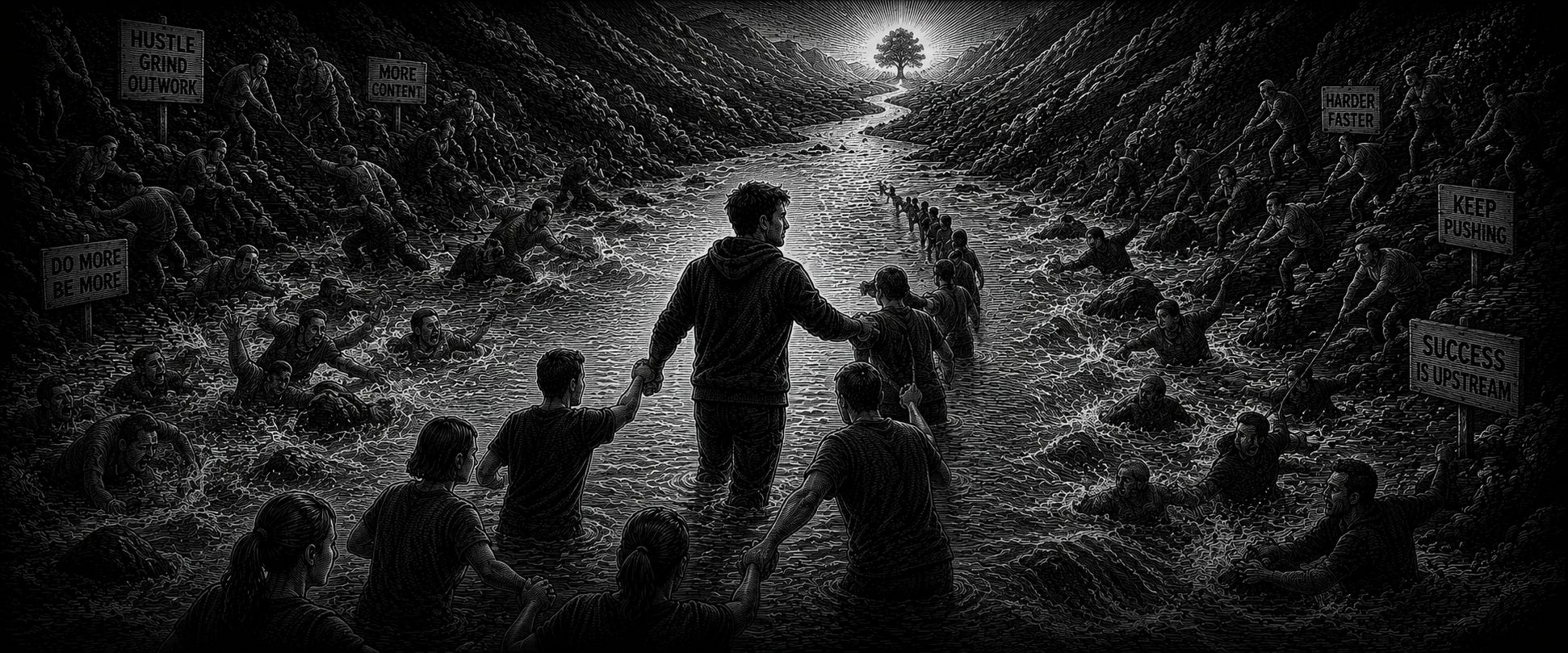
These days, when I meet strangers on calls or in DM’s, they almost always open with “oh, I heard so much about you!”. And most people wouldn’t believe me if I told them that’s entirely by design.
It keeps happening, everywhere, every time, in group chats, on calls, in random reply sections, and it’s almost always people I’ve never exchanged a word with arriving already warmed up, like it’s our second or third meeting instead of the first.
Which is absolutely strange to me, because apparently my reputation is out there working rooms with me doing none of it. And when I find an odd thing, I can’t seem to let it go until I get to the bottom of it.
So I’ve been digging deep to figure out why and how.
In this essay, I want to share the idea I came across with you, an idea that I believe, if you’re also interested in building out your network, will change the way you do so.
I post daily, sure, and most people would assume the content is what does the magic, but this idea has almost nothing to do with my content. It came from giving my network away.
An idea I call Upstreaming.
Most of the people who succeed in building a network do this very thing.
It always starts with one
For you to properly digest the idea, I need to share some context first.
A few months back, I’d been working with a client to help him grow his Twitter account. After the first 90 days of working together, I’d taken him from 0 to 10,000 followers. Which to me is a pretty average result, but to him, an astonishing one.
Writing for him (and as him), I got introduced to some of his unique ideas, one of them being to focus on acquiring A-list talent, specifically, finding someone better than you at something you’re not good at yourself, and then leveraging their strengths.
At first, as a person running a solo empire, it bounced right off. But as I sat with the idea, studied his results, way of thinking and operating system, it became apparent to me.
He did this exact thing when he hired me to run his Twitter.
So after having proven to him with the results I did, that I was definitely the Twitter guy he’d been looking for, he did something insane. He invited me to come meet him in person and help turn my knowledge into an AI agent that could help anyone grow on Twitter at a fraction of what it costs to hire a ghostwriter like me.
That ended up being a super successful 10-day sprint out in Portugal where we got 1,000 paid users in 48 hours and even beat OpenAI on Producthunt.
During this time, I helped him with everything I could reach. And when the thing grew past what two people could carry alone, when he needed extra hands, I did the thing every networking guru screams against: I reached down into my own network and handed him my people (audience, connections e.g.)
On paper it looks stupid.
Who you know is supposed to be your moat. You know that. That’s why you’re even reading this article in the first place.
Every course and guide on “strategic relationships” teaches you that you must gatekeep the access, drip out the introductions and stay positioned as the toll booth everyone drives through, so that you reap the benefits.
I can see why that is the common advice being given, because handing over your best people does feel like handing over your only advantage.
But here’s the outcome I experienced doing so.
He started saying my name in rooms I wasn’t in. He pulled me into calls with the biggest writers in my corner of the internet, from the super famous essayist whose long-form work basically taught me (and half of X) how to write to the guy who turned personal storytelling into millions of reads and even that one guy who made solo business writing its own category.
Writers I would study line by line in 2021 before I ever had any kind of success, suddenly sitting on the other side of a video call greeting me.
These people even follow me now. They remember my name. And downstream of those calls, strangers I meet online keep arriving with their own version of “I heard so much about you”, already warmed up by conversations I was never even a part of to begin with.
Upstreaming explained
Everyone I’ve ever met who knows the value of network, networks upward.
They send Cold DMs to accounts 10x their size with “would love to pick your brain some day”, or they trade business cards with whoever has the biggest title in the room.
Everyone is always swimming straight at the source of the river, against the current, next to ten thousand people all doing exact same thing.
Upstreaming goes the other way.
You find people below you on whatever ladder you’re both climbing, hand them real opportunity without an invoice attached, and let whatever they build with it flow back on the river of Karma.
Upstreaming is how you build a network if you weren’t bortn with one.
That last part is a bit personal for me as a kid raised by a single mother, because the networking everyone describes, the alumni club, the family friend who “makes a call,” the warm intro waiting at graduation, none of that stuff existed where I grew up.
Even worse, Denmark has this cultural law against putting yourself forward, the Law of Jante, drilled into every kid, teen and adult from the moment they’re born: don’t think you’re special or that you’re more than anyone else.
Good luck with self-promoting your way up in a culture built to punish self-promotion. This is why I left the country as early as I could.
But Jante has a blind spot.
There’s no rule against promoting other people. Lifting someone else is socially bulletproof everywhere on earth, and the elevator you send down tends to come back up with you on it.
One requirement though. It only works if the people you send up deliver, because if I’d handed my co-founder duds, my name would still travel through rooms I’m not in, just in the other direction.
Your whole currency here is the quality of your eye.
The Eye.
Confession: I suck at hiring.
Maybe it’s the reason I run a solo empire still to this day. I’ve just never been able to do it and do it well. I know because I managed to build a $50k/m agency only for it to come crashing down the same month from my lack of ability to hire and delegate.
This may sound super nihilistic, but…
I just don’t trust people at the level I trust myself.
But… spotting talent in the wild, in a group chat, a reply section, a random call, that comes natural to me, and it turns out I’m embarrassingly good at it.
This, for some weird reason, comes in very handy when building a network.
Part of me wants to say I’m good at it because I’m talented myself, you know “real recognize real” type thing. The more wholesome truth is I have knack for recognizing overlooked people purely because I was one myself, and the radar I built for my own survival turns out to work just as well on others.
The clearest proof is a kid named Nandu.
Back in 2021 my Notion template business was scaling hard, and somewhere along the way I came across this 16-year-old out of India, selling his own templates for a few dollars here and there.
Turned out he was better at graphic design than me, even though I sold way more. My ego sat with that (more than once). A teenager, out-designing ME?!?!?!
His covers looked like a real company made them, mine looked like a guy who watched a few Canva YouTube tutorials made them… because, well… I did.
At first, it was hard for me to admit someone below me was better at something, because it felt like losing. Lucky for me (and for him), I didn’t listen to that feeling.
I messaged him one day and asked him to do my design.
Cheap as I was (and my business wasn’t really that big yet), I offered to pay him $5 per box mockup he created for my templates.
He said yes because no one had ever paid for his expertise, I said yes because… well, $5 is $5. There was no long interview or contract, just a teenager who was visibly good and my $5.
That $5 turned into $30 for full mockup cover slideshows, five pictures each, then eventually $100 for some Instagram posts, and before I knew it, this guy was running my Instagram for me, fully on auto.
To this day, three years later, he’s my most trusted freelancer.
But that’s the small outcome in this story. The bigger one happened on the backend that I only noticed later down the line: he took everything he learned from working with me and scaled that sh*t into a six-figure agency doing Instagram content for other big founders.
Looking back now, I think I always knew he was meant for big things.
Maybe that’s why I paid him, and kept paying. Or maybe I was just selfish and wanted the $5 mockups. I still don’t know, but I do know that the conversations we had over the years, were conversations where I “mentored” him, and I did that without charging him a single dollar.
In fact, I paid HIM.
When you find someone who does great work, that sh*t is worth it.
Today, I send him clients for Instagram and he sends me clients for Twitter, and the $5 kid literally became a node in my network and somewhere along the way I became one in his.
Last year we met in Dubai, in person for the first time and he handed me a handwritten note: “Thanks for believing in me when no one else did.”
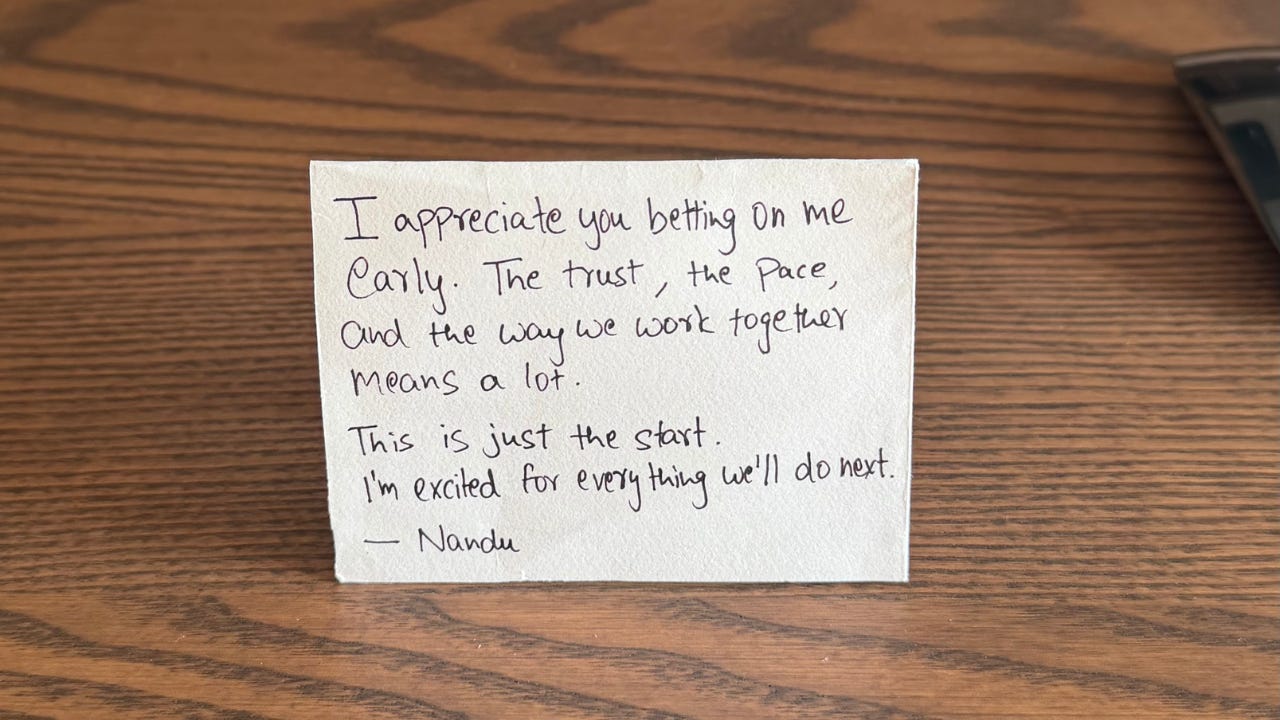
I keep that note on my desk as motivation now.
Weirdest thing is didn’t MEAN to do any of this, there was no networking strategy, no long game that I was playing and certainly no calculation about future referral networks. I just saw a 16-year-old who was better than me at something and paid him five dollars to do it.
It just… happened.
A mentor, a mentee, and equals
Years ago I heard a line somewhere that still lives somewhere in the back of my mind:
You can’t be successful in business without a mentor, a mentee, and equals.
I honestly forget who said it. Fitting, maybe, for an essay about names traveling further than the people they belong to.
The thing about this line is that for a long time, I thought it excluded me because I never really had a mentor in the official sense. Nobody took me under their wing.
But the writers, business owners and founders I studied obsessively, whose frameworks I reverse-engineered at 1am, they did mentor me for years without them even knowing I existed, and they certainly never invoiced me for that.
If you admire someone closely enough to absorb how they think, that’s your mentor right there, with the payment and permission entirely optional.
This also means (and if this is you, this should give you hope), that the poor kid with no connections has full access to the same mentors the rest of us do.
Looking back, this would’ve been useful to know at 22, lol.
And now, the strangest full-circle of my online business journey is that those exact unpaid mentors are the writers who now sit across from me on calls, because Upstreaming carried me to them.
The mentee chair is where people get it wrong most often.
They treat it as permanent so that someone stays “the guy I helped” forever, a little satellite orbiting their generosity. Done right, the mentee leaves the chair.
The whole job is handing over enough opportunity that they stop needing you.
My buddy Valdo is the cleanest example of this.
While my template business kicked off initially, he was still stuck in his 9-5, and we were real-life friends, which made his complaining harder to escape, so eventually I suggested he do the same thing I was doing.
He wasn’t really interested, so I had to almost push him into it, and it became an annoying loop that ran for months: the more he complained, the more I said “do something about it.”
Eventually after enough nudging, he took the leap.
A few templates turned into a huge portfolio of ChatGPT and AI prompts that made him over six figures, and today he has 50,000 followers on X. He moved from mentee to equal, fully, and the friendship honestly got better for it, because not only can we work on the same things, talk about the same things and enjoy the fruits of our labor together, but also because there’s a version of helping people that quietly needs them to stay smaller than you, and I wanted no part of that version.
Even to this day, I still mention his name in rooms he’s not in, purely because... well, I don’t actually know why. But I do it. The same way the guy I worked with recently does it for me.
The “put me on bro” clause
I have to put this here as a disclaimer, or this essay won’t be complete. So just to be abso-f*cking-lutely clear, none of what I just said in the past 2,000 words applies to the “put me on bro” guys, lmao.
You know the people I’m talking about.
Nandu never asked me for anything, except for some advice here and there. Valdo actively resisted my help for months and I had to almost force him.
The people worth sending upstream are always mid-rep when you find them, heads down, building badly but building, too busy to compose the ask. Meanwhile the ask arrives daily from guys whose whole portfolio is the ask itself.
Telling those two apart is the eye from earlier, doing its actual job.
I can predict the future to prove I’m right
I wanted to put this in here, just to prove that the Upstreaming idea holds true.
I’m going to attempt to predict the future.
The other day, I was scrolling Instagram and I came across a random reel with 20 likes from some Pakistani guy that said “Day 1 of escaping” and it showed him living in a shared bedspace in Dubai, with no income, no salary and no job, just trying to make something work.
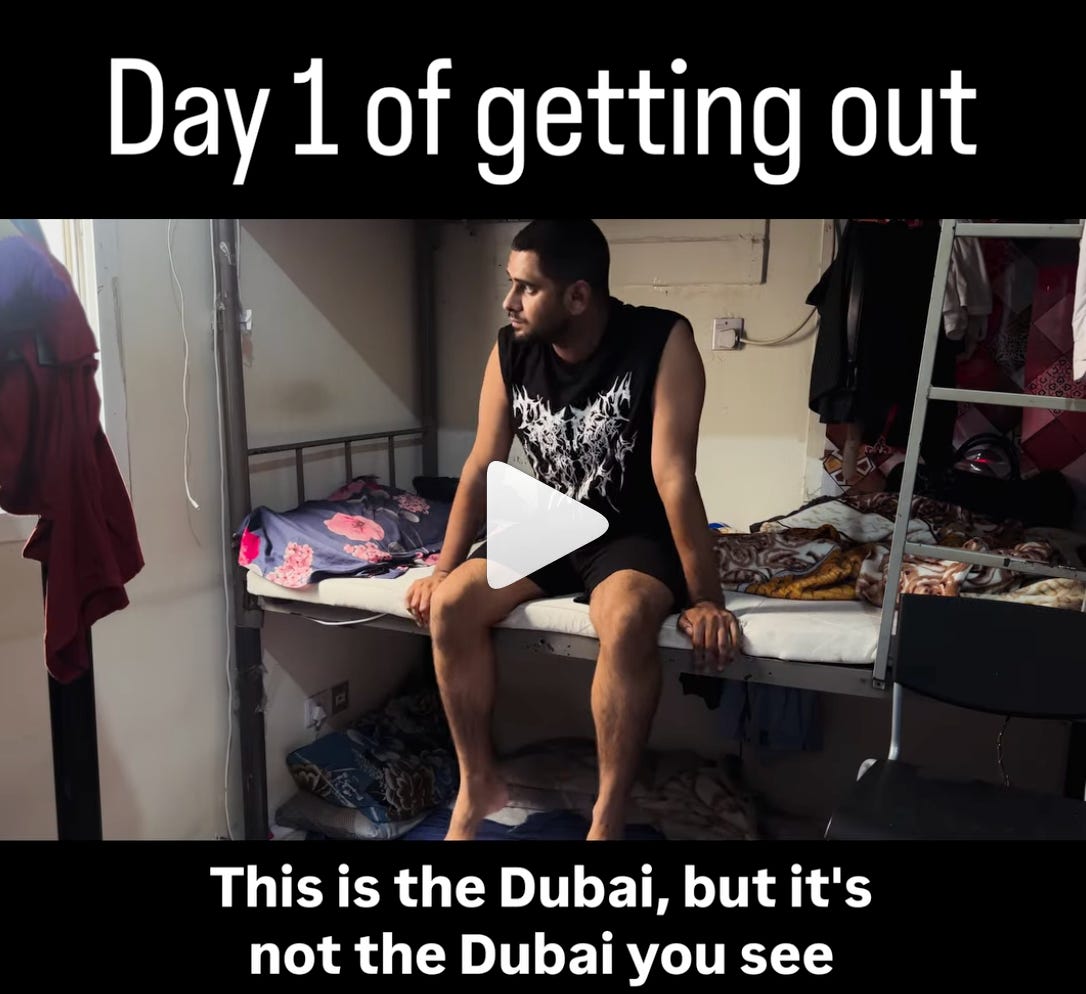
Curious about him, I checked out his profile and discovered he’d been posting 250 (?!?!?!) times since the beginning of the year.
And yet, his profile was at 300 followers.
What I saw, right then, right there in that moment, was a guy who had the hustle and drive to keep consistently posting despite the obvious lack of results.
That to me stood out.
I felt he was on the right track, but he needed some guidance maybe. A strategy that could work for him.
Because he had the first thing you need to succeed: hunger.
His consistency of posting proved it.
So, I did what my intuition told me to do.
I DM’ed him with some encouraging words, letting him know that I saw him and that I believed if he kept going, he would make it eventually. And I then took that a step further.
I solidified my bet on him by advising him to come on Twitter to share his content, as I believe he’d do much better there (he’s into tech, AI, dev e.g.). I further backed that up with offering him my $500 Twitter course completely free of charge as a gesture to help him get started there. And I even hopped on a 1-1 call with him and gave him some solid advice, without charging him a single penny.
Stupid of me? Probably yes if you ask someone who’s all about the money.
I just can’t explain what it is, but I see something in this guy.
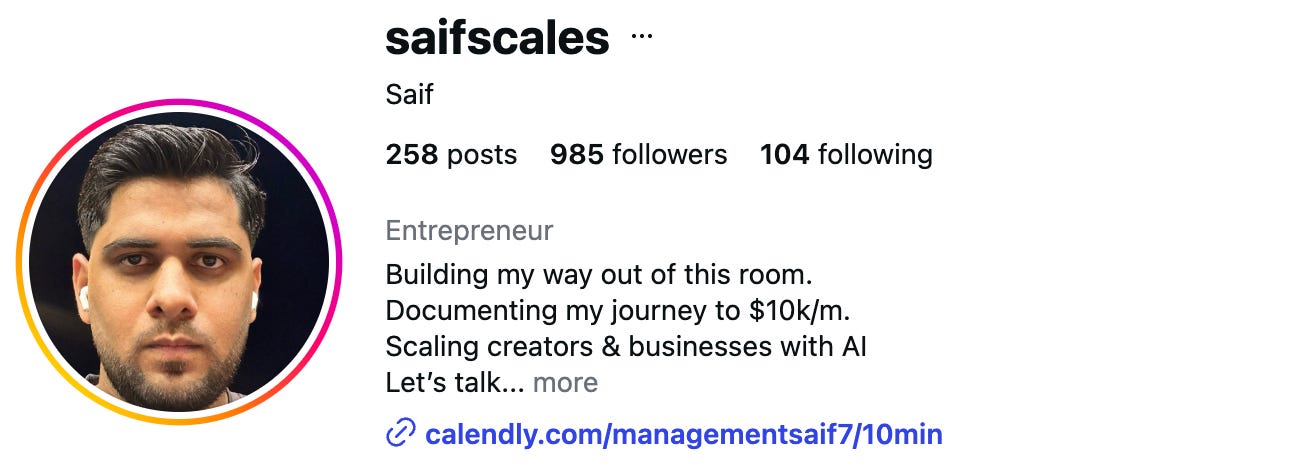
I’m telling you all this, because I want to prove to you what happens when you lift someone up. Once this guy blows up, I won’t take credit for pushing him in the right direction, but I will have a guy in my network who’s now my equal.
Today is 26th of July 2026.
He’s closing in on 1,000 followers as of writing this (that’s already 3x the amount when I first discovered him a few weeks back, so my thesis is appearing to hold true already).
I predict that this guy will blow up very soon.
Maybe on Instagram (@saifscales) or maybe on Twitter (@saifscales). Not sure yet, but all I know is that eventually, he’ll do it. I recommend you give him a follow as well.
Come back to this post in a year from now and let’s see if I was right.
Disclaimer: I will be because my intuition doesn’t lie.
The part I have no answer for
There’s a version of this essay that ends with the bullsh*t LinkedIn cliché type advice: “gIvE WiThOuT ExPeCtInG aNyThInG iN rEtUrN aNd tHe UnIvErsE pRoViDeS,” and honestly, I refuse to write it.
Partly because it reads like a fortune cookie, and partly because it hides the one genuinely uncomfortable question in this whole topic.
Everything I described worked because I meant it.
I paid Nandu five dollars before I knew what it would compound into, I pushed Valdo out of misplaced loyalty and mild irritation, I handed my co-founder my best people because he needed them, full stop.
The karma paid because I was never counting. That’s literally how karma works.
But today, I know it pays.
It’s just a compounding game rather than a game of flash sales.
You know it too, you just read 3k words of receipts on it.
So can either of us still do it purely? Does the current still carry you if you’re checking over your shoulder for it? I’ve been pondering these questions over for months and I still don’t have a clean answer yet.
The closest I’ve got will have to do. And it’s that the “put me on bro” guys give to get, visibly and everyone can smell it. So maybe intent does leak no matter what you do.
What I’m going to do instead of resolving this, is keep going with the reps.
An opportunity lands in my inbox that I can’t take? Forwarded, same day, to the most talented person I know who can, before I have time to compute anything.
Someone impresses me? I say so to a third party rather than to them.
A client needs something outside my lane? The referral goes to one of my people, with a sentence about why they’re good.
Small, boring and repeated actions. And I’ll keep doing them because I understand that the three chairs fill themselves after that:
Study someone relentlessly and you’ve got a mentor
Lift someone repeatedly and you’ve got a mentee
And do it long enough so that those mentees turn into equals
Your future network is sitting below you right now, in your replies, in your group chats, sixteen years old and better than you at something.
Mine handed me a note in Dubai.
See you out there,
Pascal
Thanks for reading Becoming!
Becoming is my letter on the inner game of building a one-person empire. Ambition, identity, money & the strange work of becoming someone you don’t want to escape from. I send one to two editions a week, each focusing on actionable implementable steps that you can take + the philosophy behind why I do what I do.
Subscribe below for free to receive new posts and support my work.
(or click here to read a few editions first)
Things I am working on outside this, in case any of them are interesting:
If you want to build a High Profit One-Person Empire™, read this free article.
If you want to grow on Twitter, check out Stanley, my AI Head Of Content.